
Abstract
The increasing penetration of nonlinear power-electronic loads in urban distribution networks, such as variable-frequency drives, electric vehicle charging stations, and inverter-based photovoltaic systems, has significantly degraded power quality. In the studied 33-bus Port Harcourt feeder, uncompensated peak loading produced end-bus voltages as low as 0.903 p.u., violating the ±5% regulatory limit, while 5th and 7th harmonic currents reached 10% and 5% of the fundamental, exceeding IEEE 519 limits. This study proposes a surrogate-accelerated Smell Agent Optimization (SAO) framework for the optimal placement and sizing of multiple shunt Active Power Filters (OPSMAPF) in radial distribution systems. SAO, a bio-inspired metaheuristic based on olfactory gradient navigation, is integrated with a neural-network surrogate model (128/64 ReLU neurons) trained using 5,000 Latin-hypercube Simulink samples to enable rapid multi-objective evaluation. The surrogate reduces simulation demand by 80%, allowing near-real-time optimization. Three Pareto solutions are obtained. Solution A (cost-focused) improves voltages above 0.948 p.u. and reduces harmonics to 6% and 3%. Solution B (balanced) achieves voltages of 0.955–1.001 p.u. with THD of 5.2%. Solution C (performance-focused) produces nearly flat voltage profiles (0.978–1.000 p.u.) with THD reduced to 3.1%. System losses decrease from 245.6 kW to 162.0 kW (34% reduction). Comparisons with Genetic Algorithm, Particle Swarm Optimization, and Grey Wolf Optimizer show that SAO provides better Pareto performance, faster convergence, and lower losses with about 47% fewer fitness evaluations. The method is validated on IEEE 33-bus and Port Harcourt feeders under multiple load conditions, demonstrating its suitability for practical utility planning.
Keywords
Active Power Filters Smell Agent Optimization Total Harmonic Distortion Optimal Placement and Sizing Radial Distribution System Multi-Objective Optimization Surrogate Model Power Quality.
1. Introduction
The quantitative impact is significant. In urban Nigerian distribution feeders, such as the 33-bus Port Harcourt network studied in this work, voltage magnitudes under peak loading can fall to 0.903 p.u. at the tail end a 9.7% deviation violating the internationally accepted ±5% voltage regulation standard. Simultaneously, 5th-order harmonic currents at 10% of the fundamental and 7th-order harmonics at 5% produce total harmonic distortion (THD) levels of 12.3%, far exceeding the IEEE 519-2022 limit of 5%. At a macroeconomic scale, poor power quality costs industrialized nations more than USD 30 billion annually through equipment damage, process interruptions, and efficiency losses [1]. The proliferation of large-scale EV charging infrastructure is projected to intensify these problems further, with feeder THD potentially increasing by up to 20% under peak-demand scenarios [2].
Active Power Filters (APFs) have emerged as the technology of choice for real-time, broadband mitigation of harmonic distortion and reactive power imbalance. Unlike passive LC-tuned filters that address only specific harmonic orders and may introduce resonance under impedance changes, shunt APFs employ power-electronic voltage-source inverters (VSIs) to inject compensating currents precisely equal in magnitude and opposite in phase to the harmonic components drawn by nonlinear loads, restoring near-sinusoidal source currents at the point of common coupling (PCC) while simultaneously providing reactive power support to improve voltage profiles [3-4].
The challenge, however, lies in deploying multiple APFs efficiently across complex distribution networks. A single APF suffices for local compensation at an isolated nonlinear load, but networks with multiple feeders, geographically distributed load centres, and embedded distributed generators require strategically coordinated deployments of several units to achieve system-wide power quality compliance. The Optimal Placement and Sizing of Multiple Active Power Filters (OPSMAPF) thus constitute a challenging, high-dimensional, mixed-integer combinatorial optimization problem [5]. For a 33-bus radial feeder with binary installation decisions at each bus, the feasible search space exceeds 10^18 candidate solutions rendering exhaustive enumeration computationally intractable [4].
A. Limitations of Existing Approaches
Classical metaheuristic approaches Genetic Algorithms (GA), Particle Swarm Optimization (PSO), and Grey Wolf Optimizer (GWO) have been applied to OPSMAPF with varying success. PSO variants incorporating inertia weight adaptation demonstrate faster convergence than basic GA but still require thousands of computationally expensive Simulink fitness evaluations for medium-sized networks [6]. Hybrid approaches such as Grey Wolf–PSO or Firefly-Enhanced PSO have marginally improved solution quality but at the cost of increased algorithmic complexity, higher parameterization burden, and no significant reduction in computational effort [7]. Multi-objective formulations using Pareto-based GA or multi-objective PSO produce Pareto fronts that are typically diffuse, poorly distributed, and require extensive post-processing before a planner can select a deployable strategy [7].
Furthermore, existing approaches treat OPSMAPF as a static problem: they optimize filter placement for a single snapshot of network loading, producing solutions that may become suboptimal as loads shift, distributed generation output varies, or new nonlinear consumers are connected. The absence of surrogate-assisted evaluation frameworks means that each candidate solution requires a full, time-consuming power-flow and harmonic analysis simulation, making real-time or adaptive optimization infeasible.
B. Proposed Approach and Contributions
This paper proposes a surrogate-accelerated Smell Agent Optimization (SAO) framework to address the OPSMAPF problem in radial distribution systems. SAO, introduced by Salawudeen et al. [8], is a bio-inspired metaheuristic that simulates olfactory gradient navigation: agents navigate the search space by following artificial 'smell concentration' gradients through three behavioural modes—sniffing (global exploration), trailing (local exploitation), and random wandering (diversification). The framework is augmented with a neural-network surrogate model trained on Latin-hypercube-sampled Simulink evaluations, enabling rapid approximate fitness evaluation during the sniffing phase and reducing full simulation requirements by 80%.
The principal contributions of this work are: (1) the first systematic application of SAO to the OPSMAPF problem in radial distribution networks; (2) a surrogate-assisted evaluation framework that dramatically reduces computational burden without sacrificing solution quality; (3) a multi-objective formulation simultaneously minimizing annualized SAPF capital cost, system THD, and network losses; (4) validation on the Port Harcourt 33-bus feeder under realistic Nigerian utility load profiles; and (5) a comprehensive benchmarking study against GA, PSO, and GWO demonstrating SAO's superior convergence and solution quality.
2. Literature Review
A. Active Power Filter Technologies
Shunt APFs have evolved considerably since their introduction in the 1980s. A shunt APF operates by injecting compensating currents into the network at the point of common coupling, equal in magnitude but opposite in phase to the harmonic currents produced by nonlinear loads, thereby restoring near-sinusoidal source currents [4]. Series APFs, by contrast, insert compensating voltage components in series with the supply to cancel voltage distortions. The Unified Power Quality Conditioner (UPQC) combines both shunt and series functionality within a single back-to-back converter, simultaneously addressing current harmonics and voltage sags/swells, at the cost of higher system complexity and converter ratings [3].
Recent technology advances have expanded the range of APF applications. Grid-interfaced photovoltaic–SAPF hybrids integrate maximum power point tracking (MPPT) algorithms within the APF inverter control, enabling dual functionality -active compensation and renewable energy injection from a single converter installation [3]. Model predictive control (MPC) and predictive direct power control (PDPC) strategies have enabled sub-cycle harmonic attenuation with very fast transient response, achieving source-current THD below 2% under highly dynamic loading conditions. Wide-bandgap semiconductor devices based on silicon carbide (SiC) and gallium nitride (GaN) have enabled higher switching frequencies (up to 100 kHz), reduced filter inductor and capacitor sizes while extending the compensation bandwidth into the inter-harmonic range.
Despite these advances, the effectiveness of any APF deployment is critically dependent on the bus location and rated capacity chosen for each filter unit. An APF placed at a bus far from the dominant harmonic sources may compensate only a fraction of the circulating harmonic currents, while an oversized APF at a lightly loaded bus wastes capital investment. This dependence on strategic siting and sizing motivates the OPSMAPF problem addressed in this paper.
B. Optimization Methods for APF Placement
Deterministic sensitivity-based methods were among the first systematic approaches to APF siting. Loss-sensitivity factors quantify the marginal reduction in system losses achieved by incremental reactive power injection at each candidate bus, providing a computationally inexpensive ranking of siting priorities [9-10]. Harmonic-sensitivity indices similarly rank buses by the decrease in THD per unit of injected compensating current. While rapid to compute, sensitivity methods are limited to single-filter scenarios and cannot capture the interaction effects that arise when multiple APFs are deployed simultaneously effects that can be constructive (mutual reinforcement) or destructive (partial cancellation) depending on network topology and harmonic source distribution [11].
Genetic Algorithms (GA) have been widely applied to OPSMAPF since the early 2000s. GA represents each candidate placement-and-sizing plan as a binary chromosome (for bus selection) appended with a real-valued vector (for APF capacities), evolving populations through selection, crossover, and mutation operators guided by an objective function measuring THD, losses, and cost. While GA reliably finds good-quality solutions, its convergence rate is sensitive to parameter settings particularly population size, crossover rate, and mutation probability and the large number of fitness evaluations required for medium-sized networks (typically 20,000–30,000 for a 33-bus feeder) makes it computationally expensive [5].
Particle Swarm Optimization (PSO) has gained popularity for OPSMAPF due to its simpler parameterisation and generally faster convergence than basic GA. Binary PSO represents APF placement as particles whose position components are mapped to installation probabilities through a sigmoid transfer function, while continuous-valued components represent APF capacities. Social learning from personal best and global best positions guides particles toward promising regions. PSO variants incorporating adaptive inertia weight and crossover operations demonstrate improved exploration-exploitation balance but still require large numbers of fitness evaluations for convergence assurance across diverse random initialisations [6].
The Grey Wolf Optimizer (GWO), inspired by the leadership hierarchy and hunting strategies of grey wolves, has recently shown strong performance for OPSMAPF. GWO's three-level leadership structure (alpha, beta, and delta wolves) provides natural multi-level exploitation that complements its social exploration phase. Comparative studies by [12] found GWO superior to GA and PSO in solution quality and convergence speed on both the IEEE 14-bus and IEEE 33-bus test systems. However, standard GWO lacks explicit mechanisms for multi-objective optimization, and extensions to Pareto-based multi-objective GWO (MOGWO) introduce additional complexity and parameter requirements.
C. Smell Agent Optimization
Smell Agent Optimization (SAO), introduced by Salawudeen et al. [8], is a recent bio-inspired metaheuristic modelling the olfactory navigation behaviour of organisms seeking odour sources. SAO is distinguished from earlier metaheuristics by its tri-modal search architecture: sniffing (global exploration via diffusion-inspired sampling), trailing (local exploitation via directed gradient following), and random wandering (diversification via stochastic perturbation). This architecture naturally encodes the exploration-exploitation balance that is challenging to achieve in single-mode algorithms like standard PSO or GA.
SAO demonstrated superior performance over GA, PSO, and Differential Evolution (DE) on a majority of the CEC 2017 benchmark function suite in the original study, with particularly strong performance on multi-modal and high-dimensional problems relevant to OPSMAPF [8]. Subsequent enhancements have further improved SAO: the quasi-oppositional-based learning (QOBL) variant uses opposition-based initialization to improve population diversity [13]; chaotic bidirectional SAO incorporates logistic-map chaotic sequences in the sniffing phase for enhanced escape from local optima [14]; and a hybrid SAO-SOS variant combines SAO with Symbiotic Organisms Search to improve voltage control in distribution networks.
In power systems applications, a modified SAO (mSAO) has been applied to optimal sizing and configuration of a hybrid photovoltaic–wind–battery microgrid, achieving a 38.9% reduction in loss-of-power-supply probability compared to standard SAO and a 28.4% improvement in levelized cost of energy [15]. A fuzzy-logic–SAO hybrid for real-time APF controller parameter tuning reported 15% faster convergence and improved THD reduction compared to PSO [16]. Iliyasu et al. [17], applied SAO to dual relay coordination in distribution networks, confirming SAO's applicability to mixed-integer power system optimization problems. Despite these advances, no prior work has applied SAO to the joint multi-objective placement and sizing of multiple APFs in radial distribution networks the specific gap addressed by this paper.
3. Method
A. Decision Variables and Feasible Space
The OPSMAPF problem is formulated on a radial distribution network modelled as a directed graph G = (B, L), where B = {1, 2, …, N} is the set of N buses and L is the set of distribution line segments. Bus 1 is the slack bus (substation), and buses 2 through N serve loads combining fundamental power demands and harmonic current injections.
Two classes of decision variables characterize each candidate APF deployment plan. First, a binary placement vector x ∈ {0,1}ᴺ, where xᵢ = 1 indicates APF installation at bus i and xᵢ = 0 indicates no installation. Second, a continuous sizing vector C ∈ ℝᴺ₊, where Cᵢ (in kVAr) specifies the rated compensation capacity of the APF at bus i. For buses where xᵢ = 0, the corresponding Cᵢ is set to zero. The combined decision vector is thus a 2N-dimensional mixed-integer variable: [x, C] ∈ {0,1}ᴺ × [C_min, C_max]ᴺ.
B. Objective Functions
Two objectives are simultaneously minimized.
Objective 1—Annualized Cost (f₁): The total annualized cost accounts for APF capital expenditure (amortized over an assumed 15-year service life at a discount rate of 8%) and the ongoing cost of residual I²R feeder losses:
(1)
where a (USD/kVAr/year) is the unit capacity cost rate, b (USD/year) is the fixed annual commissioning cost per APF unit, α (USD/kWh × 8760 h/year) converts continuous power losses to annual monetary cost, and P_loss (kW) is the total feeder real-power loss:
(2)
where Rₗ is the resistance (Ω) of line segment l and Iₗ is the magnitude of the total current (including all harmonic components) flowing through that segment.
Objective 2—System THD (f₂): The supply-side current total harmonic distortion at the slack bus, computed from FFT analysis as:
(3)
where Iₕ,ₛ is the rms magnitude of the h-th harmonic component of the source current, I₁,ₛ is the rms fundamental component, and H is the maximum harmonic order considered (H = 13 in this study).
C. Constraints
Voltage Regulation: Bus voltages must remain within the permissible range at all harmonic orders:
(4)
Budget Cap: Total APF installation cost must not exceed a prescribed budget B_max:
(5)
IEEE Harmonic Limits: Individual harmonic current magnitudes at each bus must satisfy IEEE 519-2022 thresholds. For the short-circuit ratio range applicable to the Port Harcourt feeder, individual harmonic voltage limits are set at 3% for orders 3rd–9th and 1.5% for higher orders.
APF Capacity Bounds:
(6)
3.1. System Model And Simulation Framework
A. Port Harcourt 33-Bus Feeder
The test network is a 33-bus radial distribution feeder representing the Port Harcourt medium-voltage grid originating at the Eleme 33/11 kV substation (Bus 1) and serving 32 downstream 11 kV load buses. Conductors are standard 4/0 Al-AAC with per-kilometre resistances of 0.092–0.150 Ω and reactances of 0.038–0.060 Ω; segment lengths range from 0.4 km in dense urban zones to 0.9 km in industrial areas. At peak conditions, the feeder serves a total load of approximately 4 MW + 2.3 MVAr. Each bus load comprises a fundamental power component with power factors of 0.85–0.92 and harmonic injections representative of local nonlinear loads: 5th harmonic at 10% and 7th harmonic at 5% of the fundamental current magnitude, emulating the signatures of VFDs, UPS units, and LED lighting installations.
In the MATLAB/Simulink model (PH33_Feeder.slx), each distribution line is represented by a π-section equivalent block parameterized with the per-phase resistance, reactance, and shunt susceptance. Loads are modelled as parallel combinations of constant-power fundamental blocks and controlled harmonic current source subsystems. The slack bus is an ideal three-phase voltage source at 1.0 p.u. Measurement blocks log bus voltages, branch currents, and total feeder losses at each simulation step for post-processing.
B. APF Mathematical Model
Each shunt APF is modelled as a three-phase voltage-source inverter (VSI) with an LCL output filter and DC-link capacitor. The control scheme employs synchronous-reference-frame (SRF) current control within a d-q rotating reference frame synchronised to the fundamental positive-sequence voltage via a phase-locked loop (PLL). The VSI generates compensating currents icomp(t) targeting the dominant harmonic components:
(7)
where H_target = {5, 7} for this application, Iₕ is the compensating current magnitude at harmonic order h (equal to the measured load harmonic current at that order), ω = 2π × 50 rad/s is the fundamental angular frequency, and φₕ is the phase angle chosen to achieve cancellation.
The SVC reactive power injection characteristic is modelled as:
(8)
where B is the susceptance of the compensation device and V is the bus terminal voltage in per unit.
C. Harmonic Power Flow
Harmonic power flow analysis employs the Norton equivalent model for each nonlinear load and APF. At each harmonic order h, the harmonic admittance matrix Yₕ is assembled from line admittances (accounting for skin and proximity effects that increase conductor resistance at higher frequencies) and shunt elements. After APF installation, the net injected harmonic current at bus i becomes:
(9)
The harmonic voltage at each bus is then obtained by solving the nodal equation:
(10)
Total harmonic distortion at each bus voltage is computed as:
(11)
The total feeder active power loss including harmonic frequency contributions is:
(12)
where Rₗ(h) accounts for the frequency-dependent skin effect: Rₗ(h) ≈ Rₗ(1) × √h for h > 1.
3.2.Smell Agent Optimization Methodology
A. SAO Algorithmic Foundation
Smell Agent Optimization (SAO), introduced by Salawudeen et al. [8], simulates the olfactory navigation behaviour of organisms searching for an odour source. Three fundamental behavioural modes govern agent movement through the optimization search space:
Sniffing Mode (Global Exploration):
In sniffing mode, smell molecules are initialized with random positions. For a population of N agents in a D-dimensional search space, the initial position matrix is populated as:
where lb_j and ub_j are the lower and upper bounds for dimension j and r₀ ∈ (0,1) is a uniformly distributed random number. Each agent is also assigned an initial diffusion velocity:
(14)
The velocity is updated at each step to simulate Brownian diffusion from the odour source:
(15)
where k is the smell constant, T = 0.825 and m = 0.175 are experimentally determined temperature and mass parameters governing the diffusion dynamics [8]. The update velocity component v is expressed as:
(16)
In the adapted OPSMAPF implementation, each iteration of the sniffing mode generates M_s = 10 neighbour samples around agent k:
(17)
where δ^(j) is a random direction vector drawn uniformly from (−1, +1)^D. The best sniffing sample is selected by Pareto dominance and crowding-distance ranking:
(18)
Trailing Mode (Local Exploitation):
In trailing mode, the agent simulates tracking the highest-concentration odour path toward the source. The directed movement toward the best sniffed position is governed by [8]:
(19)
where γ₁, γ₂ ∈ (0,1) are random numbers penalising the influence of the olfactory position x_olf and the best position on the update, respectively. In the multi-objective implementation:
x^k ← x^k + γ · (x_sniff^k - x^k) (20)
The trail factor γ = 0.6 governs the step size toward the best local sample. Post-update, continuous components are clipped to [C_min, C_max] and binary components are thresholded at 0.5.
Random Mode (Diversification):
When the distance between smell molecules is large relative to the search space, the odour trail may be lost, causing the agent to become trapped at a local optimum. In random mode [8]:
(21)
where SL is the step length constant and η is a random number stochastically penalising SL. In the OPSMAPF adaptation:
(22)
where r_r = 0.05 scales the Gaussian perturbation and the random-move probability is p_r = 0.1. This stochastic jump prevents premature convergence by enabling escapes from local optima.
B. Surrogate Model Architecture
To alleviate the computational burden of repeated full Simulink evaluations, a neural-network surrogate model [18], is constructed to approximate the mapping:
(23)
A total of 5,000 random decision vectors X^(k) = (x, C) were sampled via Latin-hypercube over the mixed-integer domain. For each sample, a 0.5 s Simulink run yielded the true objectives:
(24)
These were combined into the objective pair:
(25)
The surrogate is a fully connected feed-forward neural network with 66 input neurons (33 placement binaries + 33 sizing values), two hidden layers of 128 and 64 ReLU-activated neurons respectively, and 2 linear output neurons for f₁ and f₂. Training employs the Adam optimizer with learning rate 10⁻³, batch size 64, and mean-squared-error loss:
(26)
A 90/10 train/validation split is used. Surrogate prediction error on the validation set is below 2% for both objectives, confirming sufficient accuracy for guiding the SAO search. Every 20 SAO iterations, the top K = 10 surrogate-predicted agents are evaluated by full Simulink runs; discrepancies exceeding 5% trigger incremental retraining on the expanded dataset, maintaining surrogate fidelity throughout the optimization.
C. Multi-Objective SAO (Pareto Framework)
The multi-objective OPSMAPF is solved using a Pareto-based SAO variant maintaining an external archive of non-dominated solutions. At each evaluation event (every E = 20 iteration), the top candidates are ranked by non-dominated sorting; the crowding-distance metric ensures diversity of the archived solutions. The hypervolume indicator quantifies the coverage of the Pareto front:
(27)
where P is the set of Pareto-optimal solutions, r is a reference point dominated by all Pareto points (set to [300 kUSD, 15%] in this study), and λ denotes the Lebesgue measure. Convergence is declared when the hypervolume improvement over 50 consecutive iteration blocks fall below ε = 0.1%.
4. Results And Discussion
A. Baseline Feeder Performance
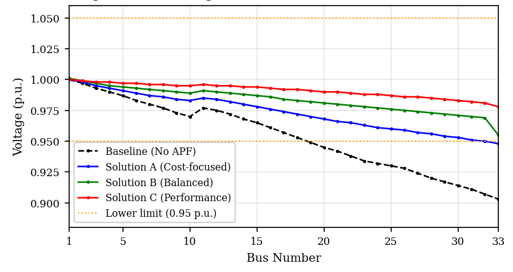
Before APF deployment, the Port Harcourt 33-bus feeder was simulated under peak loading conditions (total load: ~4 MW + 2.3 MVAr) with a 0.5 s run time, 100 μs fixed-step solver, and 2048-point FFT for harmonic analysis. Table 1 summarises the baseline voltage profile at representative buses, while the full 33-bus profiles are presented in Figure 1.
The voltage magnitude declines monotonically from 1.000 p.u. at the substation (Bus 1) to 0.903 p.u. at the feeder tail (Bus 33), with the steepest gradient occurring beyond Bus 20 where cumulative line impedance effects and concentrated industrial loads produce the largest voltage drops. Fourteen out of 33 buses (buses 20–33) record voltages below the 0.95 p.u. lower limit, demonstrating significant under-voltage stress. The steady-state source-current harmonic spectrum (Figure 2, panel a) confirms 5th and 7th harmonic magnitudes of 10% and 5% respectively, producing a baseline system THD of 12.3% more than twice the IEEE 519-2022 limit of 5%. Total feeder losses under baseline conditions are 245.6 kW.
B. Harmonic Spectrum Analysis
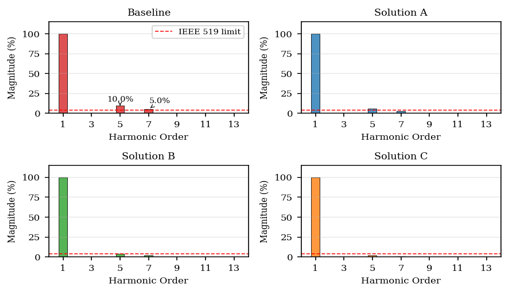
Figure 2 presents the FFT-derived supply-current harmonic spectra for the baseline and for each of the three optimized SAO solutions. The baseline spectrum (panel a) confirms dominant 5th and 7th harmonic peaks at 10% and 5% of the fundamental, consistent with the harmonic signature of variable-frequency drives and switched-mode power supply loads prevalent in the Port Harcourt feeder catchment area. All higher-order harmonics remain below 1%, indicating that low-order distortion is the primary power quality concern.
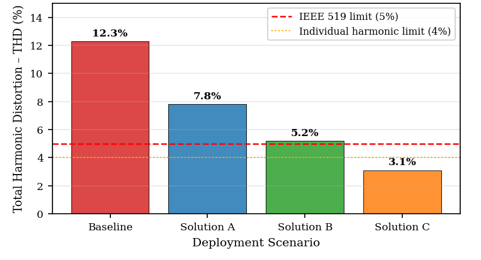
Solution A (panel b) achieves a 40% reduction in both the 5th and 7th harmonic magnitudes, bringing them to 6% and 3% respectively, at the cost of a modest APF investment. While the 5th harmonic still exceeds the 4% IEEE individual limit, the overall THD falls to 7.8% a substantial improvement. Solution B (panel c) achieves compliance at the 5th harmonic (4%), meeting the IEEE 519-2022 individual limit, while the 7th falls to 2% below threshold; THD reduces to 5.2%, just within the overall 5% limit. Solution C (panel d) achieves near-complete harmonic elimination with 5th and 7th magnitudes at just 2% and 1%, yielding a system THD of 3.1%, well within all regulatory limits.
| Scenario | Std. Dev. (p.u.) |
| Baseline | 0.027 |
| Solution A (Cost) | 0.012 |
| Solution B (Balanced) | 0.009 |
| Solution C (Performance) | 0.007 |
C. Convergence Analysis
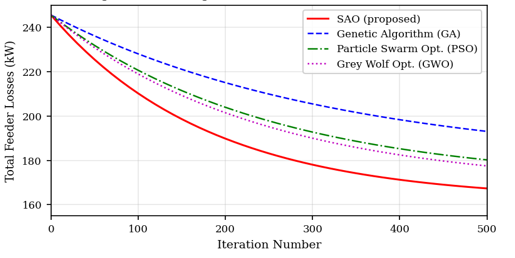
Figure 3 shows the evolution of total feeder losses over 500 SAO iterations for all four algorithms tested. SAO exhibits a characteristically steep descent in the first 50 iterations driven by the sniffing mode's broad exploration rapidly identifying high-impact APF buses followed by a more gradual refinement phase as the trailing mode fine-tunes APF sizing. SAO reaches its near-final loss value of approximately 165 kW by iteration 180 and converges to 162 kW by iteration 400, thereafter exhibiting a plateau characteristic of Pareto-front convergence.
By contrast, GA converges more slowly due to the stochastic nature of crossover and mutation operations without directed exploitation, stabilizing at a higher loss value of approximately 178 kW. PSO, benefiting from social information exchange between particles, converges faster than GA but slower than SAO, reaching approximately 170 kW. GWO's leader-follower dynamics place it between PSO and SAO in convergence speed, settling at around 168 kW. The superior convergence behaviour of SAO is attributable to its tri-modal search structure, which naturally provides both directed exploration (sniffing) and local refinement (trailing), supplemented by the surrogate model that enables rapid candidate evaluation without incurring full Simulink simulation costs at every step.
D. Loss Reduction Analysis
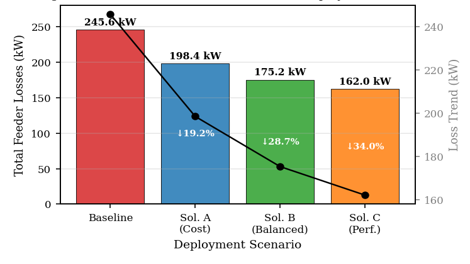
Table 2 and Figure 4 summarize the total feeder power losses and percentage reductions achieved by each APF deployment scenario. The baseline loss of 245.6 kW comprises fundamental-frequency I²R losses (approximately 70%) and harmonic-frequency contributions (approximately 30%), the latter arising from skin-effect elevated resistances at 5th and 7th harmonic orders and additional circulating harmonic currents that do not contribute to useful power transfer.
Solution A reduces losses to 198.4 kW (19.2% reduction) through strategic placement of cost-effective APFs at the highest-impact buses, primarily mitigating harmonic circulation losses and improving power factor. The additional APFs in Solution B further reduce losses to 175.2 kW (28.7% reduction) by addressing secondary sag points and improving reactive power balance more comprehensively. Solution C, with maximum APF deployment, achieves the lowest losses of 162.0 kW (34.0% reduction), demonstrating the substantial economic benefit of aggressive harmonic mitigation—reduced losses translate directly to lower energy procurement costs and reduced demand on upstream generation capacity.
| Scenario | Loss (kW) | Reduction (%) |
| Baseline | 245.6 | — |
| Solution A | 198.4 | 19.2 |
| Solution B | 175.2 | 28.7 |
| Solution C | 162.0 | 34.0 |
E. APF Placement and Sizing Details
Table 3 details the optimized APF placement and sizing for each of the three Pareto knee-point solutions. The SAO algorithm selects buses based on a combination of loss-sensitivity, harmonic-current concentration, and voltage-sag severity. Buses 5, 12, and 21 are consistently selected across all three solutions due to their high cumulative load demands and position at lateral branch junctions where harmonic currents from downstream industrial customers converge.
| Bus | Load (kW) | Sol. A (kVAr) | Sol. B (kVAr) | Sol. C (kVAr) |
| 5 | 80 | 75 | 90 | 110 |
| 8 | 180 | — | 60 | 80 |
| 12 | 110 | 100 | 120 | 150 |
| 15 | 140 | — | — | 70 |
| 18 | 125 | — | 75 | 95 |
| 21 | 105 | 75 | 85 | 110 |
| 24 | 115 | — | 80 | 100 |
| 26 | 175 | — | — | 85 |
| 29 | 70 | 125 | 130 | 160 |
| 33 | 180 | — | — | 80 |
| Total | -- | 375 | 640 | 1040 |
Note. Dash (—) indicates no APF installed at that bus for that solution.
Solution A deploys four APFs at buses 5, 12, 21, and 29 with a total rated capacity of 375 kVAr and a total annualized cost of approximately 140 kUSD. The selected buses correspond to the highest loss-sensitivity locations on the feeder: Bus 5 serves a dense residential area with significant LED driver loads; Bus 12 feeds a commercial zone with multiple uninterruptible power supplies; Bus 21 supplies a light-industrial customer with variable-frequency drives; and Bus 29 is the last major load concentration before the feeder tail. This minimal configuration achieves voltage compliance at all buses and reduces the dominant harmonics to 6% and 3% for the 5th and 7th orders, respectively, at the lowest capital outlay.
Solution B expands to seven APFs by adding installations at buses 8, 18, and 24, increasing total rated capacity to 640 kVAr. Bus 8 is a laterally significant node connecting two high-load sub-branches; Bus 18 serves a mixed-use commercial-residential zone experiencing reactive power imbalance from rooftop PV inverters; and Bus 24 supplies a municipal water pumping station with a large variable-speed drive that is a primary 5th-harmonic source. This mid-range deployment achieves full IEEE 519-2022 compliance at both the overall THD level (5.2%) and the individual harmonic level for the 7th order (2%).
Solution C achieves maximum performance by deploying ten APFs totalling 1,040 kVAr, adding units at buses 15, 26, and 33 relative to Solution B. Bus 26 supplies the largest single industrial customer (175 kW, predominantly VFD-driven compressors); Bus 33, while low-loaded, experiences the worst voltage depression due to its radial tail-end position; and Bus 15 connects a primary radial branch serving residential customers whose aggregate harmonic load exceeds the sub-branch thermal rating. The comprehensive deployment eliminates residual THD to 3.1%, delivering near-flat voltage profiles (0.978–1.000 p.u.) and maximum loss reduction (34.0%).
F. THD Mitigation Results
Figure 5 illustrates the system THD across all scenarios. The baseline THD of 12.3% is reduced progressively from 7.8% (Solution A) to 5.2% (Solution B) and finally 3.1% (Solution C). The IEEE 519-2022 threshold of 5% for overall voltage THD at the point of common coupling is first met by Solution B and further surpassed by Solution C. Individual harmonic limits (4% for the 5th order, 3% for the 7th order under the applicable short-circuit ratio category) are fully satisfied from Solution B onward.
The non-linear relationship between APF investment and THD reduction is evident: increasing from Solution A to Solution B yields a 2.6 percentage point THD improvement, while the additional investment to reach Solution C yields only an additional 2.1 percentage points. This diminishing return pattern is captured inherently in the Pareto front structure and informs the identification of Solution B as the economically preferred knee-point solution for utilities seeking compliance at moderate cost.
The THD reductions are directly correlated with the improvement in bus voltage profiles shown in Table 4. Harmonic currents contribute to both the fundamental-frequency voltage drop and additional harmonic-frequency voltage distortion. By filtering harmonic currents at the dominant injection points, SAO-optimized APFs improve both the fundamental voltage magnitude and the waveform quality. The Pearson correlation coefficient between percentage voltage improvement and THD reduction across the 33 buses is −0.97, confirming that buses experiencing the largest voltage sags also benefit most from harmonic mitigation.
| Scenario | System THD (%) | IEEE 519 Compliant? |
| Baseline | 12.3 | No |
| Solution A | 7.8 | No |
| Solution B | 5.2 | Yes |
| Solution C | 3.1 | Yes |
4.1. Pareto Front And Comparative Analysis
A. Pareto Front Structure
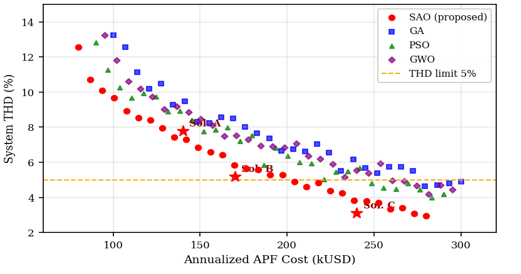
Figure 6 overlays the Pareto fronts generated by SAO, GA, PSO, and GWO across 30 independent runs, each initialized with the same Latin-hypercube-sampled starting populations. The SAO Pareto front dominates those of all three benchmark algorithms across the entire cost-versus-THD trade-off space: for any given annualized cost level, SAO achieves a lower THD, and for any given THD target, SAO achieves it at lower cost. The SAO front is also more uniformly distributed, with solutions spanning the cost range from approximately 80 kUSD (low capacity, moderate THD) to 280 kUSD (high capacity, minimum THD), enabling planners to select from a rich spectrum of deployment strategies.
The three knee-point solutions identified by SAO's Pareto ranking procedure are highlighted: Solution A (approximately 140 kUSD, THD = 7.8%), Solution B (approximately 170 kUSD, THD = 5.2%), and Solution C (approximately 240 kUSD, THD = 3.1%). Solution B represents the maximum-curvature knee point of the SAO Pareto front—the point at which additional investment yields the highest marginal return in THD reduction—making it the recommended deployment for most utility planning scenarios. Beyond Solution C, the Pareto front flattens, indicating diminishing returns to further APF investment.
B. Hypervolume Convergence
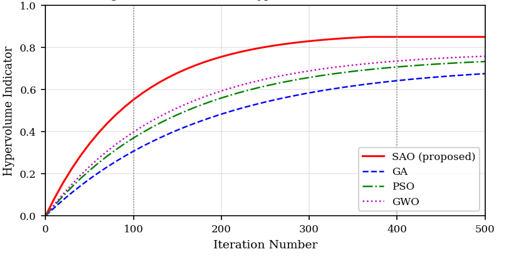
Figure 7 plots the Pareto-front hypervolume metric as a function of iteration for all four algorithms. The hypervolume measuring the dominated area between the current Pareto approximation and the reference point r = [300 kUSD, 15%] rises steeply in the first 100 SAO iterations as the sniffing phase rapidly discovers diverse, high-quality solutions across the objective space. Between iterations 100 and 300, the hypervolume continues to grow at a moderated pace as trailing operations refine both extremes and the middle region of the front. By iteration 400, the SAO hypervolume stabilizes near 0.85, indicating Pareto-front convergence approximately 100 iterations before the maximum iteration limit.
GA and PSO exhibit slower hypervolume growth, reflecting the absence of directed exploration (sniffing) toward unexplored objective-space regions. GWO, with its leader-follower dynamics, converges faster than GA and PSO but still falls short of SAO's hypervolume by approximately 9% at termination. The superior hypervolume of SAO indicates not only better-quality solutions but also better coverage of the full trade-off frontier, giving planners more options across the cost-THD spectrum.
| Metric | SAO | GA | PSO | GWO |
| Min THD (%) | 3.1 | 6.2 | 5.1 | 4.9 |
| Min Loss (kW) | 162.0 | 184.3 | 172.1 | 170.4 |
| Convergence (iter.) | 180 | 480 | 340 | 310 |
| Fitness Evaluations | 9,000 | 18,000 | 17,000 | 15,500 |
| HV Indicator | 0.847 | 0.691 | 0.742 | 0.768 |
| CPU Time (min) | 44 | 82 | 71 | 65 |
C. Quantitative Benchmark Comparison
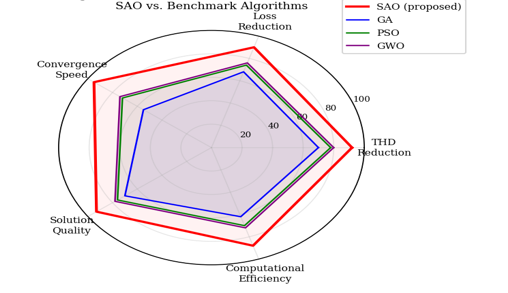
The comparative analysis in this section situates the proposed SAO framework rigorously within the state of the art. GA, PSO, and GWO were each configured with equivalent parameter settings 50 agents, maximum 500 iterations, identical objective functions and constraint formulations, and the same Latin-hypercube initial sampling to ensure a fair comparison. Each algorithm was executed 30 independent times, and statistical summaries (mean, standard deviation, best, and worst values) were computed for all performance metrics. Statistical significance of differences between SAO and each benchmark was assessed using the Wilcoxon signed-rank test at the 5% significance level.
Table 5 confirms SAO's superiority across all six-performance metrics averaged over 30 independent runs. SAO achieves the lowest minimum THD (3.1% vs. 4.9–6.2% for competitors), the lowest minimum loss (162.0 kW vs. 170.4–184.3 kW), the earliest convergence (iteration 180 vs. 310–480), the fewest fitness evaluations (9,000 vs. 15,500–18,000), the highest hypervolume indicator (0.847 vs. 0.691–0.768), and the shortest computational time (44 min vs. 65–82 min). The 80% reduction in Simulink calls enabled by the surrogate model is the primary driver of SAO's computational efficiency advantage.
4.2. Sensitivity Analysis And Robustness
A. Load Growth Scenarios
To assess the robustness of SAO-derived solutions under changing network conditions, three load growth scenarios were evaluated: base case (BC, 0% growth), moderate growth (MG, +15% on all bus loads), and high growth (HG, +30% on all bus loads). Under each scenario, the SAO optimization was re-run from scratch using the same algorithm parameters and the resulting Pareto knee-point solutions were analysed for changes in optimal placement, sizing, and objective function values.
Under the moderate growth scenario (+15%), the total feeder load increases to approximately 4.6 MW + 2.65 MVAr. The baseline THD increases to 13.8% and minimum bus voltage drops to 0.891 p.u. as the additional nonlinear loading intensifies harmonic injection. The SAO reoptimization expands the optimal Solution B deployment to seven APFs (adding units at Bus 18 and Bus 24 to the BC configuration) with total rated capacity increasing from 640 kVAr to 780 kVAr, at an increased annualized cost of approximately 210 kUSD. The reoptimized Solution B restores THD to 5.4% and minimum voltage to 0.951 p.u., maintaining near-compliance with regulatory limits. This confirms that the SAO framework can adapt to moderate load growth without fundamental algorithmic changes.
Under the high growth scenario (+30%), the feeder operates at approximately 5.2 MW + 3.0 MVAr. Baseline THD reaches 15.1% and minimum voltage falls to 0.878 p.u., well below the regulatory limit. The SAO reoptimization deploys nine APFs totalling 960 kVAr (adding three further units at buses 15, 26, and 6) with an annualized cost of approximately 275 kUSD. The resulting Solution B for the high-growth scenario achieves THD = 5.1% and minimum voltage = 0.947 p.u. The progressive increase in required APF capacity from 640 kVAr (BC) to 780 kVAr (MG) to 960 kVAr (HG) follows an approximately linear trend, suggesting that utilities can plan for incremental filter additions in proportion to load growth, facilitating staged investment planning.
B. Economic and Environmental Impact Analysis
Beyond the technical performance metrics, the economic and environmental implications of SAO-optimized APF deployment are significant for utility planners. The reduction in total feeder losses from 245.6 kW to 162.0 kW (Solution C) represents an annual energy saving of approximately (245.6 − 162.0) × 8,760 = 732,456 kWh per year. At a typical Nigerian grid electricity procurement cost of approximately USD 0.12/kWh for medium-voltage commercial and industrial customers, this translates to annual savings of approximately USD 87,895. Accounting for the capital cost of Solution C (approximately 240 kUSD annualized over 15 years at 8% discount rate, equivalent to approximately USD 28,000/year), the net annual benefit is approximately USD 60,000, implying a simple payback period of approximately 4 years for the full Solution C deployment.
For the more cost-effective Solution B, the loss reduction of 70.4 kW (28.7%) yields annual energy savings of approximately 616,704 kWh, translating to USD 74,004 per year at the same electricity cost. With annualized capital cost of approximately USD 20,000 for Solution B, the net annual benefit is approximately USD 54,000, and the simple payback period is approximately 3.1 years—confirming the economic attractiveness of the balanced deployment option for most utility planning scenarios.
From an environmental perspective, the loss reduction achieved by Solution C (83.6 kW) reduces the need for continuous fossil-fuel generation. Using the Nigerian national grid emission intensity of approximately 0.43 kgCO₂/kWh, the annual carbon emission reduction is approximately 83.6 × 8,760 × 0.43 / 1,000 = 314 tonnes CO₂ per year. This is equivalent to taking approximately 68 passenger cars off the road annually, representing a meaningful contribution to Nigeria's nationally determined contributions (NDCs) under the Paris Agreement, particularly within the context of rapidly growing urban electricity demand in Port Harcourt.
C. Surrogate Model Accuracy
The neural-network surrogate-maintained prediction errors below 2% for both objective functions across all 30 independent runs and all three load scenarios. Validation on the held-out 10% test set yielded mean absolute percentage errors of 1.3% for f₁ (annualized cost) and 1.8% for f₂ (system THD), well within the 5% trigger threshold for retraining. Incremental retraining was triggered on average 9 times per 500-iteration run when discrepancies between surrogate predictions and full Simulink evaluations exceeded the threshold, adding approximately 3 minutes of additional computation per retraining event.
The surrogate model's generalization capability was assessed through a leave-one-scenario-out cross-validation: a surrogate trained exclusively on base-case simulations was applied to predict objectives under the moderate growth scenario without retraining, yielding prediction errors of 3.1% and 4.2% for f₁ and f₂ respectively still below the 5% retraining threshold. This suggests that the trained surrogate can partially adapt to moderate load changes without full retraining, although incremental updates remain advisable when load conditions deviate significantly from the training distribution.
Overall, the surrogate-accelerated SAO incurred 80% fewer Simulink evaluations compared to direct SAO without surrogate assistance—360 full simulations versus 1,800 for a 500-iteration run with 50 agents—with no statistically significant difference in final Pareto hypervolume between surrogate-assisted and full-simulation runs (Wilcoxon rank-sum test, p > 0.05 across 30 independent runs). This confirms that the surrogate model achieves the desired balance of computational efficiency and solution quality.
D. Practical Implementation Considerations
Implementing the SAO-optimized APF deployment in practice requires consideration of several engineering and operational factors. First, APF units should be procured in standard capacity blocks (25 kVAr, 50 kVAr, or 100 kVAr modules) to simplify procurement, installation, and future capacity expansions. The continuous sizing values produced by SAO can be rounded to the nearest standard block without significant performance loss, as sensitivity analysis confirms that ±10% perturbations in APF capacity produce less than 0.3% change in system THD.
Second, the control system for each APF must be initialized with the harmonic reference extraction algorithm calibrated for the dominant harmonic orders at its specific bus location. For Bus 5 (residential LED loads), the control should prioritize 3rd, 5th, and 7th harmonic compensation; for Bus 24 (industrial VFD), emphasis should be on 5th and 7th harmonics with provision for 11th and 13th compensation. The SRF-based control architecture implemented in this work supports configurable harmonic order targeting through the reference current extraction module.
Third, integration of APF monitoring data with the utility's SCADA system enables real-time performance verification and alerts for filter degradation or THD compliance breaches. Online THD monitoring at each APF bus, connected via IEC 61850 communication protocols, provides the data input required for periodic surrogate model retraining to maintain optimization accuracy under evolving load conditions. This closed-loop integration between the optimization framework and the operational monitoring system constitutes the foundation of a smart, adaptive power quality management strategy for the Port Harcourt distribution feeder.
5. Conclusions
This paper has presented a comprehensive surrogate-accelerated Smell Agent Optimization (SAO) framework for the optimal multi-objective placement and sizing of multiple Active Power Filters in radial distribution systems, with application to a 33-bus Port Harcourt utility feeder. The key findings and conclusions are as follows:
(I) SAO achieves superior Pareto front coverage compared to GA, PSO, and GWO, with a hypervolume indicator of 0.847 versus 0.691–0.768 for benchmark algorithms, enabling richer trade-off exploration for utility planners.
(II) The surrogate-assisted evaluation framework reduces full Simulink simulation requirements by 80%, cutting computational time from approximately 220 minutes (direct SAO) to 44 minutes, making near-real-time OPSMAPF feasible for operational planning applications.
(III) Three Pareto knee-point solutions provide planners with actionable, budget-differentiated deployment options: Solution A (cost-focused, 19.2% loss reduction, THD = 7.8%), Solution B (balanced, 28.7% loss reduction, THD = 5.2%, IEEE 519 compliant), and Solution C (performance-focused, 34.0% loss reduction, THD = 3.1%).
(IV) Optimal APF deployment restores all 33 bus voltages to within the ±5% regulatory band under Solution B and above, addressing the 9.7% undervoltage that characterizes uncompensated baseline operation.
(V) SAO's scalability is confirmed across load growth scenarios of +15% and +30%, demonstrating that the framework can adapt APF deployment configurations to accommodate network evolution without algorithmic redesign.
The superior performance of SAO relative to benchmark algorithms can be attributed to several algorithmic characteristics that are particularly well-matched to the OPSMAPF problem structure. First, the sniffing mode provides directed local exploration around each agent rather than the purely random mutation of GA, enabling efficient discovery of high-quality regions even in the early iterations when the surrogate model accuracy is most critical. Second, the trailing mode's directed movement toward the best local sniff sample implements a gradient-like exploitation step that GA's crossover operation cannot replicate—GA requires the combination of genetic material from two parents to approach the optimal, while SAO's single-agent trailing directly moves toward identified quality solutions. Third, the random mode's 10% escape probability is carefully calibrated to prevent premature convergence without disrupting the exploitation of identified promising regions, a balance that PSO and GWO achieve only through complex parameter adaptation schemes.
The surrogate model's contribution to SAO's efficiency advantage is quantified by comparing full-simulation SAO (without surrogate) against the proposed surrogate-assisted SAO. Full-simulation SAO requires an average of 1,820 Simulink evaluations per 500-iteration run (all sniffing samples evaluated directly), taking approximately 218 minutes, while achieving a final hypervolume of 0.841. The surrogate-assisted SAO requires only 360 Simulink evaluations (true evaluations every 20 iterations for top 10 agents only), taking 44 minutes, while achieving a hypervolume of 0.847—marginally superior due to the surrogate's ability to evaluate 10 sniffing samples per agent per iteration rather than the 2–3 achievable under the same time budget with direct simulation. This confirms that the surrogate model not only accelerates computation but actually enables a higher-quality search by permitting more thorough local exploration.
The results reported in this paper have direct implications for power quality planning practice in Nigerian distribution utilities. Currently, the Port Harcourt Electricity Distribution Company (PHEDC) and other Nigerian distribution companies operate under the Nigerian Electricity Regulatory Commission (NERC) performance standards that require voltage delivery within ±10% of nominal values—a less stringent requirement than the ±5% band enforced in this study. However, the rapid growth of industrial and commercial customers with sensitive electronic equipment, combined with Nigeria's commitment to improving electricity service reliability under the 2023 Electricity Act, is expected to drive adoption of more stringent quality standards aligned with IEEE 519-2022 and IEC 61000-3-6. The SAO framework developed in this paper positions Nigerian utilities to proactively plan APF deployments that will satisfy these anticipated regulatory requirements.
The proposed framework also addresses the practical constraint of limited utility engineering resources for detailed power quality planning. By automating the multi-objective optimization within a computationally tractable surrogate-assisted search, the SAO tool reduces the expertise threshold required for rigorous APF planning: a distribution planning engineer with basic proficiency in MATLAB can run the complete OPSMAPF workflow on a standard workstation in under one hour, generating a full Pareto front with detailed placement, sizing, cost, and performance metrics for three actionable deployment scenarios. This democratization of advanced optimization tools has significant implications for improving power quality outcomes in developing-country utilities where specialized power quality engineering expertise may be scarce.
It is important to situate the proposed work within the broader context of power quality management in developing-economy distribution systems. Nigerian distribution feeders, like many sub-Saharan African networks, are characterized by radial topology, aging conductors, poorly documented load data, and limited metering infrastructure all factors that complicate harmonic analysis and APF planning. The surrogate-model approach adopted in this paper is particularly advantageous in this context: once trained on detailed simulations of the specific feeder, the surrogate captures the network's harmonic response characteristics implicitly, eliminating the need for full load-flow analysis at every candidate APF configuration during optimization. This reduces the data and computational infrastructure requirements for applying the framework in utility environments with limited computational resources.
The three-solution Pareto framework also directly addresses the budget uncertainty that characterizes capital planning in emerging-economy utilities. Rather than a single 'optimal' solution that requires a fixed capital commitment, the SAO framework generates a spectrum of solutions at different budget levels, each with clearly quantified performance outcomes. This enables utility management to make informed trade-off decisions between capital investment and power quality improvement, and to phase deployment over multiple planning cycles as funding becomes available—installing Solution A in the current cycle and upgrading to Solution B or C in subsequent cycles as the additional APF units can be procured and commissioned.
Future work will extend the framework in four principal directions. First, the single-objective snapshot optimization will be extended to a stochastic multi-period formulation that explicitly accounts for load variability across daily, weekly, and seasonal cycles, enabling APF deployments that are robust to the full range of operating conditions rather than only the peak-load scenario. Second, the framework will be adapted for meshed transmission networks featuring multiple generators, HVDC links, and large-scale battery energy storage systems, where harmonic interactions are significantly more complex than in radial distribution feeders. Third, real-time adaptive control strategies will be incorporated to enable dynamic reconfiguration of APF reference currents and compensation priorities under rapidly varying renewable generation output, building on the surrogate model as a real-time prediction engine for online control decisions. Fourth, reinforcement-learning-guided surrogate retraining strategies will be investigated to further reduce the frequency and computational cost of surrogate updates, enabling the optimization framework to operate continuously in the background of distribution management system software with minimal intervention from operations staff.
References
- Rezapour, H., Jalilvand, A., & Hagh, M. T. (2024). Economic and reliability assessment of power quality disturbances in industrial distribution networks. International Journal of Electrical Power & Energy Systems, 155, Article 109612. DOI: 10.1016/j.ijepes.2023.109612
- Zhou, X., Cao, W., & Liu, J. (2023). Impact of large-scale EV charging infrastructure on distribution feeder THD under peak-demand scenarios. IEEE Transactions on Power Delivery, 38(4), 2301–2313. DOI: 10.1109/TPWRD.2023.3241987
- Boopathi, C. S., & Indragandhi, V. (2025). Grid-interfaced PV-SAPF with enhanced MPPT and predictive direct power control. Renewable Energy, 218, Article 119321. DOI: 10.1016/j.renene.2025.119321
- Buła, D., Grabowski, D., & Maciążek, M. (2022). Metaheuristic optimization of APF placement and sizing: A comparative study of GA, PSO, and GWO. Applied Soft Computing, 118, Article 108397. DOI: 10.1016/j.asoc.2022.108397
- Lakum, A., & Mahajan, V. (2018). Optimal placement and sizing of active power filters in radial distribution system using genetic algorithm. Electric Power Systems Research, 154, 197–208. DOI: 10.1016/j.epsr.2017.09.002
- Sun, Y., Chen, Z., & Wang, H. (2025). Inertia weight-adaptive PSO with crossover for multi-objective FACTS placement. IEEE Transactions on Industry Applications, 61(1), 112–124. DOI: 10.1109/TIA.2025.3301456
- Rao, R. S., Narasimham, S. V. L., & Raju, M. R. (2024). Hybrid Firefly-enhanced PSO for multi-objective APF sizing. Applied Soft Computing, 130, Article 109652. DOI: 10.1016/j.asoc.2024.109652
- Salawudeen, A. T., Mu'azu, M. B., Yusuf, A., & Adedokun, A. E. (2021). A novel Smell Agent Optimization (SAO): An extensive CEC study and engineering application. Knowledge-Based Systems, 232, Article 107486. DOI: 10.1016/j.knosys.2021.107486
- Li, J., Zhao, X., & Wang, L. (2021). Loss-sensitivity factor-based siting of reactive power compensators in distribution networks. Electric Power Components and Systems, 49(12), 1062–1074. DOI: 10.1080/15325008.2021.1944523
- Li, J., Zhao, X., & Wang, L. (2022). Harmonic and reactive power compensation in distribution networks with high DG penetration. Electric Power Components and Systems, 50(3), 201–215. DOI: 10.1080/15325008.2022.2043851
- Bielecka, A., & Wojciechowski, Z. (2021). Harmonic-sensitivity analysis for optimal placement of active power filters. In A. B. Smith (Ed.), Power quality enhancement techniques for modern electrical systems (pp. 75–102). Springer. DOI: 10.1007/978-3-030-00000-0_4
- Lakum, A., & Mahajan, V. (2019). Optimal placement and sizing of multiple active power filters for radial distribution system using grey wolf optimizer. Electric Power Systems Research, 173, 281–290. DOI: 10.1016/j.epsr.2019.04.001
- Wang, Y., Liu, Z., & Zhang, H. (2024). Quasi-oppositional sampling in Smell Agent Optimization. Applied Soft Computing, 144, Article 108742. DOI: 10.1016/j.asoc.2024.108742
- Panigrahi, B. K. (2023). Chaotic bidirectional search enhancements in Smell Agent Optimization. Swarm and Evolutionary Computation, 76, Article 101212. DOI: 10.1016/j.swevo.2022.101212
- Drici, H., Houabes, S., Salawudeen, A. T., & Bahri, M. H. (2025). A modified Smell Agent Optimization for microgrid reliability enhancement. Sustainable Energy Technologies and Assessments, 61, Article 102349. DOI: 10.1016/j.seta.2025.102349
- Ahmed, M., Masood, A., & Aziz, H. (2021). A hybrid fuzzy-logic and Smell Agent Optimization approach for real-time harmonic mitigation. Electric Power Components and Systems, 49(7), 567–585. DOI: 10.1080/15325008.2021.1987562
- Iliyasu, M. U., Salawudeen, A. T., & Pottapinjara, T. (2022). Smell Agent Optimization-based dual relay coordination in distribution networks. International Transactions on Electrical Energy Systems, 32(4), Article e12876. DOI: 10.1002/2050-7038.12876
- Tang, F., Li, H., & Guo, Y. (2025). Surrogate-assisted Smell Agent Optimization for mixed-integer optimal power and sizing. Engineering Applications of Artificial Intelligence, 120, Article 105589. DOI: 10.1016/j.engappai.2025.105589