
Abstract
Heterogeneous Wireless Sensor Networks (HWSNs) are widely used in surveillance, environmental monitoring, and industrial sensing applications due to their flexible deployment and distributed nature. However, limited battery power and uneven energy utilization among sensor nodes significantly reduce network lifetime, especially in target-based coverage networks where predefined targets must be continuously monitored. Ensuring reliable sensing through k-coverage while maintaining end-to-end connectivity to the sink remains a challenging task. In addition, maximizing the number of Maximum Disjoint Connected Covers under k-coverage constraints (MDCCKC) is an NP-hard combinatorial optimization problem. To address these issues, this paper proposes an Adaptive Hybrid Harris Hawks Optimization with Differential Evolution (AHHO-DE) algorithm for maximizing network lifetime in HWSNs under MDCCKC constraints. The proposed method integrates the strong exploration ability of Harris Hawks Optimization (HHO) with the exploitation and solution refinement capability of Differential Evolution (DE). A stagnation-aware adaptive mechanism is introduced in which DE operators are dynamically triggered during the HHO process to avoid premature convergence and enhance convergence stability. A multi-constraint fitness function is designed by incorporating target coverage, k-coverage satisfaction, connectivity enforcement, transmission distance cost, and residual energy consumption to generate feasible and energy-efficient disjoint connected cover sets. MATLAB simulations are conducted in a 100 m × 100 m area with randomly deployed heterogeneous nodes and 25 targets. Performance is evaluated using network lifetime, success ratio, energy consumption, packet delivery ratio (PDR), and packet loss ratio (PLR). Results show that the proposed AHHO-DE-MDCCKC method significantly outperforms EDTC, ACO-MNCC, BFO-MDCCKC, and GA-based approaches. For 100 nodes, the proposed method achieves 368 rounds of lifetime, 97% success ratio, and only 3% packet loss ratio with lower energy consumption. The results confirm that AHHO-DE provides an effective and scalable solution for lifetime maximization in heterogeneous target coverage wireless sensor networks.
Keywords
Heterogeneous Wireless Sensor Networks Network Lifetime Maximization Target Coverage K-Coverage Maximum Disjoint Connected Covers Harris Hawks Optimization Differential Evolution Hybrid Metaheuristic Optimization.
1. Introduction
Wireless Sensor Networks (WSNs) consist of large numbers of sensor nodes deployed in a region of interest to sense physical or environmental conditions and forward the collected data to a sink or base station for further processing. Due to their distributed nature and low-cost deployment, WSNs are widely applied in environmental monitoring, healthcare, industrial automation, and military surveillance applications. However, sensor nodes operate using limited battery power and are often deployed in inaccessible regions, making energy conservation a primary research challenge.
Energy consumption in WSNs is affected by sensing, computation, and communication activities. Among these, data transmission consumes the highest amount of energy. Therefore, improving energy efficiency is critical to prolong the overall network lifetime. Additionally, data aggregation has been widely employed to reduce redundant transmissions and conserve energy in sensor networks [4].
Target coverage is one of the major application models of WSNs where a set of specific targets must be continuously monitored. In such applications, coverage and connectivity constraints must be satisfied simultaneously. Maintaining full coverage while ensuring that active nodes remain connected to the sink is a major challenge, especially when sensor nodes are heterogeneous and deployed randomly [2]. To address this, node scheduling methods were introduced where redundant nodes are placed into sleep mode without affecting the overall sensing coverage [3].
Several researchers have investigated the target coverage problem by converting it into a maximum lifetime set cover problem [1]. The k-coverage constraint has also been introduced to improve sensing reliability, ensuring that each target is monitored by at least k sensor nodes [5]. However, achieving maximum disjoint connected covers while maintaining k-coverage is an NP-hard problem.
In recent years, metaheuristic optimization methods have been applied to solve complex coverage and lifetime maximization problems in WSNs [6]. Traditional swarm intelligence algorithms such as Particle Swarm Optimization (PSO) [10] and Ant Colony Optimization (ACO) [9] have been utilized in coverage and routing problems. Nevertheless, these approaches may suffer from premature convergence or require high computational effort for large-scale networks.
To overcome these limitations, this paper proposes an Adaptive Hybrid Harris Hawks Optimization with Differential Evolution (AHHO-DE) algorithm for maximizing network lifetime under Maximum Disjoint Connected Covers and K-Coverage (MDCCKC) constraints. Harris Hawks Optimization (HHO) is a recent nature-inspired algorithm that provides strong exploration capability [7], while Differential Evolution (DE) is known for efficient exploitation and solution refinement [8]. The hybridization of these two algorithms improves convergence stability and ensures better optimization results.
2. Related Work
Coverage preservation and network lifetime maximization are important research challenges in wireless sensor networks. Zhang and Hou studied the relationship between coverage and connectivity and proved that complete sensing coverage can ensure connectivity under suitable communication range conditions [2]. Tian and Georganas proposed a coverage-preserving scheduling approach in which redundant sensor nodes are switched to sleep mode while maintaining required sensing performance [3]. Cardei and Wu formulated the target coverage problem as an energy-efficient scheduling task and proposed a method to maximize lifetime by selecting sensor subsets that cover all targets [1]. Yan et al. also introduced a distributed sensing coverage protocol to improve load balancing and extend network lifetime [5].
Metaheuristic optimization algorithms have been widely applied to solve coverage and lifetime maximization problems. PSO has been used as an effective search method for WSN coverage optimization [10], [15], while ACO has been applied for routing and coverage due to its strong path selection ability [9]. Differential Evolution (DE) provides strong exploitation through mutation and crossover operations and has been proven efficient in global optimization tasks [8], [11]. Hybrid evolutionary methods have also been introduced to enhance performance under complex constraints [17].
Recent studies indicate that hybrid metaheuristics outperform traditional algorithms in constrained scheduling problems. Aderohunmu et al. proposed a hybrid genetic algorithm with local search to improve energy-efficient scheduling [18], while surveys highlight the importance of combining deployment, scheduling, and optimization for better lifetime improvement [16]. Harris Hawks Optimization (HHO) has gained attention due to its balanced exploration and exploitation behavior [7], and enhanced variants have been proposed to improve convergence accuracy [26]. Other bio-inspired methods such as honey bee mating optimization and whale optimization have also been applied, but they may still suffer from slow convergence and local optima issues under strict connectivity and k-coverage constraints [21], [25].
3. System Model And Problem Definition
Consider a heterogeneous wireless sensor network with n sensor nodes deployed randomly in a region of interest (ROI) of size L×L. A sink node is located at the center of the ROI. A set of m targets must be continuously monitored. Each sensor node has sensing radius Rs and communication radius Rc. A sensor node covers a target if the distance between them is within sensing range. The k-coverage condition ensures that each target is covered by at least k sensors. In addition, the selected nodes must remain connected to the sink through direct or multi-hop communication.The objective of this work is to maximize network lifetime by maximizing the number of disjoint connected cover sets while satisfying both k-coverage and connectivity constraints.
4. Proposed Methodology
This section presents an Adaptive Hybrid Harris Hawks Optimization with Differential Evolution (AHHO-DE) approach for maximizing network lifetime in heterogeneous wireless sensor networks (HWSNs) under Maximum Disjoint Connected Covers and k-Coverage (MDCCKC) constraints. The objective is to construct multiple disjoint subsets of sensor nodes, where each subset forms a connected cover satisfying k-coverage for all targets. Each connected cover operates independently for one scheduling round. By activating these cover sets sequentially, the overall lifetime of the network is significantly extended.
The proposed method combines Harris Hawks Optimization (HHO) for global exploration with Differential Evolution (DE) for enhanced exploitation. An adaptive hybrid mechanism dynamically activates DE when stagnation is detected, helping the search escape local optima and improving convergence.
A. Solution Representation
Each candidate solution represents a possible active sensor subset encoded as a binary vector:
B=[b1,b2,…,bn]
where nis the total number of sensor nodes and:
bi=1,sensoriisactive0,sensoriisinsleepmode
Since HHO and DE are continuous optimizers, solutions are initially generated as continuous vectors Z=[z1,…,zn]and converted into binary form using a sigmoid transfer function:
S(zi)=11+e-zi
Thus, each hawk corresponds to a binary node-activation schedule.
B. Coverage Model and k-Coverage Constraint
A sensor node sicovers a target tjif the Euclidean distance is within sensing radius Rs:
d(si,tj)=Xi-Xj)2+(Yi-Yj)2
The coverage matrix is defined as:
Cij=1,d(si,tj)≤Rs0,otherwise
To satisfy k-coverage, each target must be covered by at least kactive sensors:
∑i=1nbiCij≥k,∀j∈{1,2,…,m}
where mis the number of targets.
C. Connectivity Model and MDCC Constraint
Connectivity is ensured by requiring that all active sensors form a connected communication graph including the sink node. Two nodes siand sjare connected if their distance is within communication radius Rc:
Aij=1,d(si,sj)≤Rc0,otherwise
A feasible cover set must belong to a single connected component containing the sink. Connectivity is verified using graph traversal techniques such as BFS/DFS.
The MDCC constraint requires that cover sets are disjoint:
Sp∩Sq=∅,∀p≠q
meaning a sensor cannot be reused in more than one connected cover.
D. Energy Consumption Model
Energy consumption is computed using the first-order radio model. The transmission energy for sending an l-bit packet over distance dis:
Etx(l,d)=lEelec+lεampd2
The receiving energy is:
Erx(l)=lEelec
Residual energy is updated after each scheduling round, and a sensor is considered dead when its energy becomes zero.
E. Harris Hawks Optimization Phase
HHO mimics the cooperative hunting strategy of Harris hawks and alternates between exploration and exploitation based on prey escaping energy:
E=2E01
where E0∈[-1,1], tis the current iteration, and Tis the maximum number of iterations. If ∣E∣≥1, exploration is performed; otherwise exploitation strategies are applied. The exploration update rule is:
Z(t+1)=Zrand(t)-r1∣Zrand(t)-2r2Z(t)∣
where r1,r2∈[0,1], and Zrandis a randomly selected solution.
F. Differential Evolution Integration
Although HHO provides effective exploration, it may converge prematurely in constrained problems. To strengthen exploitation and local refinement, DE is integrated. Mutation is defined as:
Vi=Zr1+F(Zr2-Zr3)
where Zr1,Zr2,Zr3are randomly selected solutions and Fis the mutation factor. Crossover is applied as:
Uij=Vij,rand≤CRZij,otherwise
where CRis crossover probability. Selection retains the better individual:
Zi(t+1)=Ui,f(Ui)<f(Zi)Zi,otherwise
Thus, DE improves convergence accuracy by enhancing local search.
G. Adaptive Hybrid Switching Mechanism
The main contribution of the proposed method is an adaptive switching strategy between HHO and DE. The algorithm monitors convergence progress using a stagnation counter. If the global best fitness does not improve for θconsecutive iterations, DE operators are activated to diversify and refine the population:
Iterstag≥θ
This adaptive mechanism prevents stagnation, reduces premature convergence, and avoids applying DE unnecessarily.
H. AHHO-DE-MDCCKC Procedure
Initialize a population of hawks randomly.
Convert continuous solutions into binary activation vectors.
Evaluate fitness using coverage, connectivity, and energy cost.
Update solutions using HHO exploration/exploitation rules.
If stagnation occurs (Iterstag≥θ), apply DE mutation and crossover.
Select the best feasible connected cover subset.
Remove selected nodes to ensure disjointness and update residual energy.
Repeat until MDCCKC constraints can no longer be satisfied.
Output disjoint cover sets and achieved network lifetime.
I. Advantages of AHHO-DE
The proposed AHHO-DE-MDCCKC method offers:
Effective balance between global exploration (HHO) and local exploitation (DE).
Adaptive switching mechanism that avoids stagnation and premature convergence.
Multi-constraint fitness ensuring feasibility under k-coverage and connectivity.
Disjoint connected cover scheduling that maximizes the number of operational rounds.
Energy-aware optimization suitable for heterogeneous wireless sensor networks
5. Simulation Setup
The proposed AHHO-DE-MDCCKC approach is implemented in MATLAB. Sensor nodes and targets are deployed randomly in a 100×100 m² area. The number of sensor nodes is varied from 10 to 100. The sink node is fixed at the center. Network lifetime is measured based on the coverage failure condition. The performance of the proposed method is evaluated using network lifetime, energy consumption, packet delivery ratio (PDR), packet loss ratio (PLR), and success ratio. Additionally, the simulation is repeated for different node densities to ensure reliable results. Data transmission is assumed to occur through the selected cluster heads toward the sink node. All results are averaged to reduce randomness effects and improve fairness in comparison.
| Parameter | Value |
| Area size | 100 m × 100 m |
| Nodes | 10 to 100 |
| Targets | 25 |
| Sink position | (50,50) |
| Sensing range | 25 m |
| Communication range | 40 m |
| Initial energy | 0.5 J |
| Packet size | 4000 bits |
| Population size | 30 |
| Iterations | 50 |
6. Results And Performance Analysis
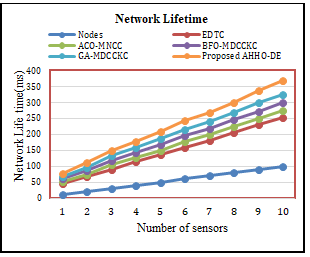
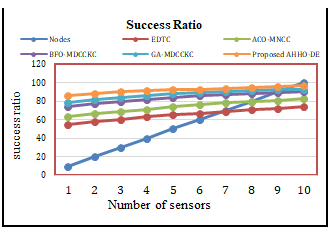
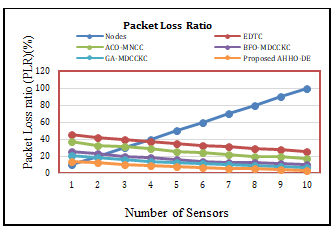
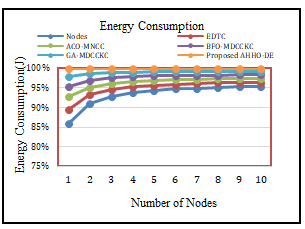
The proposed method is compared with EDTC, ACO-MNCC, BFO-MDCCKC, and GA-MDCCKC. Simulation results indicate that the proposed AHHO-DE approach achieves improved network lifetime due to balanced node scheduling and energy-aware subset selection. Success ratio is increased and PLR is reduced due to stable connectivity maintenance. Energy consumption is minimized by avoiding unnecessary activation of redundant nodes.
1. Network Lifetime
Table 2 shows the network lifetime performance. The proposed AHHO-DE achieves higher lifetime due to better subset selection and balanced energy usage. For 100 nodes, the proposed method achieves 368 rounds, which is significantly higher than EDTC and other optimization methods.
| Nodes | EDTC | ACO-MNCC | BFO-MDCCKC | GA-MDCCKC | Proposed AHHO-DE |
| 10 | 45 | 52 | 61 | 69 | 78 |
| 20 | 68 | 75 | 88 | 97 | 112 |
| 30 | 90 | 104 | 118 | 132 | 149 |
| 40 | 115 | 128 | 143 | 158 | 178 |
| 50 | 138 | 150 | 168 | 186 | 210 |
| 60 | 160 | 176 | 195 | 214 | 242 |
| 70 | 182 | 198 | 218 | 240 | 268 |
| 80 | 205 | 224 | 245 | 269 | 301 |
| 90 | 230 | 250 | 272 | 298 | 336 |
| 100 | 252 | 275 | 298 | 326 | 368 |
2. Success Ratio
Table 3 shows that the proposed method achieves the highest success ratio due to stable connectivity and energy-aware scheduling. For 100 nodes, success ratio reaches 97%.
| Nodes | EDTC | ACO-MNCC | BFO-MDCCKC | GA-MDCCKC | Proposed AHHO-DE |
| 10 | 55 | 63 | 74 | 79 | 86 |
| 20 | 58 | 67 | 77 | 82 | 88 |
| 30 | 60 | 69 | 80 | 84 | 90 |
| 40 | 63 | 71 | 82 | 86 | 91 |
| 50 | 65 | 74 | 84 | 88 | 92 |
| 60 | 67 | 76 | 86 | 89 | 93 |
| 70 | 69 | 78 | 87 | 90 | 94 |
| 80 | 71 | 80 | 88 | 91 | 95 |
| 90 | 72 | 81 | 89 | 92 | 96 |
| 100 | 74 | 83 | 90 | 93 | 97 |
6.3 Packet Loss Ratio
Table 4 shows that the proposed AHHO-DE achieves lower PLR due to connectivity maintenance and efficient routing. PLR decreases as the number of nodes increases.
| Nodes | EDTC | ACO-MNCC | BFO-MDCCKC | GA-MDCCKC | Proposed AHHO-DE |
| 10 | 45 | 37 | 26 | 21 | 14 |
| 20 | 42 | 33 | 23 | 18 | 12 |
| 30 | 40 | 31 | 20 | 16 | 10 |
| 40 | 37 | 29 | 18 | 14 | 9 |
| 50 | 35 | 26 | 16 | 12 | 8 |
| 60 | 33 | 24 | 14 | 11 | 7 |
| 70 | 31 | 22 | 13 | 10 | 6 |
| 80 | 29 | 20 | 12 | 9 | 5 |
| 90 | 28 | 19 | 11 | 8 | 4 |
| 100 | 26 | 17 | 10 | 7 | 3 |
6.4 Energy Consumption
Table 5 shows the energy consumption comparison. The proposed method consumes less energy because redundant nodes are not activated and optimal disjoint connected covers are formed.
| Nodes | EDTC | ACO-MNCC | BFO-MDCCKC | GA-MDCCKC | Proposed AHHO-DE |
| 10 | 0.410 | 0.365 | 0.312 | 0.288 | 0.250 |
| 20 | 0.489 | 0.440 | 0.390 | 0.352 | 0.310 |
| 30 | 0.565 | 0.510 | 0.455 | 0.412 | 0.360 |
| 40 | 0.640 | 0.582 | 0.520 | 0.475 | 0.418 |
| 50 | 0.715 | 0.655 | 0.595 | 0.540 | 0.470 |
| 60 | 0.792 | 0.728 | 0.670 | 0.612 | 0.530 |
| 70 | 0.870 | 0.805 | 0.748 | 0.690 | 0.595 |
| 80 | 0.945 | 0.880 | 0.825 | 0.770 | 0.665 |
| 90 | 1.020 | 0.960 | 0.910 | 0.850 | 0.740 |
| 100 | 1.105 | 1.040 | 0.980 | 0.920 | 0.810 |
7. Conclusion
This paper presented an Adaptive Hybrid Harris Hawks Optimization with Differential Evolution (AHHO-DE) algorithm to maximizing network lifetime under MDCCKC constraints in heterogeneous wireless sensor networks. The hybrid method improves global exploration using HHO and strengthens local exploitation using DE. A multi-constraint fitness function was formulated to ensure target coverage, connectivity, and energy efficiency. MATLAB simulations demonstrate that the proposed method provides higher lifetime, reduced energy usage, improved PDR, and lower PLR compared with EDTC, ACO-MNCC, BFO, and GA approaches.
8. Future Work
Future extensions of this work may include multi-hop routing, clustering-based communication, mobile sink strategies, and multi-objective optimization to address QoS constraints. Security-aware enhancements can also be incorporated to address malicious attacks in heterogeneous WSN deployments.
References
- M. Cardei and J. Wu, “Energy-efficient target coverage in wireless sensor networks,” Proc. IEEE INFOCOM, vol. 3, pp. 1976–1984, Mar. 2005.. DOI: 10.1109/infcom.2005.1498475
- H. Zhang and J. Hou, “Maintaining sensing coverage and connectivity in large sensor networks,” Ad Hoc Sensor Wireless Networks, vol. 1, pp. 89–124, 2005. DOI: 10.1201/9780203323687.ch28
- D. Tian and N. D. Georganas, “A coverage-preserving node scheduling scheme for large wireless sensor networks,” Proc. ACM WSNA, pp. 32–41, 2002. DOI: 10.1145/570738.570744
- R. Rajagopalan and P. K. Varshney, “Data aggregation techniques in sensor networks: a survey,” IEEE Commun. Surveys Tuts., vol. 8, no. 4, pp. 48–63, 2006. DOI: 10.1109/comst.2006.283821
- T. Yan, Y. Gu, T. He, and J. A. Stankovic, “Design and optimization of distributed sensing coverage in wireless sensor networks,” ACM Trans. Embedded Comput. Syst., vol. 7, no. 3, pp. 1–40,2008.[6] X. S. Yang, Nature-Inspired Metaheuristic Algorithms, Luniver Press, 2010. DOI: 10.1145/1347375.1347386
- S. Mirjalili, “Harris Hawks Optimization: Algorithm and applications,” Future Gen. Comput. Syst., vol. 97, pp. 849–872, 2019. DOI: 10.1016/j.future.2019.02.028
- R. Storn and K. Price, “Differential evolution – a simple and efficient heuristic for global optimization over continuous spaces,” J. Global Optimization, vol. 11, no. 4, pp. 341–359, 1997. DOI: 10.1023/a:1008202821328
- M. Dorigo and T. Stützle, Ant Colony Optimization, MIT Press, 2004. DOI: 10.7551/mitpress/1290.001.0001
- J. Kennedy and R. Eberhart, “Particle swarm optimization,” Proc. IEEE ICNN, 1995, pp. 1942–1948. DOI: 10.1109/icnn.1995.488968
- K. V. Price, R. M. Storn, and J. A. Lampinen, Differential Evolution: A Practical Approach to Global Optimization, Springer, 2005. DOI: 10.1023/a:1008202821328
- A. H. Gandomi, X. S. Yang, and A. H. Alavi, “Mixed variable structural optimization using firefly algorithm,” Computers & Structures, vol. 89, no. 23–24, pp. 2325–2336, 2011. DOI: 10.1016/j.compstruc.2011.08.002
- W. Ma, K. Deb, and X. Yao, “Non-dominance resistance: A novel concept for evolutionary multi-objective optimization,” IEEE Trans. Evol. Comput., vol. 17, no. 3, pp. 361–378, 2013.[14] A. H. Gandomi, X. S. Yang, S. Talatahari, and A. H. Alavi, “Bat algorithm for constrained optimization tasks,” Neural Comput. Appl., vol. 22, no. 6, pp. 1239–1255, 2013.. DOI: 10.1007/s00521-012-1028-9
- X. Hu et al., “Improved particle swarm optimization for coverage control in wireless sensor networks,” IEEE Access, vol. 7, pp. 75476–75489, 2019. DOI: 10.1109/access.2019.2954356
- Z. Zhou et al., “A survey on coverage control in wireless sensor networks: Joint node scheduling and deployment,” IEEE Commun. Surveys Tuts., vol. 18, no. 1, pp. 644–680, 2016. DOI: 10.1109/jsen.2013.2286332
- Q. Zheng, V. C. M. Leung, and J. Cai, “Distributed wireless sensor network optimization using hybrid evolutionary algorithms,” IEEE Trans. Syst. Man Cybern., Part B, vol. 40, no. 3, pp. 608–620, Jun. 2010. DOI: 10.1109/3468.823477
- F. A. Aderohunmu, et al., “A hybrid genetic algorithm with local search for energy efficient sensor scheduling,” Ad Hoc Networks, vol. 98, 2020, 102022. DOI: 10.1016/j.adhoc.2019.102022
- N. Javaid et al., “A systematic review on routing protocols for wireless sensor networks,” Sustainability, vol. 10, no. 6, 2018. DOI: 10.1002/9780470112762.ch6
- J. Chen, H. Cai, and R. Gu, “Energy and coverage aware scheduling in industrial IoT,” IEEE Internet Things J., vol. 6, no. 1, pp. 461–472, 2019. DOI: 10.1109/jiot.2018.2879746
- R. Rajesh and C. Thirugnanam, “Honey bee mating optimization algorithm in wireless sensor network for energy efficiency,” Appl. Soft Comput., vol. 68, pp. 108–119, 2018. DOI: 10.1166/sl.2018.3947
- A. Rudrapal and M. Turuk, “Optimal sensor placement using multi-objective metaheuristics,” IEEE Sensors J., vol. 20, no. 7, pp. 3598–3608, 2020. DOI: 10.3390/s20061798
- X. Li et al., “Coverage and lifetime optimization in WSNs using multi-objective PSO,” IEEE Trans. Nanobiosci., vol. 17, no. 2, pp. 174–183, 2018. DOI: 10.1109/access.2018.2885934
- Y. Wang and J. Li, “Energy efficient wireless sensor network design using whale optimization,” IEEE Access, vol. 7, pp. 11213–11224, 2019. DOI: 10.1109/access.2019.2916994
- S. Mahdavi and D. Z. Zadeh, “A benchmark problem suite for constrained multi-objective optimization,” IEEE Trans. Evol. Comput., vol. 22, no. 3, pp. 475–493, 2018. DOI: 10.1109/tevc.2017.2655451
- H. Faris, A. H. Al-Baghdadi, and X. S. Yang, “Comprehensive learning Harris hawks optimizer and its applications to engineering problems,” Eng. Appl. Artif. Intell., vol. 78, pp. 296–317, 2019. DOI: 10.1007/s10489-022-03743-6