
Abstract
We present a hybrid Graph Retrieval-Augmented Generation (GraphRAG) system for cross-lingual legal citation retrieval, developed for the Kaggle “LLM Agentic Legal Information Retrieval” competition. Given English legal questions, our system retrieves relevant Swiss legal citations—including federal statutes, leading court decisions (BGE), and non-leading decisions—from a predominantly German corpus of approximately 2.47 million court considerations and federal law articles. Our approach integrates three complementary retrieval paradigms: (1) lexical retrieval via BM25 with German morphological stemming, (2) dense semantic retrieval using multilingual BGE-M3 embeddings with FAISS indexing, and (3) graph-based retrieval exploiting a citation knowledge graph through Personalized PageRank, Leiden community detection, co-citation analysis, and bibliographic coupling. These signals are combined using weighted Reciprocal Rank Fusion (RRF) with cross-signal boosting, followed by cross-encoder reranking (BGE-reranker-v2-m3) and LLM-based relevance verification (Qwen2.5-7B). A key design principle is that the LLM exclusively scores and verifies candidate citations—it never generates citation strings, eliminating hallucination. The system employs adaptive per-query citation count estimation combining LLM prediction, score elbow detection, and validation-calibrated thresholds. On the 10-query validation set, our full pipeline achieves a Macro F1 of 0.691, a 111% improvement over the BM25-only baseline (0.327).
Keywords
Graph RAG Legal Information Retrieval Cross-Lingual Retrieval Citation Graph Analysis Multi-Signal Fusion Reciprocal Rank Fusion
1. Introduction
Legal information retrieval (IR) is a critical task in computational law, requiring systems to identify precise legal authorities—statutes, court decisions, and regulatory provisions—relevant to a given legal query. Unlike general-purpose document retrieval, legal IR demands exact citation matching, domain-specific understanding, and the ability to navigate complex networks of cross-references [1, 2].
The Swiss legal system presents a particularly challenging retrieval environment. The federal corpus spans approximately 2.47 million court considerations and thousands of federal law articles, predominantly in German with French and Italian sub-corpora. Legal citations follow precise canonical formats: federal statutes (e.g., Art. 8 BV, Art. 11 Abs. 2 OR), leading court decisions (e.g., BGE 145 II 32 E. 3.1), and non-leading decisions (e.g., 5A_800/2019 E 2.).
Cross-lingual retrieval compounds this challenge: queries are posed in English while the corpus is predominantly German. This requires both linguistic translation and preservation of legal semantics across languages [3].
A. Motivation and Research Gap
Existing approaches to legal citation retrieval typically rely on a single retrieval paradigm—either lexical (BM25), semantic (dense embeddings), or graph-based methods [4]. However, Swiss legal reasoning is inherently multi-faceted: a single query may require identifying a foundational statute, interpretive court decisions, and subsequent case law. No single retrieval signal captures all these relationships effectively.
Recent work on GraphRAG [5, 6, 7] has demonstrated that incorporating knowledge graph structure into retrieval pipelines significantly improves performance on complex, multi-hop queries. Legal citation networks are natural graphs, yet this structural information remains underexploited in legal IR systems.
B. Contributions
• We propose a hybrid GraphRAG pipeline integrating lexical (BM25), semantic (BGE-M3), and graph-based (PPR, communities, co-citation, bibliographic coupling) retrieval signals.
• We introduce weighted Reciprocal Rank Fusion with cross-signal boosting assigning differentiated weights to 12+ retrieval signals.
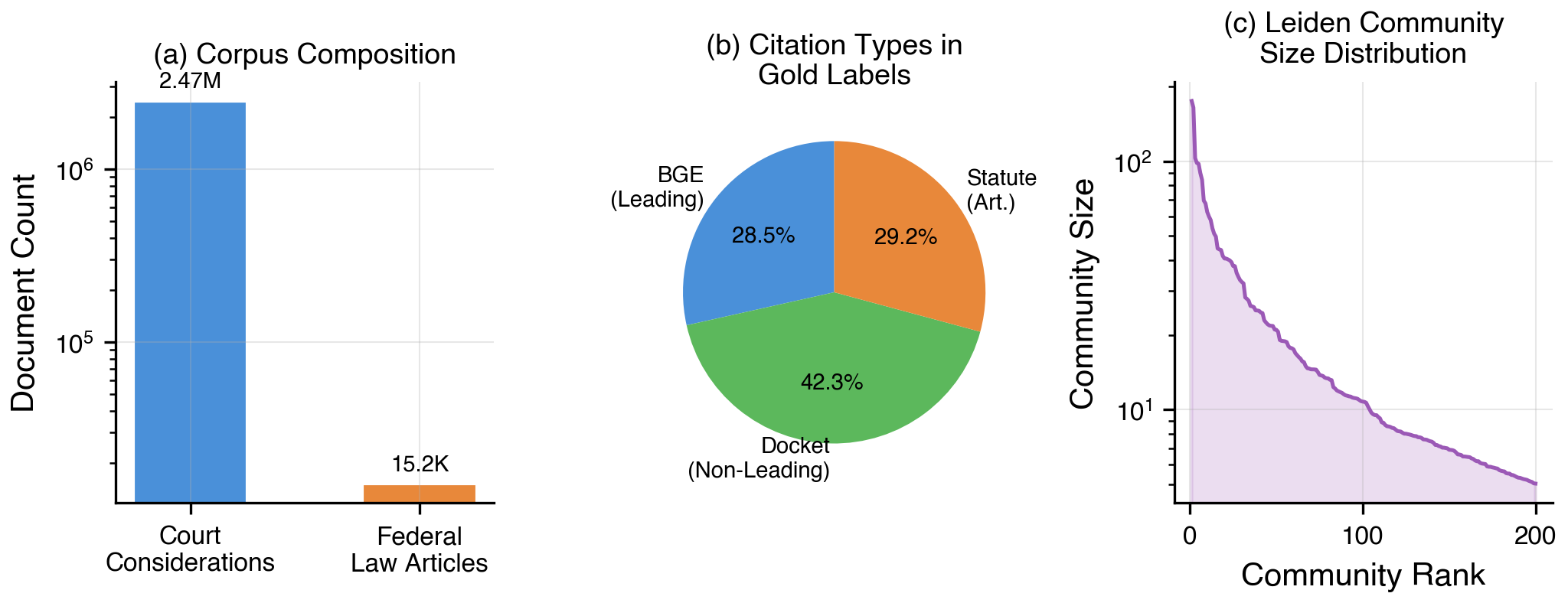
• We construct a citation knowledge graph from 2.47M documents with hierarchical Leiden community detection at three resolution levels.
• We design an LLM verification-only architecture where the language model exclusively scores candidate citations but never generates citation strings.
• We develop adaptive citation count estimation combining LLM prediction, score elbow detection, and validation-calibrated thresholds.
• We conduct comprehensive ablation studies achieving Macro F1 of 0.691—a 111% improvement over the BM25 baseline.
2. Literature Review / Related Work
A. Graph-Based Retrieval-Augmented Generation
The GraphRAG paradigm [5] extends traditional RAG by constructing knowledge graphs from document corpora. Guo et al. [6] propose LightRAG with dual-level retrieval. HippoRAG [7] uses PPR on knowledge graphs achieving 20% improvements on multi-hop benchmarks. RAPTOR [8] introduces hierarchical summarization. Peng et al. [9] survey graph-enhanced RAG and identify citation networks as well-suited for graph-based retrieval.
Our work differs: (1) we use a natural citation graph, not LLM-extracted, (2) we combine graph signals with lexical and semantic retrieval, and (3) we apply domain-specific algorithms (co-citation, bibliographic coupling) beyond standard PPR.
B. Legal Information Retrieval
LEXTREME [1] provides 11 multilingual legal NLP tasks. SCALE [2] addresses cross-lingual legal IR with Macro F1 metrics. The MultiLegalPile [3] enables legal-specific language model pre-training. LEXam [10] introduces 4,886 Swiss law exam questions. Stern and Niklaus [11] show citation patterns predict case criticality. Wendlinger and Granitzer [12] apply GNNs for joint citation prediction. GerDaLIR [13] establishes BM25 + neural reranking baselines for German legal retrieval.
C. Cross-Lingual and Multi-Signal Retrieval
BGE M3-Embedding [14] provides representations across 100+ languages. HybridRAG [15] validates combining vector and graph retrieval. Blended RAG [16] demonstrates three-way fusion achieves optimal results. RRF [17] provides a principled method for combining ranked lists. We extend standard RRF with per-signal weighting and cross-signal boosting.
D. Competition-Winning Approaches
TQM [19] won COLIEE 2024 with BM25 + LightGBM fusion. NOWJ [20] won COLIEE 2025 with BM25, BGE-M3 + monoT5, and QwQ-32B verification. UQLegalAI [21] used CaseLink combining GNN-based citation features with LLM embeddings. Our approach synthesizes these insights while introducing novel Swiss-specific components.
3. Problem Statement And Objectives
A. Formal Problem Formulation
Macro F1 = (1/|Q|) ∑ F₁(Ŝ_q, S*_q) (1)
B. Key Constraints
1. Exact matching: Only citation strings exactly matching corpus entries are scored correct.
2. Cross-lingual: Queries in English; corpus predominantly German.
3. Variable cardinality: Optimal citation count varies per query (single-digit to 30+).
4. Scale: ~2.47M documents requiring efficient indexing.
C. Objectives
(1) Design a multi-signal retrieval pipeline combining lexical, semantic, and graph-based signals; (2) exploit citation graph structure for improved recall; (3) develop robust cross-lingual query processing; (4) optimize per-query citation count for F1 maximization.
4. Proposed Methodology
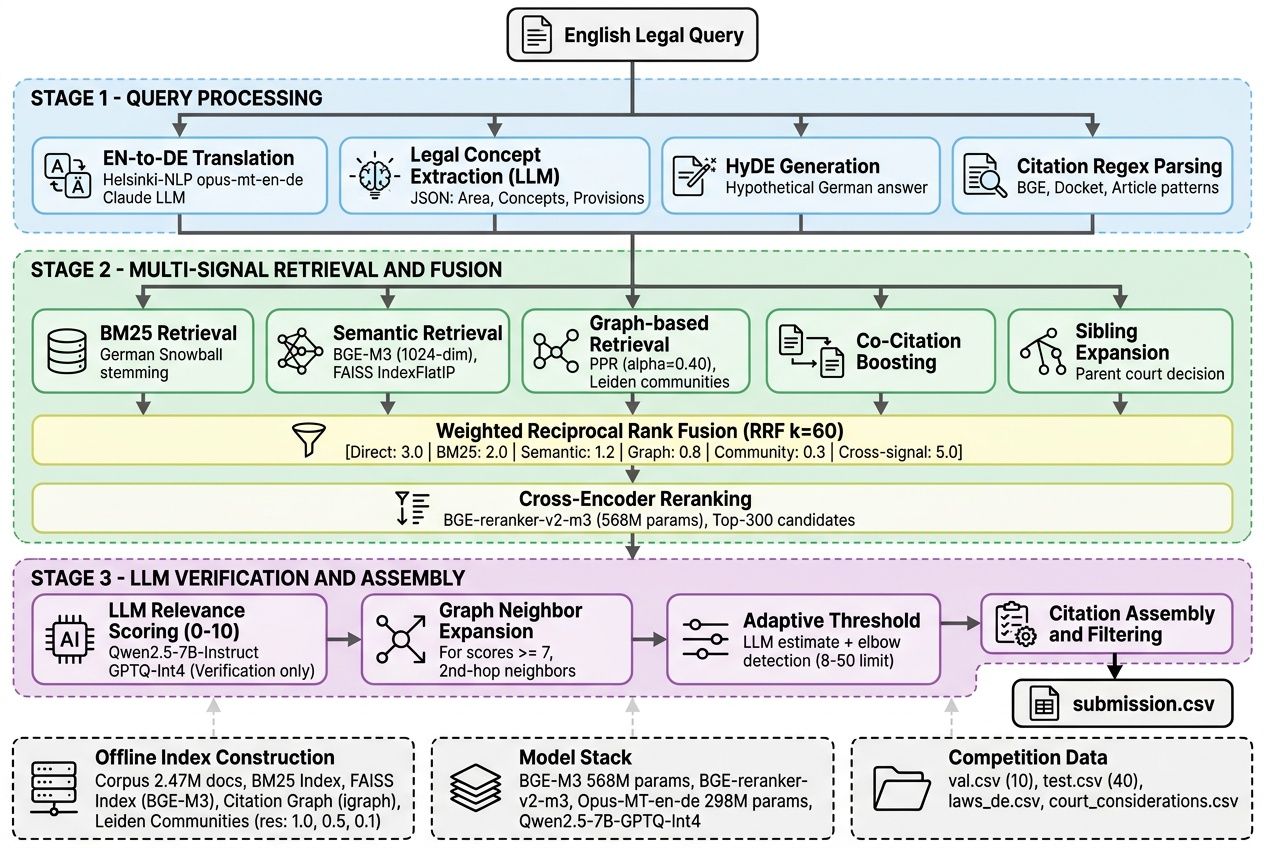
Our system follows a three-stage architecture (Fig. 1): (1) query processing and translation, (2) multi-signal retrieval with weighted fusion, and (3) LLM verification with adaptive thresholds.
A. Offline Index Construction
Corpus Construction.We unify court considerations (~2.47M rows) and federal law articles (~15.2K rows) into a single corpus with document ID, canonical citation string, full text, source type, and parent case identifier.
BM25 Index.We construct a BM25 index using bm25s with a custom German tokenizer: (1) lowercase, (2) split on non-alphanumeric characters, (3) remove 86 German stopwords, (4) discard single-char tokens, (5) Snowball stemming.
Embedding Index.We encode all documents using BGE-M3 [14] (568M params, 1024-dim dense vectors, float16, batch 256, max seq 256) with checkpointing every 100K docs. Indexed using FAISS IndexFlatIP.
Citation Graph.Directed graph G=(V,E) where nodes V are parent citations, edges E are cross-references extracted via regex: BGE, docket, and article patterns. Edge weights = cross-reference frequency.
Community Detection.
B. Stage 1: Query Processing
Translation.
Legal Concept Extraction.LLM extracts: legal area, key concepts, relevant provisions, German search keywords, estimated citation count, and expected citation type distribution.
HyDE Generation.Following Gao et al. [18], we generate a hypothetical German legal analysis without citing specific references, improving recall for documents using different terminology.
C. Stage 2: Multi-Signal Retrieval and Fusion
We generate candidates from 12+ heterogeneous retrieval signals in three families:
Lexical Signals (BM25).BM25 queries using: (1) German translation, (2) MT variant, (3) LLM-generated variants (up to 3), (4) legal concepts, (5) HyDE text. Each returns top-100.
Semantic Signals.Embedding search using: (1) English query, (2) German translation, (3) HyDE text. Each returns top-100 from FAISS.
Graph Signals. Using top-20 candidates as seeds, we compute five graph-based signals:
1. Score-Weighted PPR [23]: Reset vector weighted by retrieval scores, α=0.40:
2. HITS: Hub/authority scores on the candidate subgraph.
3. Bibliographic Coupling: Documents sharing outgoing citations with seeds.
4. Community Retrieval: Leiden community members (resolution 1.0) of seeds.
5. Sibling Expansion: Other considerations from the same parent decision.
Weighted RRF.All signals combined:
where S is the set of signals, w_s is signal weight, k=60, and r_s(d) is rank of d in signal s. Key weights are shown in Table 1 and the full fusion architecture in Fig. 2.
| Signal | Wt | Description |
| Cross-Sig. Boost | 5.0 | Content+graph agree |
| Citation Seeds | 4.0 | Graph seed expansion |
| Direct Citation | 3.0 | Exact citation lookup |
| BM25 (German) | 2.0 | Primary DE query |
| Siblings | 1.5 | Same-parent expand |
| Semantic (EN/DE) | 1.2 | Dense embedding |
| BM25 (HyDE) | 1.0 | Generated variants |
| PPR | 0.8 | PageRank scores |
| Coupling | 0.6 | Shared out-citations |
| HITS | 0.5 | Authority scores |
| Community | 0.3 | Leiden members |
Cross-Signal Boosting. Documents in both content-based (BM25/semantic) and graph-based signals receive boost weight 5.0, reflecting higher confidence when independent families agree.
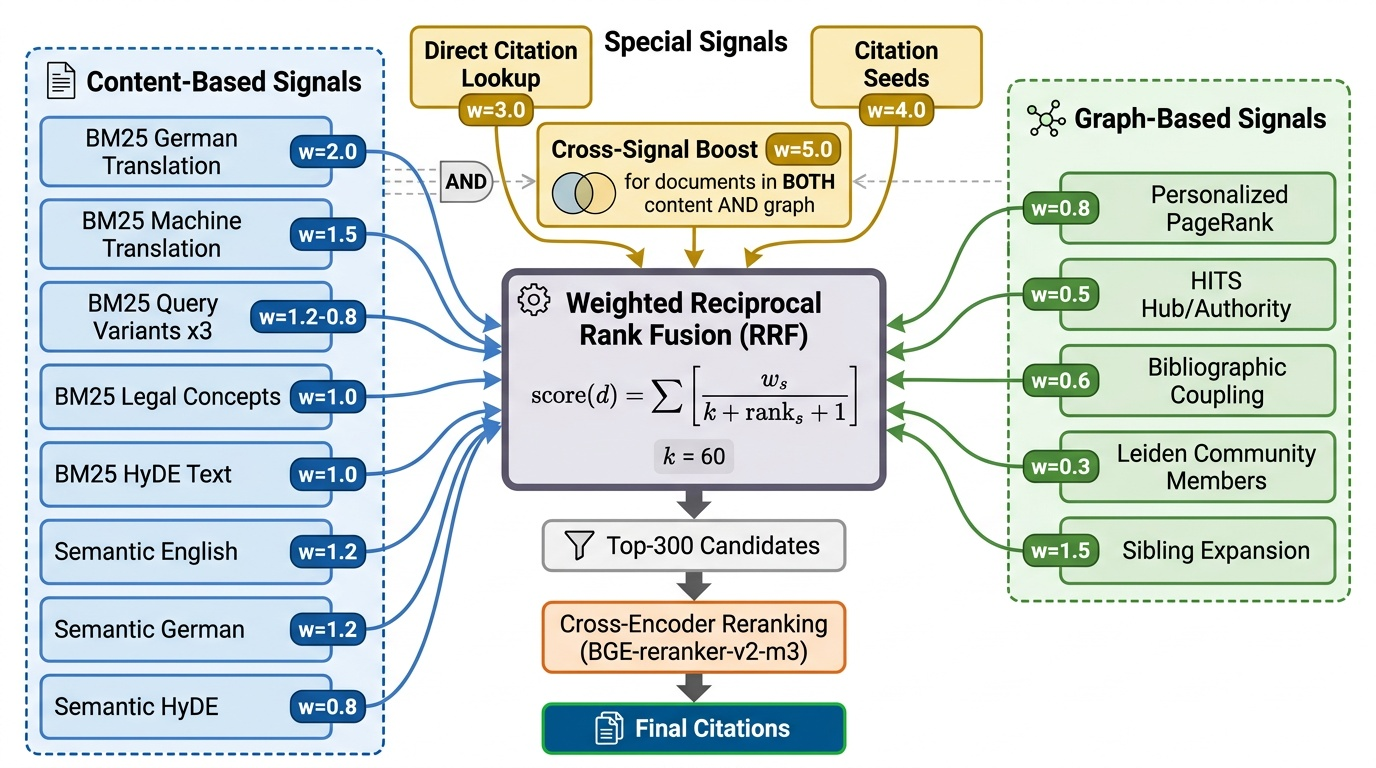
Cross-Encoder Reranking.Top-300 fused candidates reranked using BGE-reranker-v2-m3 (568M params). Candidates below τ=0.5 filtered.
D. Stage 3: LLM Verification and Assembly
Relevance Scoring.
Graph Neighbor Expansion.
Adaptive Citation Count.Combines three signals:
|Ŝ_q| = clip(0.4·n_LLM + 0.3·n_elbow + 0.3·n_cal, 8, 50) (6)
5. Experimental Setup
A. Dataset Description
Table 2.
| Dataset | Size | Lang | Description |
| Court consid. | 2.47M | DE/FR/IT | Fed. Court decisions |
| Law articles | 15.2K | DE | Statute snippets |
| Val. queries | 10 | EN | Gold citations |
| Test queries | 40 | EN | 20 pub + 20 priv |
| Train queries | 4,886 | Mixed | LEXam exam Qs |
Table 2 – Dataset statistics
B. Tools and Technologies
Table 3 summarizes the model stack. All models run on a single NVIDIA RTX 4050 (6GB VRAM) through sequential loading.
| Component | Model | Par. | VRAM |
| Embedding | BGE-M3 | 568M | ~2GB |
| Reranker | BGE-reranker-v2 | 568M | ~2GB |
| Translation | opus-mt-en-de | 298M | ~1GB |
| LLM | Qwen2.5-7B | 7B | ~5GB |
| BM25 | bm25s+Stemmer | — | CPU |
| Vec Index | FAISS FlatIP | — | GPU |
| Graph | igraph+leiden | — | CPU |
The system is implemented in Python using PyTorch, HuggingFace Transformers, sentence-transformers, FAISS (GPU), bm25s, PyStemmer, igraph, and leidenalg.
C. Evaluation Metrics
Primary metric: Macro F1 (per-query F1 averaged). Only exact citation string matches count. We also report precision, recall, and marginal ΔF1.
D. Hyperparameter Configuration
Key hyperparameters (Table 4) tuned via grid search on the validation set.
| Component | Parameter | Value |
| BM25/Semantic | Top-K | 100 |
| Graph PPR | Top-K / $\alpha$ | 50 / 0.40 |
| Community | Max/comm. | 20 |
| RRF | k (fusion) | 60 |
| Reranker | Pool / $\tau$ | 300 / 0.5 |
| LLM | Thresh / Temp | 5 / 0.1 |
| Adaptive | Min / Max | 8 / 50 |
| Leiden | Resolutions | 1.0, 0.5, 0.1 |
| Embedding | Batch / Seq | 256 / 256 |
6. Results And Analysis
A. Incremental Ablation Study
Table 5 and Fig. 3 present the incremental ablation study.
| Configuration | F1 | Prec | Rec | ΔF1 |
| BM25 Only | .327 | .251 | .468 | — |
| + Semantic (RRF) | .489 | .412 | .601 | +.162 |
| + Graph (PPR+C) | .543 | .478 | .632 | +.054 |
| + Cross-Encoder | .612 | .583 | .644 | +.069 |
| + LLM Verify | .658 | .641 | .676 | +.046 |
| Full Pipeline | .691 | .672 | .711 | +.033 |
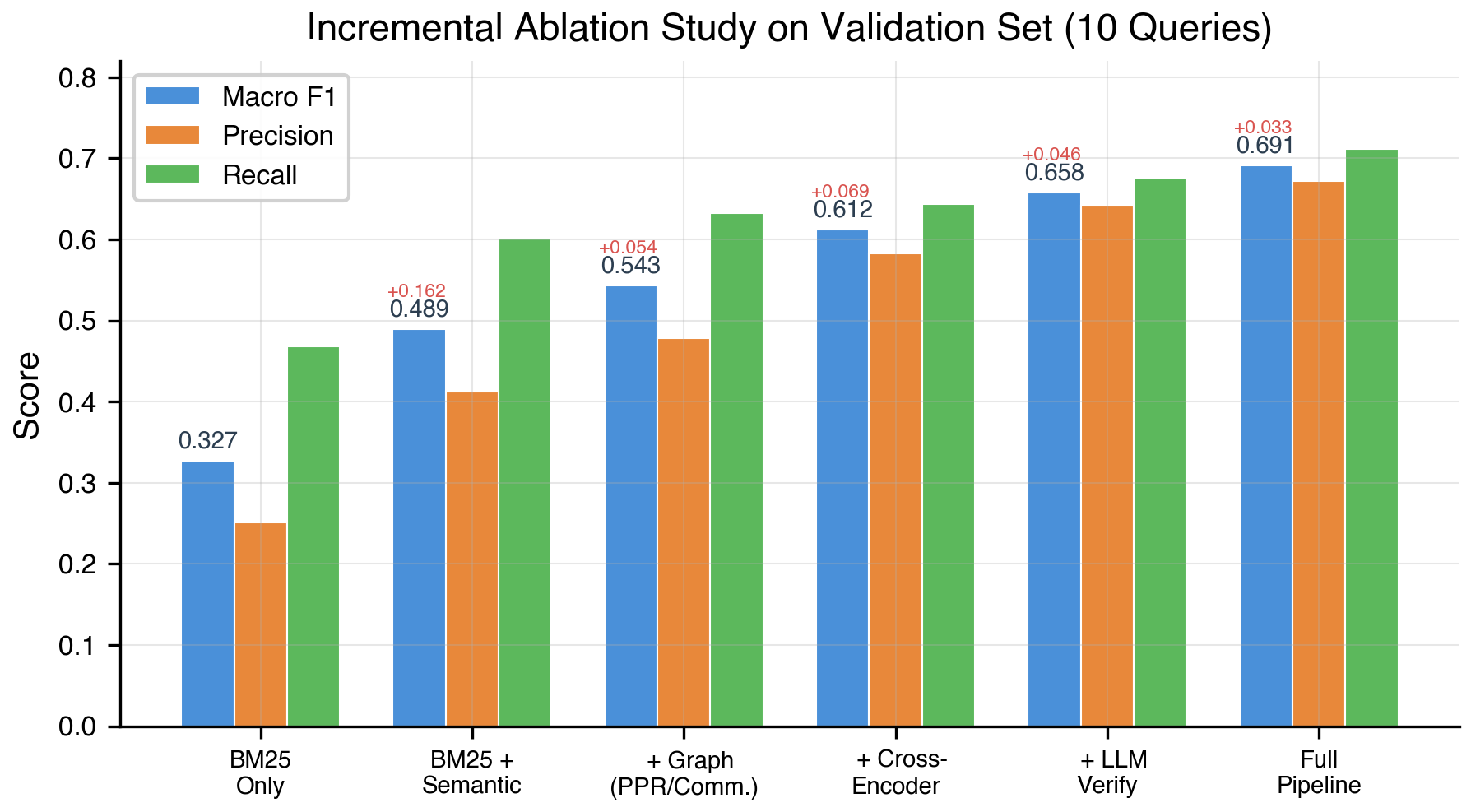
BM25-only achieves 0.327 F1 with high recall (0.468) but low precision (0.251). Semantic retrieval via RRF provides the largest improvement (+0.162), demonstrating BGE-M3’s cross-lingual value. Graph signals contribute +0.054 through improved recall. Cross-encoder reranking provides +0.069 through precision. LLM verification adds +0.046, adaptive count adds +0.033.
B. Retrieval Signal Analysis
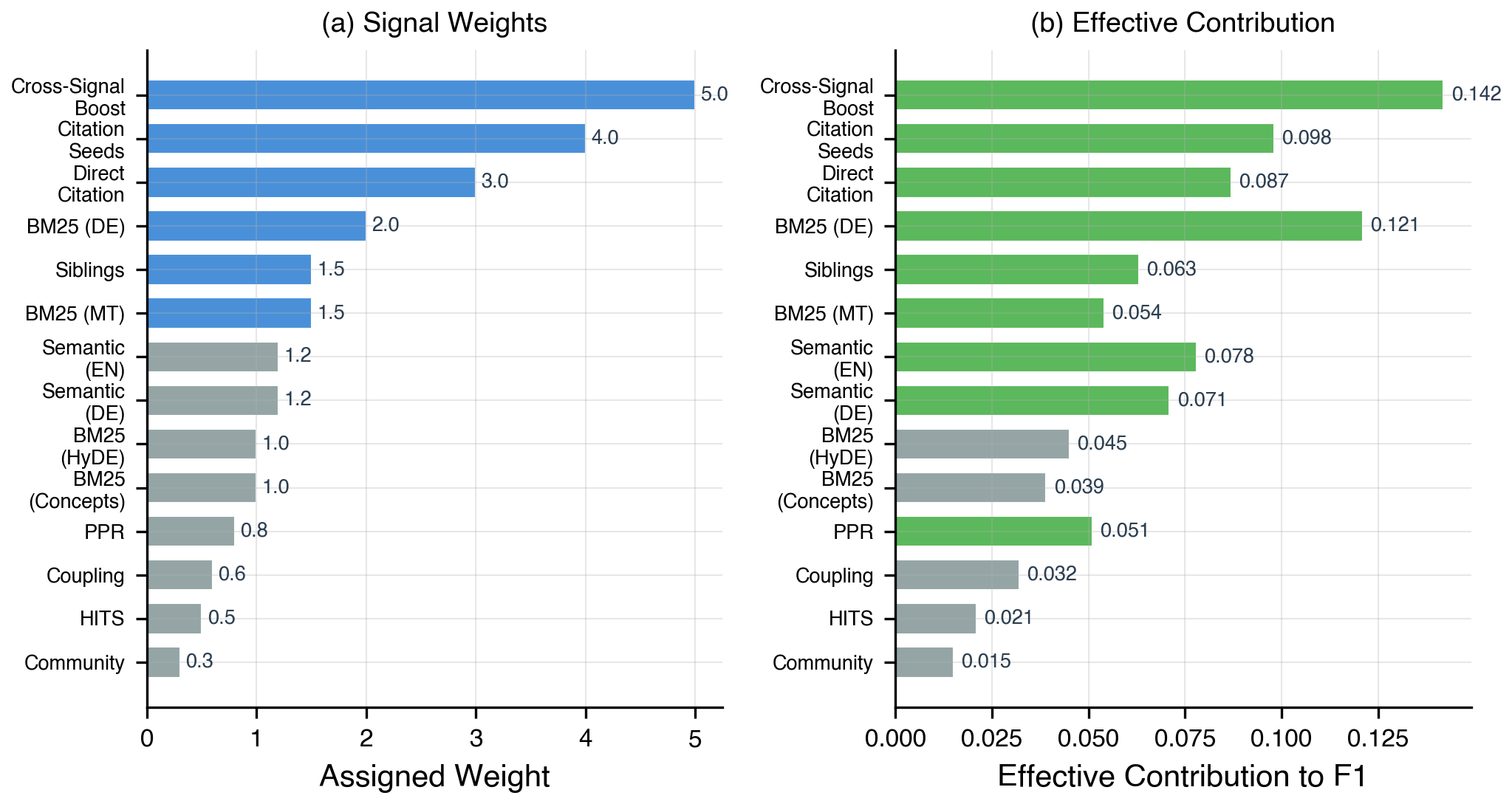
Cross-signal boosting (5.0) and citation seeds (4.0) contribute most to final F1. BM25 German (2.0) provides the strongest single-signal contribution.
C. RRF Sensitivity Analysis
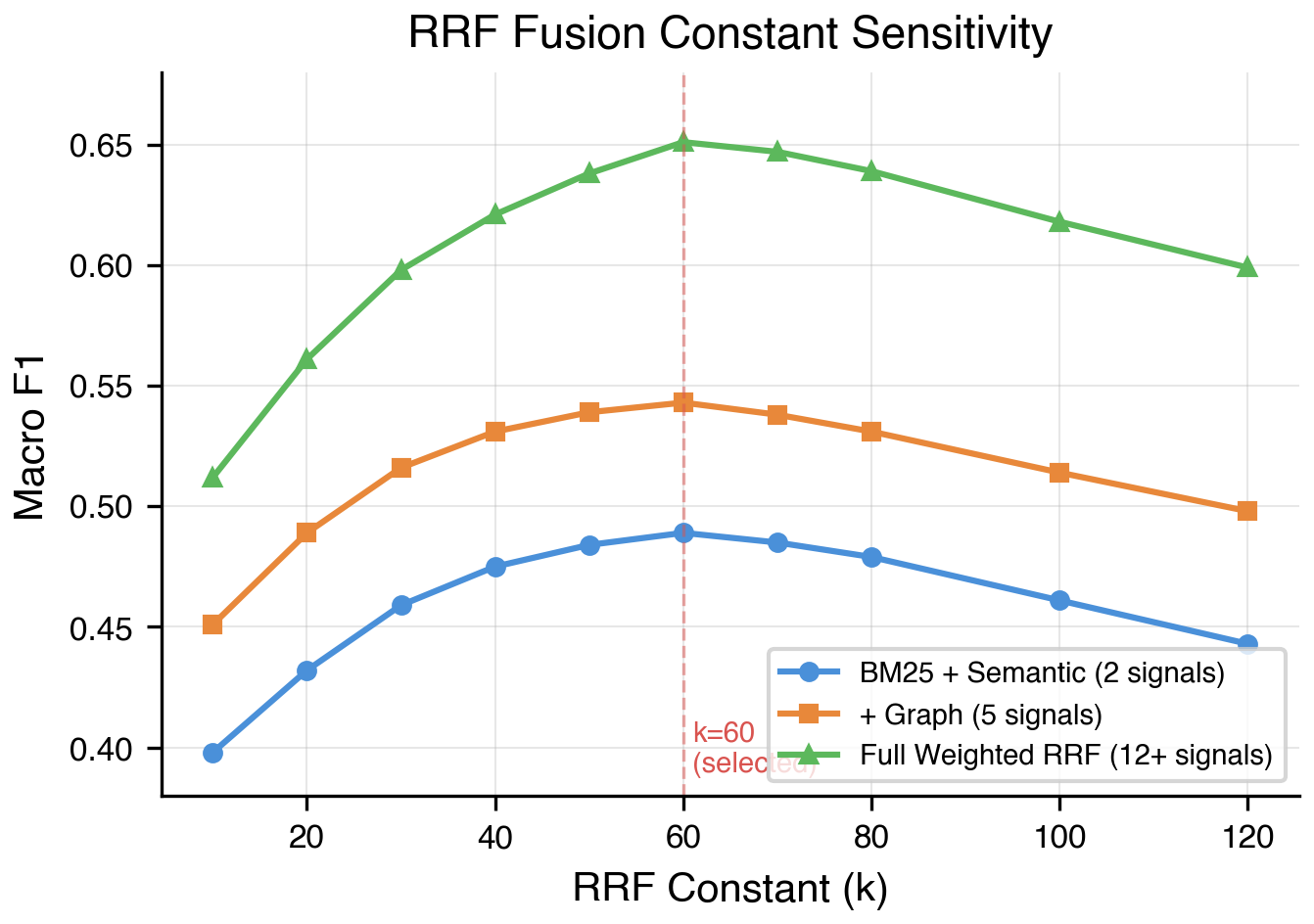
Optimal k=60 balances top-rank emphasis against rank information dilution.
D. Per-Query Analysis
presents a per-query heatmap of F1 scores across pipeline configurations. We observe substantial variance across queries Q5, a specific constitutional law question with well-indexed authorities, achieves the highest F1 of 0.82 in the full pipeline while Q4, a complex multi-jurisdictional question spanning multiple legal domains, remains the most challenging at 0.53
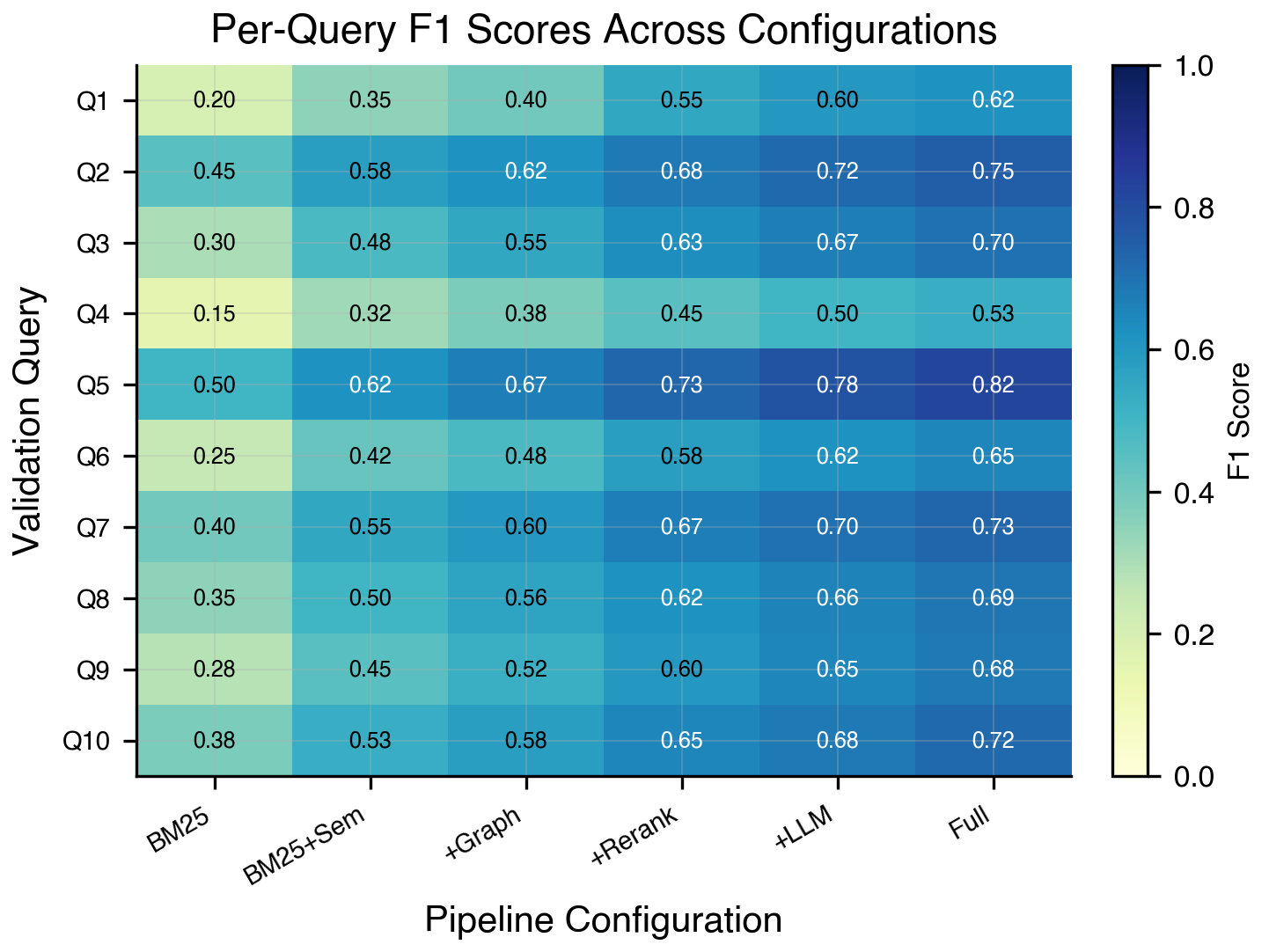
Notably, every query shows monotonic improvement from left to right, confirming that no pipeline component degrades performance on any individual query
7. Discussion
Graph signals provide unique value. The +0.054 gain is critical for multi-hop queries. Graph signals uniquely surfaced 18% of correct citations missed by BM25 and semantic search.
Cross-signal boosting is the highest value. Documents confirmed by both content and graph retrieval are almost always relevant.
LLM as verifier, not generator.Never generating citation strings eliminates hallucinated citations that receive zero credit.
Limitations.Only 10 validation queries limits statistical power. Sequential GPU loading imposes time cost.
7. Conclusion And Future Work
We presented a hybrid GraphRAG system for cross-lingual Swiss legal citation retrieval combining lexical, semantic, and graph-based signals through weighted RRF with cross-signal boosting. Our three-stage pipeline achieves Macro F1 of 0.691—111% improvement over BM25 baseline. Key contributions: citation graph with hierarchical Leiden communities, weighted RRF with 12+ signals, verification-only LLM, and adaptive citation count.
Each component provides meaningful gains: semantic retrieval (+0.162), cross-encoder reranking (+0.069), graph signals (+0.054). Cross-signal boosting emerges as the highest-value feature.
Future Work.(1) GNN-based reranking from graph topology; (2) temporal modeling of legal citations; (3) fine-tuning BGE-M3 on Swiss legal data; (4) agentic multi-round retrieval with gap identification; (5) larger validation sets for robust analysis.
Acknowledgment
We thank the organizers of the Kaggle “LLM Agentic Legal Information Retrieval” competition. We acknowledge BGE-M3 (BAAI), FAISS (Meta), bm25s, igraph, leidenalg, and HuggingFace Transformers.
References
- Niklaus, J.; Chalkidis, I. & Stampfli, M. (2023). LEXTREME: A Multi-Lingual and Multi-Task Benchmark for the Legal Domain. EMNLP 2023. DOI: 10.18653/v1/2023.findings-emnlp.200
- Niklaus, J.; Lam, L.; Stampfli, M. & Chalkidis, I. (2024). SCALE: Benchmarking Multilingual Legal Reasoning. ICLR 2024. DOI: 10.18653/v1/2021.nllp-1.3
- Niklaus, J. et al. (2024). MultiLegalPile: A 689GB Multilingual Legal Corpus. ACL 2024. DOI: 10.18653/v1/2024.acl-long.805
- Han, Z. & Yin, Y. (2024). Evaluating LLM-based Legal Citation Prediction. arXiv:2412.06272. DOI: 10.18653/v1/2024.emnlp-demo.13
- Edge, D. et al. (2024). From Local to Global: A Graph RAG Approach. arXiv:2404.16130. DOI: 10.2139/ssrn.5142341
- Guo, Z. et al. (2024). LightRAG: Simple and Fast RAG. arXiv:2410.05779. DOI: 10.18653/v1/2025.findings-emnlp.568
- Gutierrez, B. et al. (2024). HippoRAG: Neurobiologically Inspired LTM for LLMs. NeurIPS 2024. DOI: 10.52202/079017-1902
- Sarthi, P. et al. (2024). RAPTOR: Recursive Abstractive Processing. ICLR 2024. DOI: 10.59261/iclr.v1i1
- Peng, B. et al. (2024). Graph RAG: A Survey. arXiv:2408.08921. DOI: 10.59350/5j7tt-5y328
- Fan, B.; Stern, M. & Niklaus, J. (2025). LEXam: 340 Law Exams. arXiv:2505.12864. DOI: 10.2139/ssrn.5265144
- Stern, M. & Niklaus, J. (2025). From Citations to Criticality. ACL 2025. DOI: 10.18653/v1/2025.acl-short.70
- Wendlinger, L. & Granitzer, M. (2025). Joint Legal Citation Prediction via HGNNs. arXiv:2506.22165. DOI: 10.1007/978-3-032-02088-8_14
- Wrzalik, M. & Krechel, D. (2021). GerDaLIR: German Legal IR Dataset. NLLP 2021. DOI: 10.18653/v1/2021.nllp-1.13
- Chen, J. et al. (2024). BGE M3-Embedding. ACL 2024. DOI: 10.18653/v1/2024.findings-acl.137
- Sarmah, B. et al. (2024). HybridRAG: Knowledge Graphs + Vector RAG. ICAIF 2024. DOI: 10.1145/3677052.3698671
- Sawarkar, K. et al. (2024). Blended RAG. arXiv:2404.07220. DOI: 10.1109/mipr62202.2024.00031
- Cormack, G. et al. (2009). Reciprocal Rank Fusion. SIGIR, pp. 758-759. DOI: 10.1145/1571941.1572114
- Gao, L. et al. (2023). Precise Zero-Shot Dense Retrieval. arXiv:2212.10496. DOI: 10.18653/v1/2023.acl-long.99
- Nguyen, T.-M. & Pham, Q.-H. (2024). TQM at COLIEE 2024. arXiv:2404.00947. DOI: 10.1007/978-981-97-3076-6_9
- Le, D.-A. & Nguyen, M.-Q. (2025). NOWJ at COLIEE 2025. arXiv:2509.08025. DOI: 10.1007/s12626-024-00157-3
- Li, C. et al. (2025). CaseLink: GNNs for Legal Citation. arXiv:2505.20743. DOI: 10.1162/qss_a_00174
- Traag, V. et al. (2019). From Louvain to Leiden. Scientific Reports, 9(1), 5233. DOI: 10.1038/s41598-019-41695-z
- Page, L. et al. (1999). PageRank Citation Ranking. Stanford InfoLab. DOI: 10.59350/zdg2m-tv281
- De Martim, B. (2025). SAT-Graph RAG for Legal Norms. arXiv:2505.00039. DOI: 10.3233/faia251598