
Abstract
The focus of this research was to study the methods of aircraft-ground communication systems, the various subsystems of aircraft, and their components, in addition to some functions of these subsystems' components. The research was carried out using an explanatory research method. The results revealed that some of the subsystems of an aircraft are the communication system, electrical subsystem, propulsion subsystem, hydraulic system, flight control subsystem, landing gear subsystem, safety system, and environmental control subsystem. In addition, the results also show that the methods of aircraft-ground communication systems are VHF radio communication, HF radio communication, satellite communication, and automatic dependent surveillance-broadcast. The results of this research will be important to regulatory bodies like NCAA (Nigerian Civil Aviation Authority), aerospace/aeronautic engineers and researchers, pilots, weather forecasters, and stakeholders in the aviation industry. This study is very important as it will enhance understanding of aviation systems, improve safety protocols, and support the development of more efficient communication technologies.
Introduction
Aircraft-ground (aircraft to ground/ground to aircraft) communication deals with the transmission of information from the ground to the aircraft in the air and/or from the aircraft to the ground. Aircraft-ground communication techniques are the various ways or means by which the transfer of information from the ground to the aircraft in the air or vice versa is being carried out. This exchange of information between the aircraft and the ground station or control tower is almost the same as the exchange of information between the satellite in space and the ground station or earth observation station. It is simply a two-way communication between aircraft and stations or locations on the surface of the earth. Air-ground communication provides aircraft with flight status interaction and flight command transmission, as well as flight decision management capabilities. Aircraft communication capability is an exchange of voice communication and information between pilots and the command centers, ground air traffic control (ATC), maintenance centers, or other stakeholders during flight [1]. In the view of [2], Air-to-ground communication usually includes two parts in which one part for the communication between the aircraft pilot and the ground tower, and the other part is the communication between the aircraft and the ground command center. These air-ground communication systems mainly transmit information by communication satellites in the form of telephone calls and short messages. Modern civil aviation radio communication has three modes or methods, and these are very high frequency communication, satellite communication, and high frequency communication [3]. Aircraft networks operate similarly to satellites, but while satellite-to-ground communication involves long-distance signal transmission between Earth and a satellite with a noticeable delay, aircraft-to-ground communication typically operates as a closed-loop communication system, where the aircraft and ground station exchange immediate feedback in real time for safe flight operations [4]. Air traffic controllers in the tower and ground environment still mainly issue time-critical instructions to pilots via radio telephony with voice utterances. The air traffic controllers normally also note down the content of their verbal instructions, though the paper flight strips for such notes have been replaced by electronic flight strip systems [5&6]. Furthermore, increased flights in the early 2000s caused the saturation in the air traffic management communications capacity that uses the VHF data link, and the situation created a need for new research to find new communication systems to help release the pressure [7]. This is because, in the past, voice communication was the only way used between aircraft and the ground. The defects of HF and VHF voice communication frequency congestion and the effect of the human factor directly influence the efficiency and safety of flight. Thus, with the rapid development of the international aviation industry, various countries are making great efforts to implement a variety of air-ground data links in the air traffic services (ATS) application. And today, the Aircraft Communications Addressing and Reporting System (ACARS) changes the air-ground communications methods from the voice mode used in the past to both voice and data modes used currently, which has the availability of about 99.999% and convenient transmission [8, 9 & 10].
Research methodology
This research work adopted a descriptive and analytical research approach to examine aircraft subsystems and aircraft–ground communication techniques. The research was primarily based on secondary data collected from peer-reviewed journals, aviation textbooks, technical manuals, and official publications from recognised aviation authorities. These sources were carefully selected to ensure the information used in the study was accurate, credible, and relevant to the research topic. The study discussed major aircraft subsystems, including propulsion, electrical, hydraulic, avionics, flight control, fuel, landing gear, environmental control, and safety systems. The work also discusses the functions of these subsystems, their key components, and their roles in ensuring safe and efficient aircraft operation. In addition, the research examined important aircraft–ground communication techniques or methods such as VHF, HF, Aircraft Communications Addressing and Reporting System (ACARS), SATCOM, ADS-B, and radar. The findings were carefully organised and presented in a way that makes them easy to understand.
3.1 Subsystems of Aircraft and their components
3.1.1. Communication system
The communication system of an aircraft is a network of equipment enabling voice and data exchange between the aircraft and external entities (ATC, other aircraft) and internally (crew and passengers) through various communication systems.
The communication subsystem of an aircraft consists of VHF radio, HF radio, satellite communication, ACARS (Aircraft Communications Addressing and Reporting System), intercom, cabin systems, and public address systems.
3.1.2 Electrical Subsystem
The electrical subsystem of an aircraft is the subsystem that is responsible for the generation, storage, and distribution of electrical power for aircraft operations. The electrical subsystem of an aircraft consists of the generators/alternator, which produce electricity; batteries, which store energy for startup and backup; voltage regulators, which control voltage levels; and power distribution units. Which distribute power; circuit breakers/fuses that protect the electrical and electronic systems against overloads; inverters that convert DC to AC power for AC devices; bus bars that conduct electricity to various systems; wiring harnesses that transmit power and signals; and electrical loads that are systems or components using electricity.
3.1.3 Propulsion Subsystem
This is the subsystem of an aircraft that provides thrust for the takeoff, climb, cruise, and landing phases of an aircraft. This subsystem is made up of the components that generate thrust or force to move the aircraft forward, counteracting drag and enabling flight. The Propulsion Subsystem is made up of some components such as the engine, which provides power; the propeller, which converts engine power to thrust; the thrust reverser, which helps slow the aircraft during landing; the fuel system, which stores and supplies fuel to the engine; the engine controls, which regulate engine performance; and the exhaust nozzle, which directs exhaust gases for thrust.
3.1.4 Hydraulic subsystem
The hydraulic subsystem is a power transmission system of an aircraft that uses pressurised fluid to generate mechanical force for aircraft control surfaces, landing gear, and other functions. This subsystem enables the aircraft to carry out various tasks like steering, braking, and landing gear operation. This subsystem is made up of hydraulic pumps which pressurise fluid, accumulators that store pressurised fluid, reservoirs that store hydraulic fluid, actuators that convert fluid pressure to mechanical motion, valves that control fluid flow and direction, filters that clean hydraulic fluid, and lines/tubes that transport fluid.
3.1.5. Avionics System
The avionics subsystem is the subsystem of an aircraft that encompasses electronic systems for communication, navigation, flight control, and monitoring. This subsystem assists pilots with flight management, navigation, weather awareness, and safety. The avionics system of an aircraft comprises the autopilot/automatic flight control system, which controls aircraft flight; the flight management system, which manages flight plans and navigation; navigation systems for position determining; engine instrumentation, which monitors engine performance; surveillance systems such as radar; and the electronic flight bag, which is the digital tool or application that provides the pilot with digital access to flight information like charts/maps, manuals, and logs of flight operations.
3.1.6. Flight Control Subsystem
The Flight Control Subsystem is the subsystem of an aircraft that allows the pilots to control the orientation and trajectory of the aircraft. The aircraft control subsystem provides stability and maneuverability. It consists of control columns/sticks used for pilot inputs; flight control computers that process inputs for stability/control; hydraulic actuation that transmits control inputs; trim systems that adjust control surface balance; sensors that give feedback for stability augmentation; and flight control surfaces such as elevators (located on the tail for up and down movement or stabilisation) and ailerons (located on the edge of the wing for left and right movement or stabilisation).
3.1.7 Landing Gear Subsystem
The landing gear subsystem is the subsystem of an aircraft that supports the aircraft during takeoff, landing, and ground operations. It helps the aircraft to absorb shocks as well as enabling smooth movement. The landing gear helps to reduce drag in flight as well as facilitates taxiing (taxiing is the movement of the aircraft on the ground). The gear subsystem of an aircraft is made up of actuators that extend or retract landing gear; a main gear that controls or supports the aircraft's weight during landing and taxiing; tires that provide contact with the runway; brakes that slow or stop the aircraft during landing or taxiing; shock absorbers that absorb landing impacts; and a nose gear that allows steering of the aircraft by the pilot during landing and taxiing.
3.1.8. Environmental Control Subsystem
The Environmental Control Subsystem of an aircraft is the component or subsystem of the aircraft that regulates cabin temperature, humidity, pressure, and air quality for the safety and comfort of passengers. The environmental control subsystem of an aircraft consists of air conditioning packs that cool/heat cabin air when there is a need; a ventilation system that circulates air; a pressurisation system that regulates cabin pressure; a heating system that heats the cabin or components; a cooling system that cools the cabin or components; and air filters that clean incoming air.
3.1.8 Fuel Subsystem
The fuel subsystem is the subsystem of the aircraft that stores and delivers fuel to engines for operation. The fuel subsystem helps in managing the fuel quantity, pressure, and flow for engine performance as well as the safety of an aircraft. The fuel subsystem of an aircraft consists of the following: fuel tanks that store fuel, fuel pumps that transfer fuel, fuel lines that transport fuel, fuel gauges that measure fuel quantity, a fuel management system that manages fuel distribution, and fuel filters that clean fuel.
3.1.9. Safety System
The safety subsystem is the aircraft subsystem that protects passengers, crew, and aircraft in abnormal or emergency situations. This subsystem mitigates risks in critical situations. The safety subsystem of an aircraft consists of emergency power, which provides backup power for critical systems; fire detection/suppression, which detects and extinguishes fire; a collision avoidance or warning system, which detects nearby aircraft and alerts the pilot to prevent mid-air collisions; an oxygen system, which provides emergency oxygen; evacuation systems, which include ropes and slides for emergency exit; crash sensors, which detect the impact of an aircraft crash and activate some safety responses like the activation of emergency lights, the deploying of airbags, the activation of crash recorders, and the sending of distress signals.
3.2 Aircraft-Ground Communication Systems
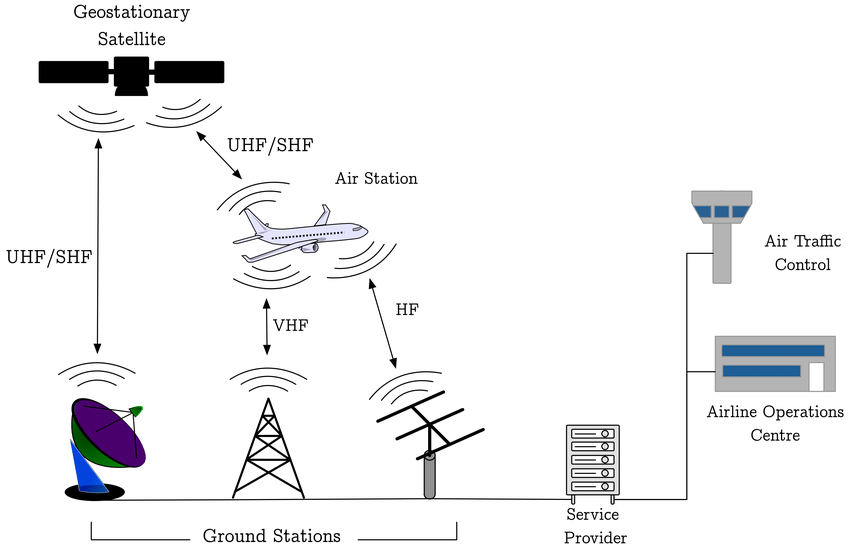
Aircraft-ground communication systems are the mechanisms or technologies that enable the exchange of information such as voice and data between the aircraft and the ground stations or towers. They provide the means through which pilots, air traffic controllers, airline operations personnel, and maintenance teams exchange information that is essential for flight coordination and safety. The major aircraft–ground communication methods or techniques are as follows.
3.2.1 VHF (Very High Frequency) Radio Communication
VHF (Very High Frequency) is a radio frequency band ranging from 30 to 300 MHz, commonly used in aviation (118–137 MHz) for clear, line-of-sight voice communication between aircraft and ground control stations. VHF communication is the primary means of voice communication between pilots and air traffic controllers in civil aviation. VHF radio communication uses amplitude modulation, which allows pilots and controllers to hear partial transmissions even when signals overlap. VHF radio communication is based on line-of-sight signal propagation since the radio waves travel in relatively straight lines and are limited by the curvature of the Earth and physical obstructions such as terrain, buildings, mountains, or the curvature of the Earth. In other words, its challenge is the limited line-of-sight range, typically around 200–300 km. Important information such as flight route adjustments, weather updates, altitude changes, and landing clearances are transmitted via the VHF system. As a result of its reliance on line-of-sight propagation, it cannot provide coverage over oceans, deserts, or remote regions without ground infrastructure. In addition, increasing air traffic has led to congestion in VHF frequency bands, sometimes causing delays or overlapping transmissions in busy airspace.
3.2.2 HF (High Frequency) Radio Communication
HF radio operates in the frequency range of 3 to 30 megahertz and enables long-distance communication by using ionospheric reflection. An aircraft can operate beyond the effective range of VHF communication, particularly during long-haul flights over oceans or polar regions. In such a situation, there will be no line of sight; hence, VHF can’t be used. Thus, HF radio communication becomes very important. This is because, instead of traveling in straight lines, HF radio waves can bounce off charged layers of the Earth’s atmosphere, allowing them to travel well beyond the horizon. HF communication is very important in oceanic and remote airspace where ground-based VHF stations are unavailable. With HF radio, pilots communicate with oceanic control centers, report their position at specific waypoints, receive route clearances, and obtain weather updates. In some cases, HF systems are also used to transmit limited data in addition to voice communication, although voice remains the primary mode. Just like the VHF, HF has its challenges too, such as varying signal quality due to changes in ionospheric conditions, which are influenced by time of day and atmospheric disturbances. HF communication is also affected by interference and signal fading.
3.2.3 ACARS (Aircraft Communications Addressing and Reporting System)
The Aircraft Communications Addressing and Reporting System (ACARS) is defined as a digital data link system that automatically transmits short messages between ground stations and aircraft to support flight operations, administrative communication, and maintenance reporting. It is a major advancement in aircraft–ground communication. ACARS represents a shift from traditional voice-based communication to digital data communication. Instead of relying on spoken messages, ACARS uses short, text-based messages to exchange information between aircraft and ground systems. These messages can be sent automatically by onboard systems or manually by flight crew. ACARS is used to transmit flight plans, weather information, air traffic control messages, and airline operational instructions. Through the use of ACARS, aircraft systems can automatically send information on fault reports, performance data, and system status messages to maintenance teams on the ground. This helps potential issues to be known and addressed before the aircraft arrives at its destination, improving safety and reducing downtime.
The messages by ACARS can be transmitted using different communication links, including VHF radio, HF radio, and satellite communication. Some of the advantages of ACARS include functioning in various flight environments, reduced pilot workload, decreased voice channel congestion, and improved efficiency in airline operations. Though ACARS has many advantages, its messages are limited in length and transmission speed.
3.2.4 SATCOM (Satellite Communication)
SATCOM (Satellite Communication) is a communication system that uses orbiting satellites to relay voice and data signals between aircraft and ground stations, thus providing wide-area or global coverage beyond the limits of line-of-sight radio. SATCOM systems use communication satellites orbiting the Earth to relay signals between aircraft and ground stations. SATCOM is especially valuable for flights over oceans, deserts, and remote regions where ground-based communication systems are unavailable, given that satellites can cover vast geographic areas at the same time. Since SATCOM supports both voice and data communication, pilots can use SATCOM to communicate with air traffic controllers and airline operations centers, while data services support ACARS messaging, real-time aircraft tracking, and flight monitoring. The major advantage of SATCOM is the wide or global coverage and reliability, which greatly enhances communication in areas where other systems are ineffective. But despite this advantage over all others, communication latency may occur, particularly with satellites in higher orbits, which can introduce slight delays in voice and data transmission. In addition, SATCOM systems are expensive to operate, as they require specialised onboard equipment and subscription services.
3.2.1.5 ADS-B (Automatic Dependent Surveillance-Broadcast)
ADS-B (Automatic Dependent Surveillance–Broadcast) is defined as the surveillance technology in which an aircraft automatically determines its position using onboard navigation systems and broadcasts that information to ground stations and other aircraft for tracking as well as situational awareness. Unlike traditional communication systems, ADS-B does not involve direct message exchange between pilots and controllers, because an aircraft equipped with ADS-B automatically broadcasts its position, altitude, speed, and identification information at regular intervals. This information is derived from onboard navigation systems and transmitted to ground stations and other nearby aircraft. When this is done, the ground-based ADS-B receivers use this broadcast data to monitor aircraft movements in real time, providing air traffic controllers with accurate and frequently updated surveillance information. It has several advantages, such as lower infrastructure costs and improved coverage in areas where radar installation is difficult or expensive. However, ADS-B communication depends heavily on the accuracy of onboard navigation data and how properly equipped the aircraft is.
3.2.1.6 Radar
Radar (Radio Detection and Ranging) is a system that uses transmitted radio waves and their reflected echoes to determine the position, distance, speed, and altitude of aircraft for the purpose of air traffic monitoring and control. Radar can be a primary or secondary type. Primary radar detects aircraft based solely on reflected signals and does not require any onboard equipment. Secondary surveillance radar, on the other hand, relies on aircraft transponders to provide additional information such as identification codes and altitude. This aircraft-ground communication technique allows air traffic controllers to monitor aircraft altitude, position, speed, and direction, making them essential for maintaining safe separation between aircraft. Radar has some advantages, such as providing independent aircraft tracking without pilot input, as well as serving as a backup surveillance system in case other technologies fail. However, radar systems require significant infrastructure investment and regular maintenance and are limited by terrain and line-of-sight coverage.
| Communication Method | Technology/Frequency | Range/Coverage |
| VHF Radio | Radio waves (118-137 MHz) | Line-of-sight, typically 200-300 km (or ~200 NM at altitude) |
| HF Radio | Radio waves (3-30 MHz) with ionospheric reflection | Long-distance, global over oceans/polar regions (beyond horizon) |
| ACARS | Digital data link (uses VHF, HF, or SATCOM as bearers) | Depends on bearer (VHF/HF/SATCOM limits apply) |
| SATCOM | Satellite relay (e.g., geostationary or LEO satellites) | Global, including oceans/deserts/remote areas |
| ADS-B | GPS-based broadcast (1090 MHz or 978 MHz) | Line-of-sight, up to ~250 NM; extendable via ground/satellite receivers |
| Radar | Radio waves (primary: echo detection; secondary: transponder interrogation) | Line-of-sight, 200-400 NM depending on type; gaps in remote areas |
Conclusion
The focus of this research was to study the methods of aircraft-ground communication systems as well as the various subsystems of aircraft and their components in addition to some functions of these subsystems' components. The research was carried out using the explanatory research method. The results revealed that some of the subsystems of an aircraft are the communication system, electrical subsystem, propulsion subsystem, hydraulic system, flight control subsystem, landing gear subsystem, safety system, and environmental control subsystem. In addition, the results also show the methods of aircraft-ground communication systems are VHF radio communication, HF radio communication, satellite communication, and automatic dependent surveillance-broadcast. These research results will be important to regulatory bodies like NCAA (Nigerian Civil Aviation Authority), aerospace/aeronautic engineers and researchers, pilots, and weather forecasters, as well as stakeholders in the aviation industry. This study is very important as it will enhance understanding of aviation systems, improve safety protocols, and support the development of more efficient communication technologies.
References
References
- Steven J. Fletcher (2017). Data Assimilation for the Geosciences. DOI: 10.1016/b978-0-12-804444-5.00023-4
- Dequan Li, Jiming Li, Xu Zhou, JinRong Hu, Xin Wang and Jing Duan (2022). FACT: An Air-Ground Communication Framework for Seeding Quality Control of Aircraft. Computer Systems Science & Engineering. vol.41, no.2. 539 -555 DOI: 10.32604/csse.2022.019551
- Kaikai Si, Qing Lua, Xiaoyan Guob, Bin Gao (2022). Application Research of Civil Aviation High Frequency Communication System. Journal of Physics: Conference Series 2364 (2022) 012027. 1 -9 DOI: 10.1088/1742-6596/2364/1/012027
- Tyler Przybylski, Niroop Sugunaraj, and Prakash Ranganathan (2023). "A Whitepaper On Aircraft Communication Systems - Topologies, Protocols, and Vulnerabilities By Center for Cyber Security Research (C2SR)". Center for Cyber Security Research Publications. DOI: 10.1108/aeat.2009.12781dab.030
- C. Mertz, S. Chatty, and J.-L. Vinot, “Pushing the limits of ATC user interface design beyond S&M interaction: The DigiStrips experience,” in 3rd USA/Europe Air Traffic Management Research and Development Seminar (ATM2000), Naples, Italy, 2000. DOI: 10.2514/atcq.3.4.205
- Oliver Ohneiser; Hartmut Helmke; Shruthi Shetty; Matthias Kleinert; Heiko Her, Šarūnas Murauskas, Tomas Pagirys, Györgyi Balogh; Andreas Tønnesen, Walter Rinaldi; Sara Mansi; Giuseppe Piazzolla, Gábor Kis-Pál; Roland Tichy; Viktor Horváth; Fanni Kling, Haris Usanovic (2022). Understanding Tower Controller Communication for Support in Air Traffic Control Displays. 12th Sesar Innovation Days, Budapest, HungaroControl. 1 – 8 DOI: 10.3390/aerospace10060560
- Kristina Kovacikova, Andrej Novak, and Alena Novak Sedlackova (2022). Analysis of Aeronautical Mobile Airport Communication System. In Proceedings of the 24th International Conference on Enterprise Information Systems (ICEIS 2022)- Volume 1, 211-217. DOI: 10.5220/0011066500003179
- ARINC Specification 620-3 [S]. Published: December 19, 1997. DOI: 10.1201/9781315222240-22
- Xu Jianyuan, Deng Xueyun, Cao Li (2012). Performance analyzing on aviation Air-ground Data Link. The 2nd International Conference on Computer Application and System Modeling (2012). 1373- 1376 DOI: 10.2991/iccasm.2012.351
- Matthew Smith, Daniel Moser, Martin Strohmeier, Vincent Lenders, and Ivan Martinovic (2017). Analyzing Privacy Breaches in the Aircraft Communications Addressing and Reporting System (ACARS). DOI:. DOI: 10.48550/arXiv.1705.07065