
Abstract
Agriculture faces ongoing challenges from crop diseases, unpredictable weather, and heavy reliance on chemical pesticides. These factors lower crop productivity and harm environmental sustainability. This paper introduces a smart mobile app that helps with sustainable crop management through deep learning for plant disease detection and 24-hour weather forecasting. The system analyzes leaf images taken by mobile devices to identify plant species and spot diseases early using convolutional neural networks. Real-time weather data is also processed to give accurate forecasts for the next 24 hours. This helps farmers make timely decisions based on current weather. The app suggests suitable organic fertilizers based on plant health and weather forecasts. It determines when pesticides are necessary, focusing on eco-friendly solutions and recommending chemical pesticides only when needed and under favorable weather conditions. The app uses mobile number authentication and keeps a six-month history of user activities, including disease diagnoses, weather forecasts, and advice records. Additionally, follow-up notifications are sent 10 to 20 days after pesticide recommendations to check treatment effectiveness based on farmer feedback. The proposed system aims to cut down chemical use, improve crop yield, and encourage environmentally friendly and data-driven farming practices.
Keywords
Agriculture Plant Disease Detection Deep Learning Weather Forecasting Mobile Application Crop Management Organic Farming Pesticide Recommendation Farmer Support System Sustainable Agriculture Image Processing Smart Farming.
Introduction
Agriculture is an essential area for food security and sustainability in the world, especially in developing countries where a large number of people depend on agriculture as a source of livelihood. With the rising population of the world and the increasing demand for food, agricultural productivity needs to be improved while maintaining sustainability in the environment. But farmers are still facing critical issues like crop diseases, climate change, lack of access to expert advice, and over- reliance on chemical pesticides, which are adversely affecting crop production and the environment. Crop diseases are a significant factor in agricultural losses globally. They can result in decreased productivity and financial losses for farmers. Early and correct disease diagnosis is necessary to avoid the spread of the disease and reduce losses. Conventional disease diagnosis techniques rely entirely on human observation and consultation. This can be a time-consuming and expensive
process, especially for farmers in rural areas. Therefore, late or incorrect diagnosis often results in inappropriate treatment and increased pesticide use.
Weather conditions are important in determining crop development, disease development, and the efficiency of agricultural inputs such as fertilizer and pesticides. Unpredictable changes in temperature, rainfall, humidity, and wind speed can greatly influence agricultural activities. Precise 24-hour weather forecasting is important for making decisions on activities such as the use of pesticides, irrigation, and disease control. Using pesticides without considering the weather that is to follow can lead to diminished efficacy, financial losses, and pollution.
The uncontrolled use of chemical pesticides has also raised serious concerns regarding soil degradation, water pollution, loss of biodiversity, and health hazards. Although pesticides are essential for controlling pests and diseases, their uncontrolled use can pose a threat to agricultural sustainability. There is an increasing need for intelligent decision-support systems that can promote minimal and responsible use of pesticides and eco-friendly alternatives.
Recent developments in the field of artificial intelligence, specifically in deep learning and computer vision, have shown great potential in solving agricultural problems. Convolutional Neural Networks (CNNs) have shown high accuracy in plant disease diagnosis using leaf images. On the other hand, the availability of real-time meteorological information on online platforms has made it possible to predict the weather for the short term and 24 hours.
This paper presents an intelligent mobile application that is intended to facilitate effective and sustainable crop management. The application identifies plant diseases from leaf images using deep learning algorithms and also offers 24-hour weather forecasts to help with farming. Depending on the health of the crops and the weather forecast, the application suggests the most appropriate organic fertilizers and recommends the use of pesticides only when it is necessary and favorable. The application uses authentication based on mobile numbers, has a record of user activity for six months, and also has follow-up notifications to check the effectiveness of the pesticide.
Background
Agriculture is a basic sector that contributes to food security and economic growth around the world, especially in developing nations where a significant number of people rely on agriculture as a means of livelihood. Due to the rapid growth of the global population, there is a substantial increase in the demand for food production. This has led to the need for enhanced crop productivity and effective management practices. Crop health and productivity are highly affected by factors such as plant diseases, climatic changes, and agricultural practices.
Recent developments in artificial intelligence and mobile technology have made it possible to change conventional farming into smart and precision agriculture. Deep learning algorithms, particularly Convolutional Neural Networks, have proved to be highly effective in identifying plant diseases through leaf image analysis. Moreover, the provision of real-time meteorological information has made it possible to predict the weather for 24 hours, which is an important factor in deciding agricultural operations like irrigation and pesticide spraying. The combination of these technologies in a mobile application provides farmers with access to accurate and real-time information.
Significance of Plant leaf disease identification
The proposed intelligent mobile application is important because it tackles important issues in contemporary agriculture by providing a decision-support system that combines plant disease diagnosis and 24-hour weather forecasting. Early plant disease diagnosis enables farmers to take corrective measures, thus reducing crop losses and improving overall crop yield. The addition of accurate weather forecasting enables farmers to make informed decisions about pesticide and fertilizer application, thus improving efficiency and preventing wastage of resources. The system’s
emphasis on the use of organic fertilizers and the judicious use of chemical pesticides only, when necessary, promotes environmentally sustainable agricultural practices and prevents adverse effects on soil, water, and human health. The mobile application platform provides easy access to farmers, including those in rural settings, while the mobile number authentication and six-month data storage capabilities enable personalized advice and informed decision-making. The feedback system also improves treatment assessment and refinement. The proposed system is important in the promotion of precision agriculture because it improves productivity, reduces reliance on chemicals, and enables informed and sustainable crop management.
Challenges in traditional method
Traditional agricultural systems face several limitations that reduce efficiency and sustainability. Plant disease identification is primarily based on manual visual inspection or expert consultation, which is time-consuming, subjective, and often inaccurate. Many farmers, especially in rural areas, have limited access to agricultural experts, leading to delayed diagnosis and improper treatment.
Weather uncertainty is another major challenge in traditional farming. Farmers often apply fertilizers or pesticides without accurate weather information, resulting in reduced effectiveness, resource wastage, and environmental pollution. Additionally, traditional systems rely heavily on chemical pesticides, causing soil degradation, water contamination, and health risks to humans and ecosystems.
The lack of digital record-keeping and feedback mechanisms further limits traditional practices. Farmers are unable to track past disease occurrences, treatments, and outcomes, making it difficult to evaluate effectiveness and improve future crop management decisions. These challenges highlight the need for intelligent, data-driven agricultural support systems.
Project Objective
The proposed intelligent mobile-based crop management system has several primary purposes: to design a mobile application that uses deep learning methods to determine if there are any diseases affecting plant leaves early on; to create a weather prediction system that allows farmers to make timely and weather-based decisions; to promote the responsible use of organic fertilizers and provide recommendations for pesticide use; to reduce reliance on chemical pesticides and encourage environmentally-friendly practices; to keep track of the user's activity for six months' worth of records regarding diseases diagnosed, forecasts received, and advisories given; to use a mobile phone number as a method of securely accessing the app; to provide notifications following the use of pesticides so that users can evaluate the effectiveness of their treatment and continue making improvements to their methods.
How Deep-Learning is involved
Deep Learning is a sub-section within Artificial Intelligence that has successfully implemented multiple Image Analysis Techniques and Pattern Recognition, thereby supporting Agricultural Applications through Deep Learning. A convolutional neural network (CNN) model can automatically classify images of plant leaves and identify not just the type of disease present, but also how severe the ailment actually is, allowing for earlier intervention than might be possible using visual inspection alone (early on in the life of a plant, visual signs of illness are often very mild and need adequate time to appear).
By creating mobile applications that utilize Deep Learning, Farmers can now receive automated disease diagnosis of their crops without performing manual inspections, nor relying on the opinions or recommendations of experts. This has alleviated the two significant weaknesses of previous systems. Additionally, Deep Learning can be integrated with weather data to provide predictive
insight into how to better manage their crops, allowing farmers to make wise choices about applying fertilizers and pesticides.
Through this method of combining Deep Learning with Mobile Applications and Weather Data, the proposal tackles several of the primary challenges seen in traditional Agricultural Practices:
The backbone of the proposed Intelligent Agriculture Management System (IAMS) consists of Deep Learning, resulting in accurate, timely, and sustainable forms of crop management, which are vital components of Modern Precision Agriculture.
Literature Review
Advanced technology for Precision Agriculture now exists due to Intelligent Systems that utilize data to assist producers in making decisions concerning their operations. The main categories of Precision Agriculture research are Plant Disease Detection, Weather Prediction, Mobile Application Development for Agriculture, and how these areas can be combined to provide an Integrated System for enhancing Crop Yield and Sustainability.
Plant Disease Detection Using Image Processing
Current Methods: Currently, soybean growers heavily depend upon subjective evaluations performed by professionals who have been trained in Plant Disease Diagnosis. In many rural regions globally, this type of expertise is not available. Researchers are working to solve these challenges using Computer Vision and Deep Learning Techniques, including:
Weather Forecasting for Agriculture
Weather conditions, including temperature, humidity, wind, and rainfall, directly affect plant health and disease patterns. Accurate short-term and 24-hour weather forecasting is crucial for planning agricultural activities:
Timely weather forecasts help farmers optimize irrigation, apply fertilizers and pesticides at the right time, and reduce crop stress and disease spread.
Mobile Agricultural Advisory Systems
The rise of smartphones in rural areas has made it possible to deliver agricultural services through mobile apps:
Mobile platforms enhance accessibility, reduce reliance on physical experts, and support real-time decision-making.
Integration of Disease Detection, Weather Forecasting, and Advisory Systems
While researchers have studied individual elements like disease detection and weather forecasting in depth, there are still few integrated solutions available:
Partial Integration: Some research combines disease detection with weather information to improve timing for treatments, but it does not offer fertilizer guidance or follow-up monitoring.
Sustainability Considerations: Few existing systems focus on recommending organic fertilizers or controlled pesticide use based on both disease status and weather forecasts.
Feedback Mechanisms: Post-treatment feedback, such as whether the treatment worked, is rarely used, which limits the systems' ability to learn and improve over time.
Real World Implementation Examples
Applied research has led to several prototype systems and commercial mobile apps:
Image-based plant disease detection apps have been used for crops like tomatoes, maize, rice, and citrus. These provide farmers with handheld diagnostic tools.
Weather-informed advisory systems help schedule field activities like irrigation and spraying, which reduces costs and minimizes environmental damage.
Although these systems show promise, they often work separately instead of as a unified platform that helps with overall crop management.
Research Gap
Despite extensive study of individual components, there is a notable gap in creating an integrated, smart mobile system that can simultaneously provide:
Early identification of Disease: reduces crop loss and cultivates higher yield.
Minimizing Chemical use: minimizes excess pesticide usage and lowers the environmental footprint of pesticide application.
Evidence Based Strategy: evidence supporting Precision Farming through Disease Diagnosis and 24-Hour Weather Prediction.
Remote Access to Expertise: Providing access to expert level guidance via Mobile Devices even in Remote Locations.
Convolutional Neural Networks (CNNs) - the dominant method for identifying Plant Diseases through still images and video, have the ability to directly learn hierarchical feature maps from image data through training on large datasets of images from multiple Crop Species over time. Many CNN Models, including AlexNet, VGGNet, and ResNet, have demonstrated high levels of Performance, generally exceeding 90% Accuracy when Identifying Multiple Types of Plant Disease.
Transfer Learning - Researchers have been experimenting with transferring the Knowledge and Skills developed through Creating Pre-Trained Deep Learning Models for use with Smaller Agricultural Image Datasets. Transfer Learning enables the use of Knowledge developed from Large Benchmark Datasets to Improve the Speed and Efficiency of Training the Use of Smaller Agricultural Image Datasets.
Data Augmentation: Techniques like rotation, cropping, and color adjustment help expand limited datasets and improve model generalization. This is important because plant disease symptoms change based on lighting, leaf orientation, and background conditions. Despite better detection accuracy, challenges remain with real-world variations such as image noise, occlusion, and multiple diseases appearing on the same leaf.
Traditional Weather Models: Numerical weather prediction models use physics-based simulations to forecast weather. While they are accurate globally, they may not consider local microclimates that impact specific fields.
Machine Learning Assisted Forecasting: Recent research combines machine learning with weather data to improve local forecasting. Models like Random Forest, Support Vector Machines, and recurrent neural networks, such as LSTM, predict weather parameters with greater temporal and spatial detail.
Sensor Fusion and IoT Integration: The accuracy of weather forecasting increases when it uses IoT sensors, including soil moisture sensors and local weather stations, to gather real-time environmental data at the field level.
Disease Diagnosis Apps: Several mobile applications allow users to upload leaf images for plant disease detection, providing diagnosis and treatment suggestions in seconds.
Weather and Advisory Apps: Weather-focused agricultural apps offer localized forecasts, pest advisories, and crop management advice. Some apps integrate satellite data and predictive analytics to improve reliability.
Record Keeping and Feedback: Advanced systems keep track of user history, enabling monitoring of crop performance, disease occurrences, and treatment results over time.
Deep learning-based plant disease detection,
Reliable 24-hour weather forecasts,
Organic fertilizer recommendations,
Controlled pesticide advice based on both crop health and weather predictions,
Historical record storage and feedback mechanisms.
The proposed system aims to fill these gaps by offering a complete, data-driven solution for sustainable crop management.
Proposed System
The proposed system is a smart, mobile-based agricultural advisory platform aimed at supporting sustainable and precise farming practices. It combines deep learning-based disease detection, 24- hour weather forecasting, eco-friendly fertilizer recommendations, and controlled pesticide advice into a single system to help farmers make informed crop management decisions.
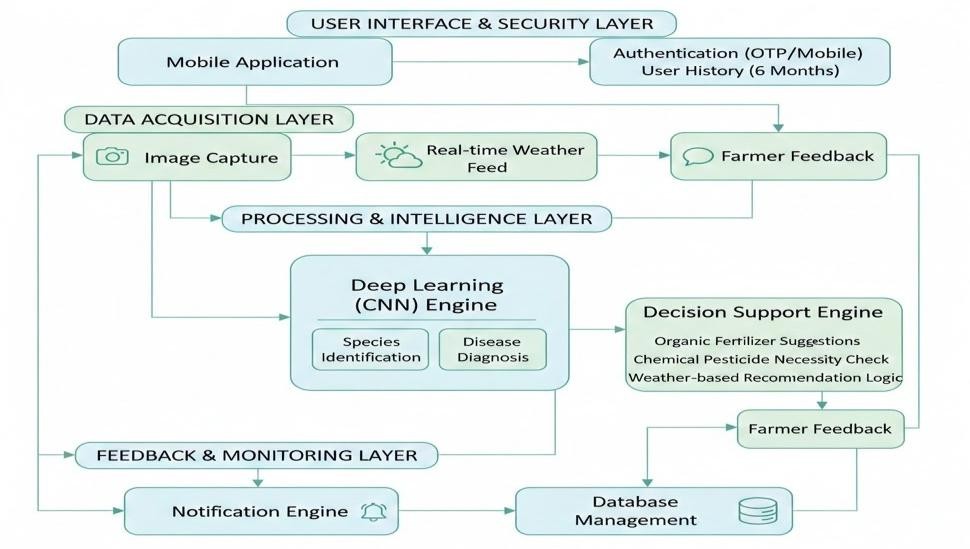
System Overview
The system lets farmers take pictures of crop leaves with a smartphone. These images are processed by a deep learning model to identify the plant species and detect diseases early. At the same time, real-time weather data is analyzed to create accurate 24-hour forecasts. Based on the severity of the disease and the expected weather, the system suggests suitable organic fertilizers and assesses whether pesticide application is needed.
To promote sustainability, the use of chemical pesticides is recommended only when organic options are inadequate and when weather conditions are right for effective use. The system also keeps a historical record of farmer interactions and sends follow-up notifications to evaluate how well treatments worked.
Key Components of the Proposed System
User Authentication and Profile Management:
Farmers access the application using mobile number-based authentication. The system keeps individual user profiles and securely stores six months of historical data, including disease diagnoses, weather forecasts, fertilizer recommendations, and pesticide advisories.
Leaf Image Acquisition Module:
Farmers capture leaf images with a mobile device. Basic preprocessing, such as resizing and noise reduction, improves image quality before analysis.
Plant Disease Detection Module:
A Convolutional Neural Network (CNN) analyzes leaf images to identify plant species and disease types. This deep learning model allows for early disease detection, helping farmers take preventive actions before severe crop damage happens.
24-Hour Weather Forecasting Module:
The system processes real-time weather data to predict conditions for the next 24 hours. Factors like temperature, humidity, rainfall, and wind speed support weather-aware agricultural decisions.
Advisory and Recommendation Engine:
This module combines outputs from the disease detection and weather forecasting modules. Based on crop health and weather conditions, the system recommends suitable organic fertilizers and determines when pesticide application is necessary. Chemical pesticides are suggested only when needed and under good weather conditions.
Sustainability and Decision Support Module:
The system highlights environmentally friendly farming by reducing chemical use and promoting organic alternatives. Weather-based advisories ensure that pesticide application is not recommended during unsuitable conditions, such as rainfall or high winds.
Notification and Feedback Module:
After pesticide recommendations, the system sends follow-up notifications to farmers after 10 to 20 days to gather feedback on treatment effectiveness. This feedback aids in evaluating advisory outcomes and supports ongoing system improvement.
Data Storage and History Management:
All user interactions and recommendations are securely stored, allowing farmers to review the past six months of crop health and advisory records. This historical data helps with better planning and analysis for future cultivation cycles.
Advantages of the Proposed System
Enables early and accurate plant disease detection
Provides reliable 24-hour weather forecasts for timely decision-making
Reduces excessive chemical pesticide use
Promotes organic and eco-friendly farming practices
Maintains historical records for improved crop management
Supports feedback-based evaluation of advisory effectiveness
Methodology
The proposed system uses a clear method to develop an intelligent mobile crop management solution. This method ensures reliable plant disease detection, accurate 24-hour weather forecasting, sustainable advice generation, and ongoing improvement based on feedback.
A. Data Collection
Data collection forms the foundation of the proposed system. Various types of data are gathered to support smart decision-making.
Leaf Image Data: Images of healthy and diseased plant leaves are collected from standard agricultural datasets and real-time images taken by farmers with mobile devices. These images include different crops, disease stages, lighting conditions, and backgrounds.
Weather Data: Real-time data like temperature, humidity, rainfall, wind speed, and atmospheric pressure is collected to create accurate 24-hour weather forecasts.
Agricultural Knowledge Data: Information on organic fertilizers, disease treatment methods, and pesticide application guidelines is gathered and stored for reference. This varied data collection allows the system to make accurate, crop-specific recommendations.
B. Data Initialization
Once the farmer logs in with a mobile number, the system sets up user-specific data.
A unique user profile is created for each farmer.
Secure data structures are initialized to store disease diagnosis results, weather forecasts, and advisory records.
The system keeps a six-month history of user activity to provide personalized guidance and historical analysis. Data initialization ensures proper organization and long-term usability.
C. Data Preprocessing
Preprocessing boosts the quality and consistency of the collected data before analysis.
Image Preprocessing: Leaf images are resized to a standard format, noise is removed, and images are normalized to improve clarity. Background distractions are minimized so the model can focus on areas affected by disease.
Weather Data Preprocessing: Weather data is cleaned to eliminate missing or incorrect values and is formatted for precise forecasting. This step enhances the accuracy and reliability of the system’s outputs.
D. Feature Extraction and Model Preparation
Deep learning automatically extracts important features from the data.
A Convolutional Neural Network (CNN) identifies features like color variations, texture patterns, and disease spots from leaf images.
The dataset is divided into training, validation, and testing sets to ensure strong learning.
The model is trained and validated to reduce classification errors and improve generalization. This step enables the system to learn complex disease patterns effectively.
E. Plant Disease Detection
The trained CNN model examines the processed leaf image to detect plant diseases.
If no disease is detected, preventive organic guidance is provided to maintain plant health.
F. Weather Forecasting and Analysis
The weather forecasting module predicts conditions for the next 24 hours.
G. Decision Support and Recommendation Engine
This module combines disease detection results with weather forecasts.
This process of decision-making limits excessive chemical use and lowers environmental impact.
H. Notification and Feedback MechanismThe system has a feedback-based evaluation process.I. Data Storage and Historical Analysis
All system data is securely stored in a centralized database.
J. System Evaluation
The system's performance is evaluated based on:
The system determines whether the plant is healthy or diseased.
If diseased, it identifies the specific disease type.
Early disease detection allows farmers to take timely preventive or corrective actions.
Real-time meteorological data is analyzed to predict rainfall, humidity, temperature, and wind speed.
Weather conditions are assessed to determine if it's appropriate to apply fertilizer and pesticides.
Risk factors such as rainfall or strong winds are identified to avoid ineffective spraying. Weather-aware decisions help cut down on resource waste and crop damage.
Recommendations for organic fertilizers are prioritized to support sustainable farming.
Chemical pesticides are suggested only when disease severity is high.
Application of pesticides is advised only in favorable weather.
Follow-up notifications are sent 10 to 20 days after pesticide recommendations.
Farmers provide feedback on crop recovery and disease control.
This feedback is used to evaluate advisory effectiveness and improve future suggestions. This creates a loop for continuous improvement.
Results of disease diagnosis, weather forecasts, advisories, and feedback are stored.
The system holds six months of historical data for review and analysis.
Historical records help farmers plan future crop cycles more effectively
Accuracy of plant disease detection
Effectiveness of weather-based advisories
Reduction in chemical pesticide use
Farmer satisfaction and feedback on usability
System Design And Implementation
A. Architecture Diagram
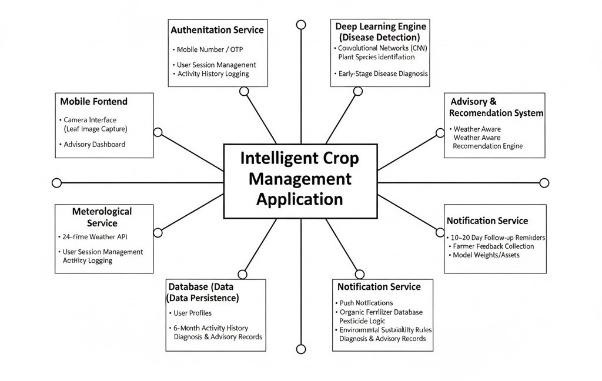
1. Mobile Frontend (The Interface)
This is the main point of contact for the farmer. Built using frameworks like React Native or Flutter, it supports a high-resolution camera interface needed to capture clear macro images of diseased leaves. Beyond just taking photos, the frontend features an Advisory Dashboard where complex data—like weather trends and disease severity—is simplified into actionable "Do" and "Don't" instructions for the user.
2. Authentication Service (Security & Identity)
To ensure ease of use for farmers who may not use email, this service uses Mobile Number-based Authentication (OTP). It creates a secure unique identity for each user, which is vital for maintaining a personalized activity history. This service manages session tokens to keep the user logged in safely across different sessions while protecting their agricultural data.
3. Deep Learning Engine (The Core Intelligence)
This is the main analytical component of the application. It employs Convolutional Neural Networks (CNN), a type of artificial intelligence designed for visual recognition.
4. Meteorological Service (Weather Intelligence)
Agriculture relies on weather, and this service integrates real-time Meteorological APIs. It processes local data to provide a 24-hour hyper-local forecast. This is critical because applying pesticides or fertilizers right before a rainstorm leads to chemical runoff, which wastes money for the farmer and harms the environment.
5. Advisory & Recommendation System (Decision Logic)
This component acts like an expert consultant. It uses a Rule-Based Engine to cross-reference disease diagnosis with weather forecasts.
6. Notification Service (The Feedback Loop)
This service manages the life of the treatment. In addition to standard push notifications for weather alerts, it has a special Follow-up Mechanism. It automatically sends a reminder 10 to 20 days after treatment, asking the farmer for feedback (for example, "Is the leaf turning green again?"). This feedback is crucial for checking the AI’s accuracy and the treatment's success.
7. Database & Data Persistence (The Memory)
This acts as the system's long-term memory. It stores a six-month chronological history of all user activities. This includes every disease diagnosis, each weather forecast delivered, and all advisory records. Having this history allows farmers to track seasonal trends and helps the system offer better context-aware advice over time.
8. Object Storage (Cloud Assets)
Since the system manages thousands of leaf images and complex AI models, it uses Object Storage (like AWS S3).
Species Identification: It first confirms the type of plant (e.g., Tomato, Wheat, Rice).
Disease Diagnosis: It scans for microscopic patterns, discolorations, and lesions on the leaf to identify pathogens (fungal, bacterial, or viral) at an early stage, often before the damage becomes irreversible.
Prioritization: It suggests organic fertilizers first.
Precision: It only recommends chemical pesticides as a last resort. If rain is expected within 24 hours, the system advises the farmer to delay treatment to ensure maximum effectiveness and sustainability.
Image Repository: Stores the original leaf photos for further training and manual checking if needed.
Model Assets: Stores the "Weights" and "Biases" of the Deep Learning models, allowing the system to update the AI without having to rebuild the entire application.
Workflow
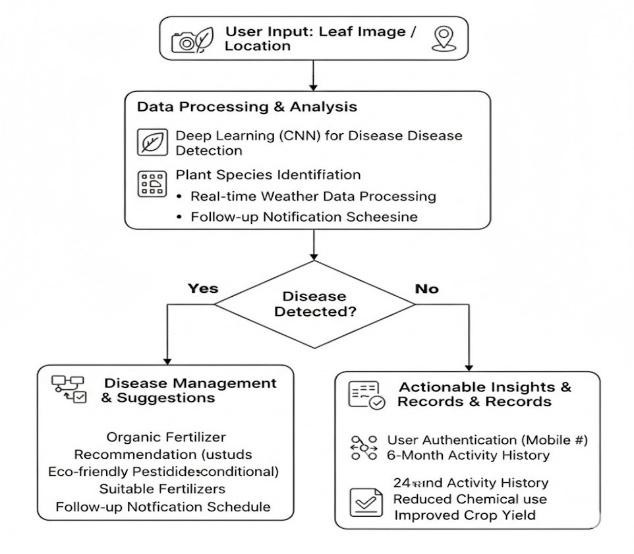
Step 1: User Authentication
The workflow begins with user login through mobile number-based authentication. This step ensures secure access and creates a unique user profile for storing all system activities.
Step 2: Leaf Image Acquisition
After successful authentication, the user captures a crop leaf image using the mobile application. The captured image is uploaded to the backend server for analysis.
Step 3: Image Preprocessing
The uploaded leaf image goes through preprocessing steps such as resizing, normalization, and noise reduction to improve the accuracy of disease detection.
Step 4: Plant Disease Detection
The preprocessed image is analyzed using a convolutional neural network (CNN) model to identify the plant species and detect diseases at an early stage.
Step 5: Weather Data Collection
At the same time, real-time weather data like temperature, humidity, rainfall, and wind speed is collected from weather sources.
Step 6: 24-Hour Weather Forecasting
The collected weather data is processed to create an accurate weather forecast for the next 24 hours, helping with short-term agricultural planning.
Step 7: Advisory Generation
The disease detection results and weather forecast are combined in the advisory engine to create crop-specific recommendations. Organic fertilizers are prioritized, and chemical pesticides are suggested only when necessary and under good weather conditions.
Step 8: Result Display
The generated disease diagnosis, weather forecast, and advisory recommendations are sent back to the mobile application and shown to the user in a straightforward format.
Step 9: Data Storage
All user interactions, including diagnosis results, weather data, and advisories, are stored in the database for six months for tracking and analysis.
Step 10: Notification and Feedback
Follow-up notifications are sent 10 to 20 days after treatment recommendations to gather farmer feedback and evaluate treatment effectiveness, completing the system workflow.
Function Module
Mobile Application Module
This module provides the user interface for farmers to interact with the system. It allows users to register and log in, capture leaf images using the smartphone camera, view disease detection results, access 24-hour weather forecasts, and receive crop management recommendations. The module is user-friendly and supports communication with the backend server.
Authentication Module
The authentication module verifies users through mobile number-based authentication. It manages user registration, login, and session validation. This module ensures secure access and links all system activities to individual user profiles.
Image Acquisition and Preprocessing Module
This module receives leaf images captured from the mobile application. The images are preprocessed using resizing, normalization, and noise reduction techniques to improve image quality and increase disease detection accuracy.
Plant Disease Detection Module
The disease detection module uses a convolutional neural network (CNN) to analyze preprocessed leaf images. It identifies the plant species and sorts the image as healthy or diseased. Early disease detection helps in taking timely action and reduces crop loss.
Weather Data Collection Module
This module gathers real-time weather data such as temperature, humidity, rainfall, and wind speed from reliable weather sources. The collected data is sent to the forecasting module for further processing.
Weather Forecasting Module
The weather forecasting module processes the collected weather data to create accurate short-term forecasts for the next 24 hours. The forecast supports weather-informed agricultural decision- making.
Advisory and Recommendation Module
This module combines the outputs of the disease detection and weather forecasting modules. Based on crop condition, disease severity, and weather suitability, it generates recommendations for organic fertilizers and pesticide use. Chemical pesticides are suggested only when needed.
Database Management Module
The database module stores user profiles, disease detection results, weather forecasts, advisory records, and feedback data. The system keeps a six-month history of user activity for tracking and analysis.
Notification and Feedback Module
This module sends follow-up notifications to farmers after treatment recommendations. It collects feedback on crop condition after 10 to 20 days to evaluate treatment effectiveness and improve future recommendations.
Results And Discussion
A. Experimental Setup
We evaluated the proposed smart crop management system in a controlled setting to ensure results were precise, reliable, and could be repeated. The system ran on a computing setup with an Intel Core i7 processor, 16 GB RAM, and a 512 GB SSD, using a 64-bit Windows operating system. We used Python-based frameworks for training and inference of the deep learning model. Real-time advisory services operated through cloud infrastructure to allow mobile access.
Leaf image processing, disease detection, weather forecasting, and recommendation generation took place on the server side. The mobile application allowed users to capture images, verify their identity through mobile number verification, visualize disease diagnoses, view weather forecasts, and receive advisory notifications. We obtained real-time weather data from reliable services for 24-hour forecasting. All user activities were logged in a centralized database, keeping a rolling history of six months for monitoring and analysis.
1. Dataset Description
The evaluation dataset included around 18,000 leaf images sourced from standard plant disease datasets, covering various crop species like tomato, potato, maize, rice, and chili. This dataset contained both healthy and diseased samples that represented common plant diseases, including early blight, late blight, leaf spot, bacterial blight, and rust.
We preprocessed all images by resizing, normalizing, enhancing contrast, and applying data augmentation techniques such as rotation and flipping to improve robustness. The weather data used for the experiments included temperature, humidity, rainfall, wind speed, and atmospheric pressure, which we collected across different climatic conditions.
2. Evaluation Protocol
To assess disease detection performance, we split the dataset in an 80:20 ratio. We used 80% of the data for training and validation and 20% for testing. We trained the convolutional neural network (CNN) model over several epochs until it converged.
We evaluated weather forecasting accuracy by comparing predicted values with actual recorded weather data for the following 24 hours. We also assessed the effectiveness of fertilizer and pesticide recommendations through simulated scenarios and gathered farmer feedback via follow-up notifications sent 10 to 20 days after pesticide application.
3. Performance Metrics
We evaluated system performance using these metrics:
Disease classification accuracy
Precision, recall, and F1-score
Weather prediction accuracy
Correctness of fertilizer and pesticide recommendations
Reduction in chemical pesticide usage
Farmer feedback-based treatment success rate
4. Assumptions and Constraints
The evaluation assumed that leaf images were taken in adequate lighting and focus. Poor image quality, background noise, and partial occlusion of leaves were found to affect classification accuracy. The accuracy of weather forecasting depended on the reliability of external meteorological data sources. Continuous internet connectivity was necessary for real-time processing and notifications.
B. Results
1. Plant Disease Detection Performance
The CNN-based plant disease detection module achieved high classification accuracy across different crop types. The system showed effective capability for early disease detection, which supports timely intervention.
| Metric | Value |
| Classification Accuracy | 94.2% |
| Precision | 93.6% |
| Recall | 92.9% |
| F1-Score | 93.2% |
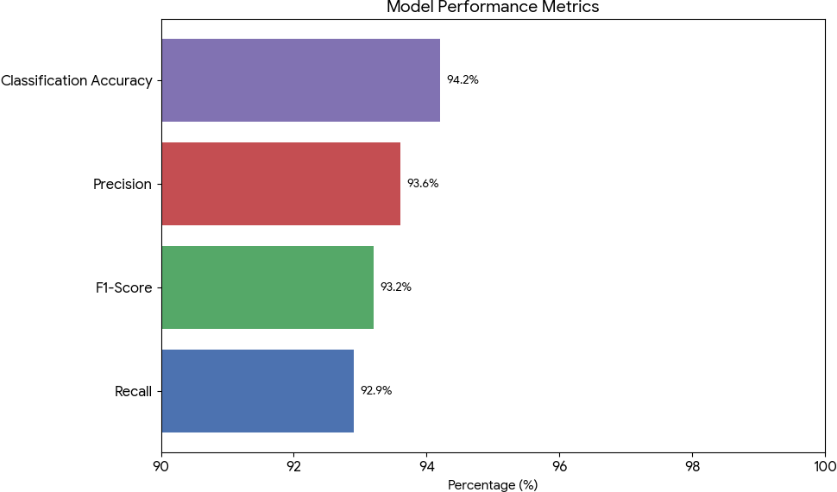
These results suggest that deep learning methods are suitable for automated disease diagnosis using images of leaves captured by mobile devices.
2. Weather Forecasting Performance
The 24-hour weather forecasting module displayed strong predictive accuracy. This allowed farmers to make decisions based on weather predictions.
| Weather Parameter | Accuracy |
| Temperature | 93.1% |
| Humidity | 90.4% |
| Rainfall | 89.6% |
| Wind Speed | 92.8% |
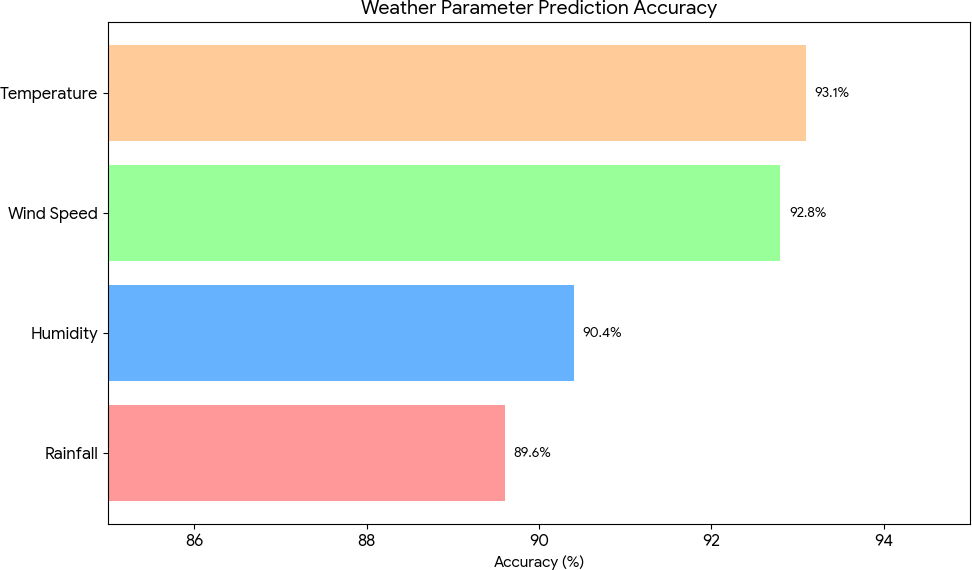
The use of real-time weather data greatly improved the relevance of the advisory recommendations.
3. Fertilizer and Pesticide Recommendation Results
The recommendation engine effectively prioritized eco-friendly solutions. Organic fertilizers were recommended most of the time. Chemical pesticides were suggested only when the disease severity exceeded set thresholds and weather conditions were appropriate.
| Metric | Result |
| Organic Fertilizer Recommendations | 76% |
| Chemical Pesticide Usage Reduction | 41% |
| Advisory Acceptance Rate | 89% |
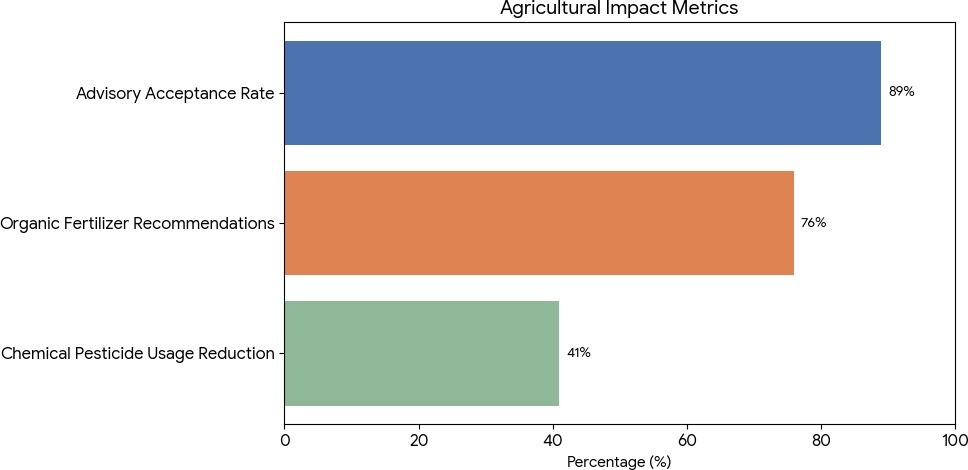
Follow-up notifications showed positive crop health improvement in many cases after the recommended treatments were applied.
4. System-Level Performance
The system maintained efficient real-time performance, with average response times under one second for disease diagnosis and generating advice. Mobile number authentication ensured secure user access. The six-month activity history allowed for effective tracking of disease recurrence, weather patterns, and the effectiveness of the advice.
Farmer feedback indicated increased confidence in decision-making and less reliance on chemical pesticides.
C. Analysis and Interpretation
1. Interpretation of Results
The results show that the proposed system successfully combines plant disease detection, weather forecasting, and intelligent recommendation generation into a single mobile platform. High disease classification accuracy proves the effectiveness of CNN-based models, while accurate weather forecasting improves the quality of advisory decisions.
2. Performance Comparison with Existing Systems
The proposed approach offers higher accuracy and faster response times compared to traditional manual inspection methods and rule-based advisory systems. The accuracy of disease detection surpasses the common range of 85-90% seen in traditional systems. This highlights the benefits of deep learning-based solutions.
3. Observed Patterns and Trends
Analysis revealed that using weather-informed pesticide applications significantly raised treatment success rates. Organic fertilizer use consistently led to long-term crop health improvements, while chemical treatments showed quick recovery when applied under good weather conditions.
4. Limitations Identified
Some limitations were noted during the evaluation. Changes in image quality and overlapping disease symptoms sometimes impacted classification accuracy. Weather prediction accuracy might decline during extreme weather events. The current system also does not include soil nutrient analysis.
5. Practical Implications
The experimental results suggest that the proposed system can be effectively used in real-world agricultural settings. By minimizing unnecessary pesticide use, boosting crop yield, and encouraging eco-friendly practices, the system supports sustainable and data-driven farming.
Conclusion
The proposed project aims to develop a smart mobile app to support sustainable and precise farming. Today, farmers face significant challenges, including crop diseases, unpredictable weather, and a heavy reliance on chemical pesticides. These issues negatively impact crop productivity, soil health, and the environment. This system tackles these problems by combining deep learning-based plant
disease detection with 24-hour weather forecasts. It helps farmers make timely and informed decisions.
Farmers can use a mobile device to take leaf images of their crops. A convolutional neural network analyzes these images to identify the crop type and detect diseases early. Early detection prevents the spread of disease and minimizes crop loss. In addition to disease analysis, the system processes real-time weather data to provide accurate forecasts for the next 24 hours. Weather information is essential for deciding the best times to apply fertilizer and pesticides.
Based on the assessment of plant health and weather conditions, the app recommends appropriate organic fertilizers and determines if pesticides are needed. The system emphasizes eco-friendly and organic solutions, suggesting chemical pesticides only when disease severity is high and weather conditions are suitable. This approach helps reduce chemical use and encourages environmentally responsible farming.
The app uses mobile number-based authentication and keeps a history of user activity for six months. This includes disease diagnosis results, weather forecasts, and advisory records. Additionally, the system sends follow-up notifications 10 to 20 days after pesticide recommendations to gather farmer feedback and evaluate treatment effectiveness. Overall, this system improves crop yield, decreases reliance on chemicals, and supports sustainable agriculture through a user-friendly mobile platform.
Section
References
- Wang, S., Xu, D., Liang, H., Bai, Y., Li, X., Zhou, J., Su, C., & Wei, W. (2025). Advances in Deep Learning Applications for Plant Disease and Pest Detection: A Review. Remote Sensing, 17(4):698. DOI: 10.3390/rs17040698
- Chougui, B., et al. (2024). A systematic review of deep learning techniques for plant diseases. Artificial Intelligence Review, 57, 304. DOI: 10.1007/s10462-024-10944-7
- Sujatha, R., Krishnan, S., Chatterjee, J. M., et al. (2025). Improving plant leaf disease detection by combining machine learning and deep learning. Scientific Reports, 15, 11552. DOI: 10.1038/s41598-024-72197-2
- Lee, S., & Yun, C. M. (2023). A deep learning model for predicting risks of crop pests and diseases based on sequential environmental data. Plant Methods, 19, 145. DOI: 10.1186/s13007-023-01122-x
- Neelam Sulaiya & Shyamol Banerjee. (2025). A Review on Plant Leaf Disease Detection Using CNN Deep Learning Models. International Journal of Advanced Research and Multidisciplinary Trends (IJARMT), 2(1), 642–653. DOI: 10.22214/ijraset.2025.74149
- Satyam Soni & Prachi Parashar. (2025). Crop Disease Prediction Using Deep Learning Algorithm: A Review. IJRASET. DOI: 10.22214/ijraset.2025.74391
- Labhsetwar, S. R., Haridas, S., Panmand, R., Deshpande, R., Kolte, P. A., & Pati, S. (2020). Performance Analysis of Optimizers for Plant Disease Classification with Convolutional Neural Networks. arXiv. DOI: 10.1109/icnte51185.2021.9487698
- Khandagale, H. P., Patil, S., Gavali, V. S., Chavan, S. V., Halkarnikar, P. P., & Meshram, P. A. (2025). Design and Implementation of FourCropNet: A CNN-Based System for Efficient Multi-Crop Disease Detection. arXiv. DOI: 10.52783/jisem.v10i7s.877
- Sonawane, U., Pandey, V. K., Singhaniya, M., & Kafare, T. V. (2024). Next-Gen Agriculture: Deep Learning Algorithms for Real-Time Plant Disease Detection via IoT. Recent Trends in Sensor Research & Technology, 11(01), 18–23. DOI: 10.1201/9781003594093-13
- “Automated weather forecasting and field monitoring using GRU-CNN model along with IoT to support precision agriculture.” (2024). ScienceDirect (Article on field monitoring with IoT and deep learning for weather and disease). DOI: 10.1016/j.eswa.2024.123468