
Abstract
The provision of environmentally friendly and reliable power is crucial for advancing healthcare, education, and stimulating local economic development in Nigeria. Thus, the study focuses on the design of reliable and efficient hybrid renewable energy using photovoltaic and wind turbines system for Oron communities. Studies have shown that hybrid renewable energy is a viable solution for both urban and rural electrification. The system is designed by considering various parameters such as: inverter rating, size of PV arrays, number of batteries, wind turbine and height. Hybrid Optimization Model Electrification Renewable (HOMER) software was used in the design to determine the optimum load and daily consumption rate required based on the data generated from NIMET and HOMER. The outcome of the energy system for Oron community is modelled to accommodate a peak load of 11111.56kW with daily consumption rate of 8900kW, and excess energy of 4300kW/ yr. This requirement is satisfied by 20 wind turbines height of 65m at 2.35m/s wind speed to generate 4500kW/yr and PV array of 88,715 panels of 350watts each. The total battery required is 89,535.7kwh and 13000 kW converters to meet load demands. This study therefore reveals a viable and cost effective method of providing stable rural electrification to overcome power outage in Oron communities.
Keywords
Hybrid renewable energy HOMER Wind/ Photovoltaic system
1. Introduction
The need for affordable, reliable and sustainable energy is of great necessity to human, since human activities depend on energy for various applications such as: cooking, lightings etc. Provision of this environmentally friendly electrification is crucial for advancing healthcare, education and stimulating local economic development. Nigeria as a country has been suffering from shortage of electricity, making its rural communities to be in total blackout [9]. A typical community that faced this scenario is Oron community. Majority of the individuals who reside in this rural region face limited supply of power for their daily activities from the national grid. Despite the effort of the Akwa Ibom State Government in connecting this remote area to the national grid, the energy supply is still not enough to meet their demands as supply comes in one or two days within a week.
This problem has made citizens to make use of conventional sources of generating electricity. Researchers and energy experts are exploring new alternatives to support the power that comes from the national grid and at the same time reduce the effects of using fossil fuels that cause environmental hazards [7]. The current alternative sources that can proffer solution to this epileptic power supply and environmental degradation include; solar, geothermal, wind, tidal, hydro power among others.
Oron community is located in a coaster area and it is blessed with abundant winds and solar energy but sunlight is not consistent throughout the year, giving room to hybrid renewable energy. These numerous available renewable energy sources make the community to be suitable for this study. Hybrid Renewable Energy System (HRES) combines two or more renewable energies sources to improves reliability on power generation [12].
Current studies have unveiled the efficacy of using HRES in rural and urban electrification in Nigeria and beyond. For instance, HRES for sustainable power supply was developed by employing wind and solar in Minna, Lokoja, Abuja, Markurdi, Ilorin and Jos [20]. The results revealed that the hybrid system was suitable and beneficial to standalone wind energy system and photovoltaic in Makurdi, Ilorin, Abuja, and Lokoja. In a similar case, Isiaka et.al (2019) also used HOMER 3.4.3 simulation tool for power generation in Bayero University, Kano. The output of the process unveiled that the renewable energy comprising of diesel generators, PV, wind turbine, are optimal in terms of reliability, economy and efficiency. The technical feasibility of an optimal hybrid renewable energy system, designed for the rural electrification of an off-grid community of Edem Urua, a remote village located in the southern part of Nigeria was also examined. Mathematical modelling method and energy resources such as solar, wind, diesel-generator and battery were employed. The simulation and optimization were carried out using the HOMER analysis tool. The results of the analysis revealed that three optimal system configurations; Solar/DieselGenerator/Battery-Bank, Solar/wind/Diesel-Generator/Battery-Bank and Solar/Wind/Battery-Bank were the most cost effective and technically preferred solutions [14].
In another development, Lanre et al (2023) solved the problem of power outage in healthcare centres of Agbalaenyi, Okuru-Ama, Ejioku, Doso, Kadassaka and Damare-Polo in Nigeria using solar, diesel and wind energy sources. The outcome of the investigation shows that the combination of solar and wind energy are cost effective. Nurudeen et al (2025) also combined two renewable energy sources namely; wind and solar energy in Kano municipal. Weibull distribution through the standard deviation method was applied for ten years data. The solar and the turbine generated 2.335 kWh and 1.104 kWh respectively.
Nevertheless, ([1]; [18]; [21]; [5]; [2]; [10]) also focused their designs on wind and photovoltaic system in order to provide stable power for rural dwellers. Consequently, the review shows that researchers have done their best by providing a reliable power for major cities in Nigeria without considering the rural communities like Oron, which suffers epileptic power supply from the national grid. Thus, this study focused on proffering solution to this problem by modelling a viable hybrid renewable system for this community.
2 Methodology
Materials
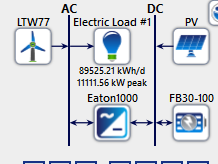
HOMER 3.4.3 simulation tool was used for the power generation. The system was designed using wind turbine, photovoltaic (PV) arrays with power converters and batteries. The battery functions as a backup unit and serves as a storage system.
2.1.1Project SiteInformation
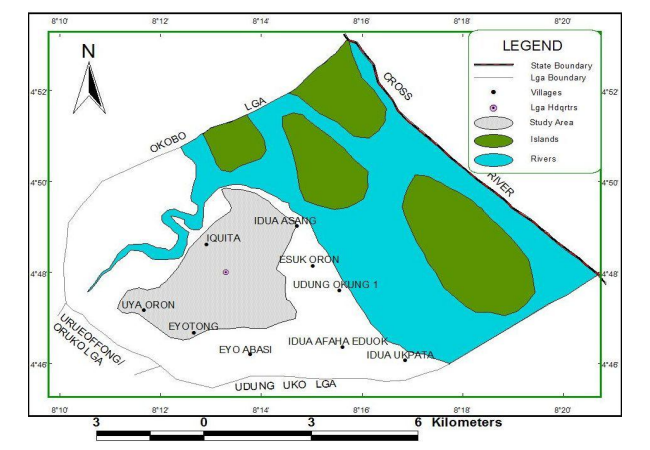
Oron is one of the major cities in Akwa Ibom State, Nigeria with an estimated population of 87,209. This comprised of five (5) communities namely; Eyo Abasi, Uya Oro, Eyetong, Idua and Iquita. Figure 1, shows the map of Oron local government, located between longitude of 8.26⁰E and latitude 4.80⁰N at the right bank of the lower Estuary of the Cross River [4]. It is located at a coastal region which is characterized by costal estuarine topography with creeks mangrove and general low-lying sometime undulating land. There are fewer tall obstructions such as trees, hill and mountains which allowed good exposure to sun light and wind speed.
2.1.2 Meteorological Data: The data used for the area under study was gotten from Nigeria meteorological Agency (NIMET). The data employed include; wind speed and solar irradiance data.
2.1.2.1 Wind Speed Data
The data utilized was extracted from NIMET site, which has an annual average wind speed of 2.25m/s for three years and four months as revealed in Table 1.
| YEARSMONTHS | 2021Average wind speed in (m/s) | 2022Average wind speed in (m/s) | 2023Average wind speed in (m/s) | 2024Average wind speed in (m/s) |
| January | 2.530 | 2.540 | 2.530 | 2.510 |
| February | 2.590 | 2.530 | 2.590 | 2.490 |
| March | 2.430 | 2.590 | 2.430 | 2.390 |
| April | 2.020 | 2.430 | 2.020 | 2.060 |
| May | 2.360 | 2.020 | 2.360 | |
| June | 2.380 | 2.360 | 2.380 | |
| July | 2.500 | 2.380 | 2.500 | |
| August | 2.300 | 2.500 | 2.300 | |
| September | 2.080 | 2.300 | 2.180 | |
| October | 1.770 | 1.870 | 1.960 | |
| November | 1.860 | 1.960 | 1.880 | |
| December | 2.150 | 2.080 | 2.060 |
2.1.2.2 Solar Data
Table 2 shows the solar resources data that encompasses the average daily global solar radiation and average clearness index by taking into account the effect of temperature throughout the year.
| YEARS/MON-THS | 2021 Clear-ance Index | Average daily Radia-tion(kWh/m2/day) | 2022 Clear-ance Index | Average daily Radia-tion(kWh/m2/ day) | 2023Clear-ance Index | Average daily Radia-tion(kWh/m2/ day) | 2024 Clear-ance Index | Average daily Radia-tion(kWh/m2/ day) |
| Jan | 0.590 | 5.630 | 0.596 | 5.610 | 0.591 | 5.620 | 0.611 | 5.810 |
| Feb | 0.566 | 5.670 | 0.563 | 5.650 | 0.565 | 5.670 | 0.576 | 5.770 |
| March | 0.516 | 5.350 | 0.518 | 5.370 | 0.515 | 5.360 | 0.514 | 5.350 |
| April | 0.491 | 5.100 | 0.493 | 5.080 | 0.492 | 5.100 | 0.480 | 4.990 |
| May | 0.481 | 4.770 | 0.480 | 4.790 | 0.475 | 4.780 | ||
| June | 0.446 | 4.360 | 0.445 | 4.350 | 0.444 | 4.360 | ||
| July | 0.395 | 3.890 | 0.391 | 3.880 | 0.393 | 3.890 | ||
| August | 0.360 | 3.680 | 0.361 | 3.700 | 0.361 | 3.690 | ||
| Sept | 0.389 | 4.050 | 0.387 | 4.020 | 0.388 | 4.010 | ||
| October | 0.429 | 4.310 | 0.430 | 4.330 | 0.429 | 4.320 | ||
| Nov | 0.510 | 4.910 | 0.507 | 4.850 | 0.506 | 4.840 | ||
| Dec | 0.520 | 4.850 | 0.510 | 4.860 | 0.507 | 4.830 |
2.1.3System Load Data
Energy audit was carried out via questionnaire. Five hundred and twenty (8,621) questionnaires were used to gather information on the numbers of residential buildings, commercial buildings, schools, hospitals and health centers with their electrical appliances and ratings for the five (5) communities that make Oron nation.
2.2 Temperature Data
Table 3 unveils the temperatures of the selected site location.
| S/N | MONTH | 2019 | 2020 | 2021 | 2022 | 2023 | 2024 |
| 1 | January | 32.3e= | 33.1e= | 32.3e= | 30.6e= | 31.2e= | 31.2e= |
| 2 | February | 29.5e= | 28.8e= | 30.2e= | 29.5e= | 28.3e= | 28.7e= |
| 3 | March | 27e= | 28.6e= | 29. 8e= | 27.7e= | 28.4e= | 28.6e= |
| 4 | April | 27e= | 27.6e= | 27.7e= | 27.6e= | 27,2e= | 27.6e= |
| 5 | May | 26e= | 25.5e= | 26.5e= | 26.4e= | 25.6e= | 26.6e= |
| 6 | June | 25e= | 26.5e= | 25.9e= | 26.5e= | 25.8e= | 26.5e= |
| 7 | July | 24e= | 25.2e= | 24.8e= | 24.6e= | 23.3e= | 24.7e= |
| 8 | August | 24e= | 24.6e= | 23.5e= | 24.7e= | 23.8e= | 24.5e= |
| 9 | September | 25e= | 24,5e= | 25.5e= | 24.1e= | 25.6e= | 25.4e= |
| 10 | October | 25e= | 27.5e= | 25.5e= | 26.5e= | 26.5e= | 25.5e= |
| 11 | November | 29e= | 28.5e= | 29.1e= | 28.2e= | 27.5e= | 27.6e= |
| 12 | December | 30.3e= | 29.2e= | 28.4e= | 29.6e= | 30.1e= | 29.7e= |
Methods
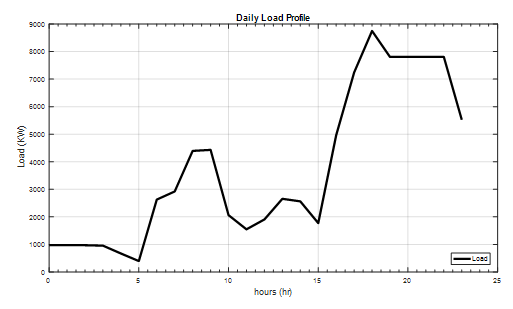
HOMER software was utilized to ascertain the operational strategy and optimal sizing of the system. This is achieved by making energy balance calculation in each hourly time step of the year. In each time step, HOMER compares the energy demand and calculates the energy that flow to and fro from each component of the system. The energy balance calculation is performed by HOMER for each system configurations that were considered. It then determines whether the configuration meets energy demand under the specified conditions, estimates the cost of installation and operates the system over the project life cycle. The hourly and daily load profile for the site under review is shown in Table 3 and Figure 2.
| Hour | Load (kW) |
| 00 | 972.190 |
| 01 | 972.190 |
| 02 | 972.190 |
| 03 | 956.440 |
| 04 | 671.350 |
| 05 | 396.220 |
| 06 | 2627.630 |
| 07 | 2923.020 |
| 08 | 4394.590 |
| 09 | 4431.930 |
| 10 | 2064.180 |
| 11 | 1548.410 |
| 12 | 1906.660 |
| 13 | 2656.250 |
| 14 | 2563.350 |
| 15 | 1773.800 |
| 16 | 4965.130 |
| 17 | 7241.990 |
| 18 | 7804.160 |
| 19 | 8748.890 |
| 20 | 7804.160 |
| 21 | 7804.160 |
| 22 | 7804.160 |
| 23 | 5522.170 |
2.2.2Sensitivity Analysis
This analysis was examined for each of the components that make up the HRES to ascertain the number of components required to meet up the load demands.
2.2.2Design of Solar and Wind System
i) Power for PV is determined by using equation 1:
P=〖Ins〗_t × A×Eff(pv)
Where:
P = power
〖Ins〗_t= insolation time
A = area of single PV panel
Eff(pv) = overall efficiency of the PV panels and converters.
ii) The overall efficiency is shown in equation 2:
Eff(pv)= e=2
Where:
H = annual average solar radiation on tilted panels.
P_R = performance ratio
iii) The numerical methods of wind energy
Wind energy density was used to measure the volume of the region's wind energy resources by using equation 3:
P=〖1/2 ρV〗^3
Where:
ρ = air density kg/m3,
V = is the wind speed (m/s).
The air density was also calculated by employing equation:
ρ=[1.276(1+0.00336T)]×[(P-0.378e)1000]
Where:
P = monthly average atmospheric pressure
T = monthly average temperature
e= absolute humidity
2. 4 EconomicData
The cash flow summary contains capital cost of N311,952,575,250.00, Replacement cost of N44,408,022,474.66, salvage cost N24,941,239,369.13 and operational and maintenance (O&M) cost of N10,916,416,546.01. This revealed that the system is designed to bring return of investment after 20 years.
3. Results and discussion
3.1Simulation output
The HRES for the Oron community in Figure 3 consists of primary alternative current load of 89,525.2 kWh daily, and a peak load of 11111.56kW. The HOMER software determines the best possible configuration for the hybrid renewable energy system.
The power consumption is unveiled in Table 4. The simulation process gave a primary load of 32,676,701 kWh per year and there was no deferrable and D.C load in the system. However, Table 5, also indicated that 4,315,059 kW/yr is an excess electricity energy generated. This value represents 8.99 % of total energy generated and will be used for an expansion when required.
| Consumption | kWh/yr | Percentage (%) |
| AC primary load | 32,676,701 | 100 |
| DC primary load | 0 | 0 |
| Deferable loadTotal | 032,676,701 | 0100 |
| Quantity | kWh/yr | Percentage (%) |
| Excess electricity | 4,315,059 | 8.99 |
| Unmet electric load | 0 | 0.0 |
| Capacity shortage | 0 | 0.0 |
Table 6, revealed the electricity generated by each component. The generic flat plate generated (PV) 43,433,670kWh/year which represents 90.5 % while the Leitwind 77 generates 4,565,587kWh/yr which indicates 9.5 %.
| Component | kWh/yr | Percentage (%) |
| Generic flat plate (PV) | 43,433,670 | 90.5 |
| Leitwind 77 (wind turbine) | 4,565,587 | 9.5 |
| Total | 47,999,257 | 100 |
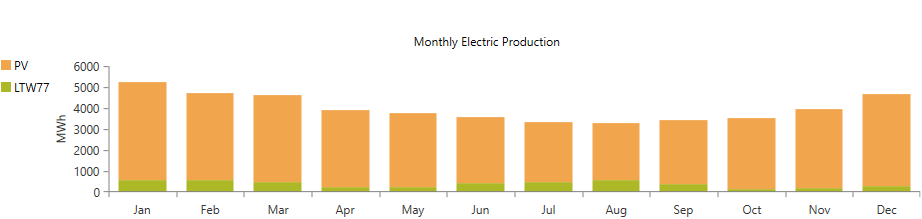
Moreover, Figure 4 represents the monthly electric power generation for Oron local government area.
3.2 Cost Comparisonof Hybrid, Grid and Household Generators
Table 7 shows the cost of energy consumption for three consecutive sources of energy for the year 2024 in Oron. The hybrid energy provides 24 hours, grid average of 2hours and 30 minutes, and household generator average of 4 hours throughout the year.
| Months | Cost of HRES (N ) | Cost of using grid (N) | Cost of running generator (N) |
| January | 2,644,884,741.03 | 129,220,746.09 | 45,206,179.24 |
| February | 2,512,639,653.76 | 127,654,431.01 | 44,302,057.97 |
| March | 2,380,395,128.35 | 127,915,494.54 | 43,397,936.69 |
| April | 2,248,151,263.26 | 210,302,124.22 | 44,703,471.13 |
| May | 349,654,590.90 | 126,610,226.47 | 43,849,765.98 |
| June | 1,983,662,890.64 | 125,305,966.43 | 43,387,936.69 |
| July | 1,586,930,305.90 | 126,349,179.46 | 42,945,876.06 |
| August | 1,586,930,305.90 | 123,999,706.85 | 43,171,906.38 |
| September | 1,983,662,890.64 | 126,610,226,47 | 42,719,845.74 |
| October | 1,983,662,890.64 | 127,654,431.01 | 43,036,284.88 |
| November | 2,248,151263.94 | 127,915,478.02 | 45,206,179.24 |
| December | 2,380,395,128.35 | 130,526,014.17 | 45,658,239.87 |
| Total | 23,505,998,392.89 | 1,528,676,271.26 | 528,098,272.28 |
3.3Comparative Analysis of Results Using Artificial Neural network (ANN)
The result obtained from the optimization using ANN, shows N 811.391 against N810.56 being obtained from HOMER as LCOE. Comparing the values demystified that the ANN result is close to 1, which depicts that the ANN performed better than HOMER. The results of the regression model from ANN gives 0.99961, 0.9994, and 0.9992 for training, test and validation processes respectively.
4. Conclusion
The study employed HOMER software in renewable energy modelling for Oron electrification. The results show a peak load of 11MW/h with daily consumption rate of 89525.21kWh and excess energy of 4,315,059kWh/ yr. This implies that the system requires 20 wind turbines, height of 65m at 2.35m/s wind speed, PV array of 88,715 panels of 350 watts each or array of 77,625 panels of 400watts are required. In addition, 89,535.7kwh batteries and 13000 kW converters are also needed for the renewable energy to meet load demands. The system ensured that there are no unmet loads and the excess energy is at acceptable minimum. Therefore, the study shows that HRES is fit for Oron communities when compared to other sources of power by considering the environment and its resources and the cost of installation.
References
- Adejumobi I. A., Oyagbinrin S.G., Akinboro F. G., Olajide M.B. (2011). Hybrid Solar and Wind Power: An Essential for Information Communication Technology Infrastructure and People in Rural Communities. International Journal of Recent Research and Applied Studies, 9 (1): 130 -138. DOI: 10.14741/ijcet/22774106/spl.4.2016.38
- Ajao K. R, Oladosu A. and Popoola T. (2017). Using HOMER Power Optimization Software for DOI: 10.4314/jast.v16i1-2.64779
- Cost Benefit Analysis of Hybrid-Solar Power Generation Relative to Utility Cost in Nigeria. International Journal of Recent Research and Applied Studies, 1(7): 96 – 102. DOI: 10.4314/jast.v16i1-2.64779
- Beulah I. O., Bassey E. A. and Ekong D. (2019). Effects of Urban Crime on the Economic Of Oron Urban, Akwa Ibom State, Nigeria, Journal of Agricultural ,Environmental Resource and Management, 4(1): 426 - 437. DOI: 10.61090/aksujaeerd.2023.007
- Cheng L.I., Yang X., Hai-Guo H.E., Wang Z.H., and Tang W. (2016). Optimization Allocation DOI: 10.1109/cec.2016.7744133
- of Standalone Microgrid System Capacity Based on Complementary Characteristic of Wind and Solar. Chinese Journal on Renewable Energy Resources 28:109 – 115. DOI: 10.4028/www.scientific.net/amr.860-863.271
- Dunmade I. S. (2002). Indicators of Sustainability: Assessing the Suitability of a Foreign DOI: 10.1016/s0160-791x(02)00036-2
- Technology for a Developing Economy. Technology in Society, 24(4): 461- 471. DOI: 10.1016/s0160-791x(02)00036-2
- Hachimenum, N.A. (2015). Impact of Power Outages on Developing Countries: Evidence From Rural Households in Niger Delta, Nigeria. Journal of Energy Technologies and Policy, 5(3):1-13. DOI: 10.1016/j.eneco.2020.104882
- Hadi, N. A., Ateeb H., Yuhani P. W., Jubaer A., Kamyar M., San Chuin L., Zulkurnain M. DOI: 10.1007/978-981-16-9781-4_7
- (2021). Sizing and Economic Analysis of StandAlone Hybrid Photovoltaic-Wind System for Rural Electrification: A Case Study Lundu, Sarawak. Cleaner Engineering and Technology, 4: 100-191. DOI: 10.1016/j.clet.2021.100191
- Isiaka, S., Musefiu A., and Isah M. ( 2019). Design, Simulation and Optimization of a Hybrid DOI: 10.1109/iceerp49088.2019.8956985
- Renewable Energy System for Bayero University, Kano Nigeria. International Journal of Computer Trends and Technology, 67 (10): 73 – 80. DOI: 10.14445/22312803/ijctt-v67i10p113
- Kehinde, S. O., Kufre M. U., and Nseobong I. O. (2022). Design and Optimization of DOI: 10.9734/jerr/2023/v25i121055
- Hybrid Renewable Energy System for Rural Electrification of an Off-Grid Community. European Journal of Engineering and Technology, 10(1): 28 - 42. DOI: 10.14710/ijred.0.31316
- Lanre, O., Omowunmi M. L., Toyeeb A. A., James G. A., Kufre E. J. and Ahmad A. S. (2023) DOI: 10.9734/ajpr/2023/v13i4291
- Optimal Planning and Deployment of Hybrid Renewable Energy to Rural Healthcare Facilities in Nigeria. Energies, 16:1-24. DOI: 10.3390/en16217259
- Nnadi, D. B., Odeh C. I., and Omeje C. (2014). Use of Hybrid Solar-Wind Energy Generation for Remote Area Electrification In South-Eastern Nigeria. Journal of Energy in Southern Africa, 25 (2): 61- 69 DOI: 10.17159/2413-3051/2014/v25i2a2670
- Nurudeen, I., Abdullahi A., Henry D. L., Fortune V. R., Muhyideen A., and Salisu A. (2025). Design and Installation of a Solar and Wind Hybrid System n Kano State, Nigeria. American Journal of Energy and Natural Resources, 4 (1): 20 - 28. DOI: 10.54536/ajenr.v4i1.4157
- Ohijeagbon, O. D . Ajayi, O. O., Waheed, M. A., Enesi Y. S. , Festus A. O. (2019). Design of Optimal Hybrid Renewable Energy System For Sustainable Power Supply to Isolated-Grid Communities in North Central, Nigeria. 2nd International Conference on Sustainable Materials Processing and Manufacturing (SMPM 2019), Procedia Manufacturing, 35: 278 – 284. DOI: 10.1016/j.promfg.2019.05.040
- Zade, A. B. Asha G., Ku P.M. and Ganesh L. (2016). Hybrid Solar and Wind Power Generation With Grid Interconnection System for Improving Power Quality. 1st International Conference on Power Electronics, Intelligent Control and Energy Systems, 50 – 58. DOI: 10.1109/icpeices.2016.7853296