
Abstract
The cryptocurrency market is highly fragmented, with trades taking place on multiple centralized and decentralized exchanges. This fragmentation, coupled with differences in liquidity, trading volume, transaction costs, and network conditions, often results in temporary discrepancies in the price of the same cryptocurrency. The identification of potential arbitrage opportunities in this volatile and rapidly moving market is a huge challenge when real-world constraints are not considered. This study proposes a smart real-time system for identifying and analyzing the differences in cryptocurrency prices using a hybrid artificial intelligence approach. The proposed method integrates Long Short- Term Memory (LSTM) networks for analyzing price variations over time, Autoencoders and Isolation Forests for identifying anomalies in an unsupervised manner, Gradient Boosting for filtering profitable trades, and Reinforcement Learning for improving decision-making. The proposed system retrieves real-time prices from different centralized and decentralized exchanges and analyzes arbitrage opportunities by considering transaction costs, blockchain network charges, and transfer times. Experiments conducted on multi-exchange price data, data from decentralized exchanges, and blockchain network data reveal that the proposed system significantly improves the accuracy of detection and suppresses false positives compared to the conventional rule-based and single-model approaches. By integrating multiple AI approaches with real-world market assumptions, this system provides a scalable and realistic solution for cryptocurrency arbitrage detection and market analysis using AI.
Keywords
Cryptocurrency Arbitrage Anomaly Detection Deep Learning Real- Time Trading Reinforcement Learning.
Introduction:
The fast evolution of cryptocurrencies has significantly impacted global financial markets by facilitating decentralized, borderless, and continuous trading of digital assets. Unlike traditional financial markets, cryptocurrency trading is performed 24/7 on a large number of centralized exchanges (CEXs) and decentralized exchanges (DEXs), each of which has its own unique level of liquidity, trading
volume, transaction fees, and market participants. This highly fragmented market often leads to temporary inconsistencies in the price of the same cryptocurrency on different markets, thus providing an opportunity for arbitrage.
Arbitrage trading is the process of buying and selling an asset in different markets to capitalize on the price variations. In cryptocurrency markets, arbitrage opportunities may emerge duetothe timetakenforinformation distribution,imbalanced distributionof liquidity, exchange-specific limitations, and congestion in the blockchain network. But it is a challenging task to detect and execute profitable arbitrage opportunities. The high volatility of cryptocurrency prices, along with high-frequency fluctuations, and exchange- specific limitations like transaction costs, transfer times, and confirmation times, increase the risk of false alerts and unprofitable trades. In traditional rule-based and statistical arbitrage detection, there are predefined thresholds and naive assumptions that are not always effective in dynamic and non-linear markets, such as the cryptocurrency market. These techniques are not effective in adapting to the changing market conditions and tend to produce false positives in volatile markets with low liquidity. This leads to the need for more intelligent and adaptive techniques to effectively identify significant price anomalies with low risk of execution.
Recent breakthroughs in the field of artificial intelligence and machine learning have shown great promise in the analysis of financial markets, especially in tasks such as time series forecasting, anomaly detection, and decision- making under uncertainty. Techniques such as Long Short-Term Memory (LSTM) networks are very useful in modeling time dependencies in stock price sequences, while unsupervised learning algorithms such as Autoencoders and Isolation Forests are highly effective in detecting anomalies in stock prices without the need for any labeled training data. In addition, techniques such as Gradient Boosting improve the accuracy of predictions by combining the predictions of several weak models, while Reinforcement Learning allows systems to
learn how to make optimal trading decisions by interacting with the environment.
However, despite these advances, existing research is often focused on individual machine learning models or offline analysis, which makes them less applicable to real-time arbitrage detection in live cryptocurrency markets. Furthermore, existing research is often less applicable to real-world scenarios because it neglects important real-world constraints such as transaction costs, blockchain latency, and congestion. To overcome these issues, this study proposes the development of an intelligent real-time cryptocurrency price disparity detection system that combines various machine learning and artificial intelligence approaches in an integrated analytical framework. The proposed system will continuously monitor real-time cryptocurrency price information from both centralized and decentralized markets and analyze it using an AI-engineered core capable of identifying authentic price irregularities amidst noise and false positives. The proposed system combines various approaches, including temporal modelling, anomaly detection, ensemble learning, and adaptive decision- making.
The main contributions of this research are as follows:
The development of an architecture for scalable real-time data ingestion that can aggregate live price feeds from multiple cryptocurrency exchanges. Development of a hybrid framework for AI that combines LSTM networks, Autoencoders, Gradient Boosting, Isolation Forests, and Reinforcement Learning for effective price disparity and anomaly detection. The inclusion of real-world trading conditions such as transaction costs, congestion, and asset transfer times in the arbitrage calculation process. An experimental evaluation showing better accuracy and fewer false positives than the conventional and single- model methods.
Literature Review:
The growing volumes of cryptocurrency trades have given rise to extensive research into the mechanisms driving the price fluctuations,
ways to recognize the presence of 'arbitrage,' or optimizing the process itself via automated means [2], [12]. Generally, people seem to divide the earlier techniques into five broad clusters or categories – rule-based systems, statistical models, classical machine learning techniques, deep learning models, and hybrid models together with reinforcement techniques [2]. While everybody commends the advantages, all models suffer from the common drawbacks in terms of flexibility, timeliness, and viability [2], [12].
methods [12]. Nonetheless, these methods are not effective in managing time dependencies cohesively, which are part and parcel of any financial time series data, leading to diminished efficiency in a market where patterns are in constant motion.
training requirements through simulations or data sets, while the policies used might not generalize the models to unseen environments [9]. Most models in the paper operate under near-perfect assumptions.
There is also a scarcity of tools employing a multitude of AI tools from various disciplines simultaneously: time series prediction, anomalies, and adaptive decision-making [6], [9]. To fill this gap, it is evident there exists a strong demand for an intelligent, real-time, multi-model approach which incorporates deep learning, unsupervised anomaly detection, ensemble approaches, and reinforcement learning. Rather than just identifying price anomaly with a high degree of accuracy, it is also important to assess its profitability, which includes important elements like transactional fees, latency, and market changes.
Dataset:
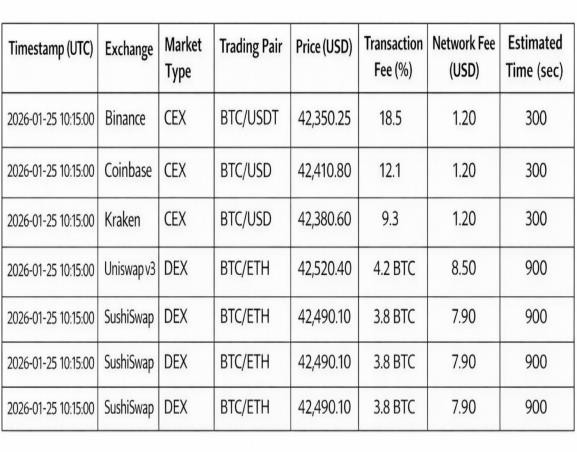
A real-time cryptocurrency dataset is constructed by continuously collecting price feeds from multiple centralized and decentralized exchanges at fixed time intervals. Each data record includes asset price, trading volume, transaction fees, network costs, and estimated transfer times. Derived features such as price spreads, net profit, and anomaly flags are computed in real time to support arbitrage detection and decision-making.
Methodology:
agreement between the two, following which flag events are passed on.
Introduction:
Rule-Based and Threshold-Based Arbitrage Systems: In general, during the initial periods, arbitrage signals relied on using specific formulas, i.e., if there was an increasing difference in price between two exchanges, a particular signal would be triggered [2], [12].This is rather simple, quick, and therefore preferred. But again, with big downsides. This type of inflexibility doesn't take into account shifts in the market and ends up with false readings, especially when market volatility increases significantly [2]. They do not factor in any trading fees, confirmation times, or congestion either, creating a big disconnect between profit potential and actual profit earned [2]. As the markets continue to progress and evolve, these flawed models continue to be ineffective.
Statistical and Econometric Methods: Methods such as cointegration, pairs trading, the mean reversion model,or the z-score-based arbitrage model have their historical antecedents in traditional finance, with the last two models being extended into the crypto domain [3], [12].These models try to capitalize on the historical relationship or deviations. Though these statistical tools provide a good mathematical basis, these methods operate on the assumption of stationarity and linearity, which may not be the case due to the volatile nature of the crypto market and the data these methods usually require, which is historical data [3].
Classical MachineLearningApproaches: However, with increasing computing power, conventional Machine Learning techniques such as Support Vector Machines (SVM), k- Nearest Neighbour’s (k-NN), Random Forest, and Gradient Boosting have been implemented to make predictions in crypto market prices and detect anomalies [8]. However, these methods have been found to be more adaptive in their nature in contrast to traditional statistical
Deep Learning-Based Methods: Particularly, deep learning for cryptocurrency markets analysis has received considerable attention due to its potential for forecasting complex patterns [5]. Long Short-Term Memory and Gated Recurrent Unit type neural networks can be used for forecasting, which can easily pick up the patterns of movement in cryptocurrency prices [4], [13]. Convolutional Neural Networks are also used for feature extraction in the market data, which has been pre-processed for analysis [5]. Nevertheless, in spite of these exceptional predictive capabilities, the application of deep learning models faces several disadvantages, which include the computationally intensive nature of these models, making it more challenging to program these models in real time [5]. It may also easily overfit the market data, especially when it is insufficient in nature. It has also been seen that the majority of the studies done in this area only consider the predictive features in terms of prices, leaving the arbitrage signals aside.
Anomaly Detection Techniques: Unsupervised models such as Autoencoders, Isolation Forest, and One-class SVM have also been employed to identify unusual movements or quirks within the prices, especially within the crypto markets due to the lack of labelled data on abnormalities [6], [7].Anomalies, however, present a problem because without the support of prediction or decision-making models, the models cannot distinguish between noise and real arbitrage opportunities, especially with the chances of massive false positive rates, including the identification of unfruitful price moves as profitable [6].
Reinforcement Learning in Cryptocurrency Trading: Reinforcement Learning is widely used in automated trading, where intelligent agents learn good strategies through interactions in the environment [9], [10]. As the environment changes, the models perform optimistically, relying on long-term rewards rather than short-term profits. Despite the presence of Reinforcement Learning in automated trading, there are key challenges in the model. These challenges include the large
Research Gaps and Motivation: From a careful perusal of the extant literature, several gaps have also come to attention [2], [12]. For example, several of the existing systems concentrate on a singular model-based approach and offline analysis. This compromises the robust nature of such systems when exposed to live cryptocurrency market scenarios. Some of the models have also oversimplified assumptions of trading scenarios; hence, a disconnect occurs when they are executed live.
Data Collection & Pre-processing: Periodically, we retrieve real-time price information from varied combinations of centralized and decentralized exchanges. Each data entry represents the asset's price information, traded volumes, fees associated with the transaction, fees associated with the network, and the transfer time required to transfer the asset from one node to another. First, we access the timestamp information associated with the provided data sets. We also normalize the features associated with the dataset using the min-max normalization method.
FeatureEngineering:The raw market data is converted to derivative measures to aid the arbitrage detection. The derivatives include the calculation of the asset spread between multiple exchanges, as well as obtaining volatility measures, normalized volumes, total costs, and net profits.
Time-Series Price Modelling: Historical prices help train the LSTM networks to recognize temporal dependencies and short- term trends. These predicted prices, in turn, offer some context that can help distinguish actual price anomalies from the usual noise. Anomaly We use unsupervised algorithms for detecting unusual price gaps. Auto Encoders detect anomalies based on the difference in error, while Isolation Forest uses feature partitioning. The ensemble method demands
Anomaly Detection: We will apply unsupervised learning to identify uncommon price gaps using autoencoders and an isolation forest. Autoencoders detect anomalies based on reconstruction error, and Isolation Forests isolate outliers by segmenting features. We will then combine the outputs using an ensemble approach: only those anomalies flagged by both models move forward for deeper analysis.
Predictive Opportunity Filtering: Gradient Boosting models determine if the anomalies detected can be profitable. It weighs the price spreads against trading volume, volatility, transaction costs, and latency in determining whether an opportunity is viable or not.
ReinforcementLearning-BasedDecision Optimization: A Reinforcement Learning agent is presented in an online manner to fine- tune the arbitrage decisions. The trading setting has been considered a Markov Decision Process, where the state consists of market features and anomaly scores. The reward is identified as the estimated net profit post compensation of transaction costs and execution delay penalties.
Generation and Evaluation of Alert: Confirmed arbitrage opportunities will be turned into real-time alerts. System performance is effectively quantified using precision, recall, false-positive rate, and financial metrics such as average profit and Sharpe ratio. A comparative analysis against rule-based and single-model baselines is carried out.
System Architecture:
The proposed system aims at a scalable, modular, real-time setup for spotting cryptocurrency price gaps between different exchanges. In this respect, it is divided into three layers: data intake, AI-driven analysis, and alert plus decision support. Such layering enables real-time processing, easy mixing and matching of different data sources, and stability in the fast pace of markets.
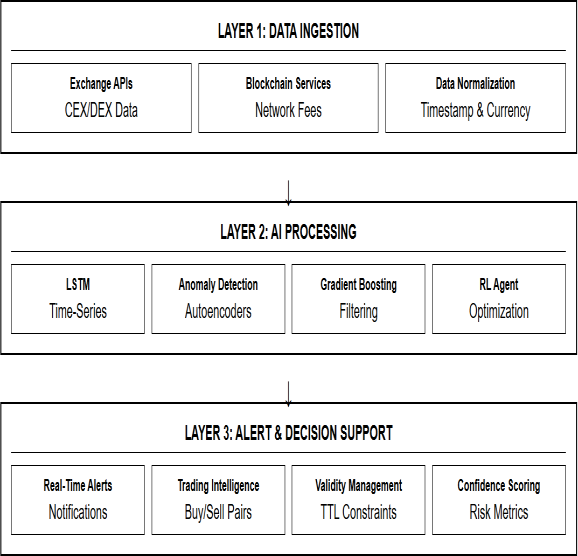
Data Ingestion Layer: It provides the responsibility of pulling live market data from both the centralized and decentralized crypto platforms. Price feeds arrive by using exchange APIs and blockchain data services at regular intervals. Examples of data points include current price, asset prices, trading volume, fees per exchange, blockchain network costs, and time to estimate the transfer. To provide consistency, all the streams utilize one timestamp format and are normalized to one quote currency. The layer makes an initial check to eliminate any duplicate or corrupted entries before handing the data over to processing.
AI Processing Layer: Here sits the system's analytical core: It fuses various models of machine learning and deep learning to analyse market behavior in search of meaningful price discrepancies. Modules cover timeseries modelling, anomaly detection, predictive filtering, and adaptive decision- making. Temporal price patterns are modelled using Long Short-Term Memory networks, unusual market movements are highlighted by Autoencoders and Isolation Forests, while Gradient Boosting assists in filtering out viable arbitrage opportunities. A Reinforcement Learning agent fine tunes the decisions at real- world constraints.
Alert and Decision Support Layer: This layer pushes actionable insights to users. Following the identification of a price disparity by the AI processing layer, the system sends alerts in real time with details such as buy/sell
exchanges, estimated profit, transaction costs, and confidence scores. Time-to-live rules are applied to make sure that alerts remain relevant in rapidly moving markets.
Unique Features of the Proposed Research:
A Unified Multi-Model AI Fusion: This system integrates Long Short-Term Memory networks, Autoencoders, Isolation Forests, Gradient Boosting, and Reinforcement Learning to form one comprehensive framework instead of relying on one method, along with the benefits of using those methods together. Integrating multiple methods enables it to perform time-series models, anomaly detection, predictive filtering, and reinforcement learning simultaneously.
Real-Time Cross-Exchange and Cross- Market: The platform also features real-time pricing variations, analysing both centralized exchanges (CEX) and decentralized exchanges (DEX) for the discovery of arbitrage opportunities that would be latent and not viewable on traditional and only CEX- supporting systems.
Latency Sensitive Arbeit: The best improvement is drawing explicit network latency considerations along with blockchain confirmation times and trans-action fees when arbitrage viability is assessed. This decreases false positives dramatically and only highlights opportunities that can be realistically implemented.
Ensemble-Driven Anomaly: Only data points which are agreed upon by several unsupervised methods will be “validated” as an anomaly. These methods are “noisy” themselves, which means we get much fewer errors than we would from each model separately.
AdaptiveDecisionsusingReinforcement Learning: A Reinforcement Learning agent will allow the system to refine its arbitrage decisions on the fly as the market changes. It seeks profitability in the long term, not in the short term, and can help the system remain strong in the face of volatility or changes in the market.
Synthetic Real-Time Streaming Evaluation: The work describes the development of synthetic real-time replays, where the data is replicated in the same manner as the live markets using historical data. 6.7 Cost-Conscious Profit Est Moving beyond the actuals represented by the mere differential prices, the framework uses the exchange fee, gas prices, and actual slip charges towards the estimation of the actual profit earned.
Scalable, Modular Architecture: Its modular architecture allows data ingestions, AI processing, and alerting to scale independently. More exchanges, assets, or models may be added, yet the entire system need not be rebuilt.
Noise-Resilient: The system also effectively filters out 'noisy' price movements by using a combination of "temporal modelling, anomaly detection, and predictive filtering."
Real World Relevance and Reproduce: Public databases, simulation of evaluation in real time, and clear metrics of performance guarantee reproducibility and extensibility of this technique.
Results and Discussion:
For instance, it has been mentioned in one document that the system has been put to test with a mixture of historical data related to prices from different exchanges, such as decentralized market data and network data. For instance, a dataset has been compiled where it has been possible to access data from several exchanges such as Binance, Coinbase, Kraken, Uniswap, and SushiSwap. For instance, to make sure that real-time data can be provided as per requirements, a form of sequential data has been created with factors such as transaction fees incorporated into it.
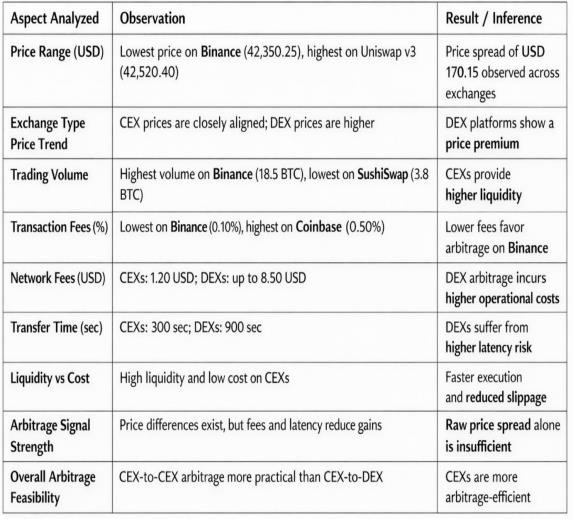
It can also be noted that the results reveal the overall accuracy and improvements that the hybrid AI framework offers in the identification of anomalies and arbitrage opportune. Use of the collective power of Autoencoders and Isolation Forests effectively reduced noise or false positives, even in turbulent environments. The addition of LSTMs provided the system with some form of contextual awareness, effectively allowing it to filter out random short-term movements that did not amount to actual value. However, the overall
identification of arbitrage opportune, keeping in mind the costs of prices, was provided by the Gradient Boosting model.
Further improvements came about through the introduction of Reinforcement Learning, which enabled the optimisation of the decision- making process. Here, the agent is able to learn flexible strategies that hunt for opportunities with a large profit margin, as well as avoid trades that coincide with network congestions. From the results, the proposed system is able to generate better results in terms of the risk profile, as indicated by higher average net profit and a drawdown that is lower compared to the baseline methods.
In this, using a combination of realistic data with a selection of models based on the power of artificial intelligence is a good approach in the practical detection of disparities in the prices of cryptocurrency in real-time as well as the analysis of the opportunities that come with the trade.
Conclusion:
In this, a smart system is proposed to identify price gaps in cryptocurrencies using a multicast of centralized and decentralized exchanges. The proposed smart system utilizes a blend of artificial intelligence methods including time series prediction, unsupervised anomaly detection, ensembling, and reinforcement learning to address the challenges associated with traditional methods using a rule-based
approach and individual AI methods. Modularization of the proposed smart system supports highly scalable and timely analysis.
Tests were run tapping into available data from multiple exchanges, DEX transactions, and blockchain network statistics, which demonstrated enhanced accuracy with a reduction in false alarms. Incorporating realistic constraints in a real-world scenario, such as transaction costs, latency, and send times, helped in differentiating between purely theoretical possible arbitrage opportunities and actual feasible opportunities. By combining ensemble anomaly detection with adaptive decision-making mechanisms, more effective risk-adjusted returns were achieved.
Thus, in brief, the work reveals the possibilities of enhancing the quality of online financial analysis of cryptos through the application of various AI methods. The framework remains promising as a foundation of the arbitrage detection system, particularly upon implementation. Looking ahead, more research might focus on live implementation, extending the list of exchanges/assets, and enhancing risk handling.
References
- Nakamoto, S., “Bitcoin: A Peer-to-Peer Electronic Cash System,” Bitcoin Whitepaper , 2008. DOI: 10.2139/ssrn.3977007
- Makarov, I., and Schoar, A., “Trading and Arbitrage in Cryptocurrency Markets,” Journal of Financial Economics , vol. 135, no. 2, pp. 293– DOI: 10.1016/j.jfineco.2019.07.001
- Katsiampa, P., “Volatility Estimation for Bitcoin: A Comparison of GARCH Models,” Economics Letters , vol. 158, DOI: 10.1016/j.econlet.2017.06.023
- Hochreiter, S., and Schmidhuber, J., “Long Short-Term Memory,” Neural Computation , vol. 9, no. 8, pp. 1735– DOI: 10.1162/neco.1997.9.8.1735
- Goodfellow, I., Bengio, Y., and Courville, A., Deep Learning , MIT Press, 2016. DOI: 10.1007/s10710-017-9314-z
- Chalapathy, R., and Chawla, S., “Deep Learning for Anomaly Detection: A Survey,” arXiv preprint arXiv :1901.03407 , 2019. DOI: 10.20944/preprints202411.2377.v1
- Liu, F. T., Ting, K. M., and Zhou, Z.- H., “Isolation Forest,” Proceedings of the 8th IEEE International Conference on Data Mining , pp. 413–422, 2008. DOI: 10.1109/icdm.2008.17
- Friedman, J. H., “Greedy Function Approximation: A Gradient Boosting Machine,” Annals of Statistics , vol. 29, no. 5, pp. 1189–1232, 2001. DOI: 10.1214/aos/1013203451
- Sutton, R. S., and Barto, A. G., Reinforcement Learning: An Introduction , 2nd ed., MIT Press, 2018. DOI: 10.1016/s0893-6080(99)00098-2
- Jiang, Z., Xu, D., and Liang, J., “A Deep Reinforcement Learning Framework for the Financial Portfolio Management Problem,” arXiv preprint arXiv :1706.10059 , 2017. DOI: 10.1109/intellisys.2017.8324237
- Gandal, N., Hamrick, J. T., Moore, T., and Oberman, T., “Price Manipulation in the Bitcoin Ecosystem,” Journal of Monetary Economics , vol. 95, pp. 86– DOI: 10.1016/j.jmoneco.2017.12.004
- Dimpfl, T., and Peter, F. J., “Nothing but Noise? Price Discovery Across Cryptocurrency Exchanges,” Journal of Financial Markets , vol. 49, 2020. DOI: 10.1016/j.finmar.2020.100584
- Zhang, Y., Zohren, S., and Roberts, S., “Deep Learning for Volatility Forecasting,” Quantitative Finance , vol. 20, no. 9, pp. 1519–1537, 2020. DOI: 10.1080/14697688.2024.2387222
- Uniswap Labs, “Uniswap v3 Core Whitepaper,” 2021. DOI: 10.2139/ssrn.5484951
- Kaggle, “Cryptocurrency Historical PricesDataset,”Available: DOI: 10.7717/peerj-cs.1998/table-1