
Abstract
In this paper, we proposed a driver drowsiness detection method for which only eyelid movement information was required. The proposed method consists of two major parts. 1) In order to obtain accurate eye openness estimation, a vision based eye openness recognition method was proposed to obtain an regression model that directly gave degree of eye openness from a low-resolution eye image without complex geometry modeling, which is efficient and robust to degraded image quality. 2) A novel feature extraction method based on unsupervised learning was also proposed to reveal hidden pattern from eyelid movements as well as reduce the feature dimension. To develop such a system we need to install some hardware components like camera inside the vehicle, which can capture the image of the driver at a fixed interval, and an alarm system, which will alert the driver after detecting his/her level of drowsiness and in the next level it will stop the vehicle automatically. Now apart from these hardware components, we need a software part also, which can detect the level of drowsiness of the driver and is the main concern of our paper. In this paper, we develop a drowsiness detection system that will accurately monitor the open or closed state of the driver’s eyes in real-time. The proposed method was evaluated and shown good performance.
Keywords: Image, Pixel, Image resolution, Image processing, Image restoration, sampling, Image coding.
Introduction
Driver drowsiness is one of the biggest safety issues facing the road transport industry today and the most dangerous aspect of driver fatigue is falling asleep at the wheel. Fatigue leads to sleep, it reduces reaction time (a critical element of safe driving). It also reduces vigilance, alertness and concentration so that the ability to perform attention-based activities (such as driving) is impaired. The speed at which information is processed is also reduced by sleepiness. The quality of decision-making may also be affected [1][2][3].
Driver falls in micro sleep, results in collision with object or vehicle, or they cannot recognize that he or she has drifted into a wrong lane. The consequences of a drowsy driver are very dangerous and lead to loss of lives, casualties and vehicle damage. As the most important safety factor, it is necessary to make some serious measures, in order to improve working conditions of drivers [4][5][6][7][8][9][10].
so that negative consequences subjected by a drowsy driver can be minimized. Computer Science and Engineering contributes their responsible role for development and betterment of society by providing their valuable services in various fields belong to different aspects of life. Driver drowsiness detection system is such an example that can be used as a security measure that alerts the drowsy driver while driving, in order to safeguard himself as well as others [11].
A few systems already had been created, in light of recording of head developments, movement of steering wheel, heart rate variability or grip quality. Systems that utilize a camera for the tracking of eye movements have already been created. In any case, so far no framework has turned out to be adequately reliable. Previous method relies on the LED's and multiple cameras to estimates the facial expressions however moving vehicle introduces new difficulties like variable lighting and running backgrounds. This paper presents a solution for minimizing the road accident caused by the drowsiness of driver by alerting through a single camera placed on the dash board of vehicle. Smart vehicle vendors have developed this technology by applying different techniques.
The algorithm of eye detection system integrated with hardware to develop the smart vehicles, which can implement nationwide to avoid the road accidents. Microcontroller and camera are used to make and intelligent hardware and software integrated system. The purpose of this study is to build up a model of Drowsiness Detection System. The system will precisely check in real time, the open or close condition of the eyes of driver. By checking the driver's eyes, the indications of driver drowsiness can be identified in the beginning to protect from vehicle accident [15].
In this paper we proposed a driver drowsiness alert system. It is non-intrusive system for monitoring driver drowsiness based on open and close conditions of eyes. Eye behaviour provide significant information about driver’s alertness and that if visual behaviour can be measured then it will be feasible to predict driver’s state of drowsiness, vigilance or attentiveness. The power electronic converters and renewable energy systems are discussed in [20]-[66].
An image is an array or a matrix of square pixels arranged in columns and rows. An image is an artifact, for example a two-dimensional picture that has a similar appearance to some subject usually a physical object or a person.
2.1. Characteristics
Images may be two-dimensional, such as a photograph, screen display, and as well as a three-dimensional, such as a statue or hologram. They may be captured by optical devices such as cameras, mirrors, lenses, telescopes, microscopes, etc. and natural objects and phenomena, such as the human eye or water surfaces. The word image is also used in the broader sense of any two-dimensional figure such as a map, a graph, a pie chart, an abstract painting. In this wider sense, images can also be rendered manually, such as by drawing, painting, carving, rendered automatically by printing or computer graphics technology, or developed by a combination of methods, especially in a pseudo-photograph.
2.2. Volatile image
A volatile image is that exists only for a short period of time. This may be a reflection of an object by a mirror, a projection of a camera, a scene displayed on a cathode ray tube.
2.3. A fixed image
A fixed image, also called a hard copy, is that has been recorded on a material object, such as paper , textile by photography & digital processes.
2.4. Mental image
A exists in an individual's mind something one remembers or imagines. The subject of an image need not be real. it may be an abstract concept, such as a graph, function, & imaginary entity. For example, Sigmund Freud claimed to have dreamed purely in aural-images of dialogs. The development of synthetic acoustic technologies and the creation of sound art have led to a consideration of the possibilities of a sound-image made up of irreducible phonic substance beyond linguistic or musicological analysis.
2.5 Still image
A still image is a single static image, as distinguished from a kinetic image. This phrase is used in photography, visual media and the computer industry to emphasize that one is not talking about movies, in very precise, pedantic technical writing such as a standard. A film still is a photograph taken on the set of a movie or television program during production, used for promotional purposes.
2.6. Moving image
A moving image is typically a movie, video including digital video. It could also be an animated display such as a zoetrope.
Image processing is a subset of the electronic domain where in the image is converted to an array of small integers called pixels, representing a physical quantity such as scene radiance, stored in a digital memory and processed by computer or other digital hardware. For the moment, lets make things easy and suppose the photo is black and white. that is lots of shades of grey, so no colour. We may consider this image as being a two dimensional function, where the function values give the brightness of the image at any given point. We may assume that in such an image brightness values can be any real numbers in the range 0.0 (black) to 1.0 (white). The ranges of x and y will clearly depend on the image, but they can take all real values between their minima and maxima.
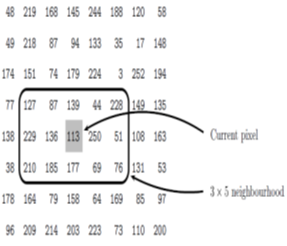
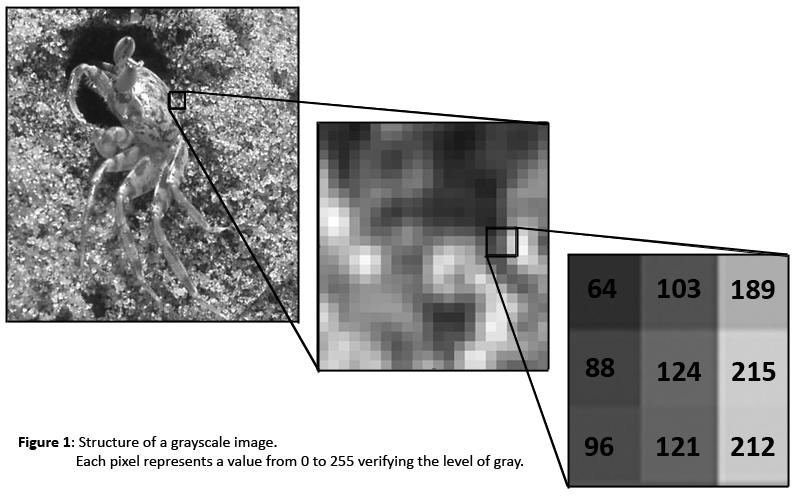
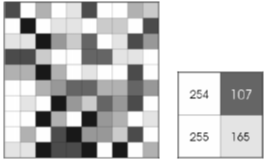
A digital image differs from a photo in that the x, y, and f(x,y)values are all discrete. Usually they take on only integer values, so the image shown in figure 1 will have x and y ranging from 1 to 256 each, and the brightness values also ranging from 0 (black) to 255 (white). A digital image can be considered as a large array of discrete dots, each of which has a brightness associated with it. These dots are called picture elements or pixels. The pixels surrounding a given pixel constitute its neighbourhood. A neighbourhood can be characterized by its shape in the same way as a matrix. we can speak of a 3*3 neighbourhood,of a 5*7 neighbourhood it may be necessary to specify which pixel in the neighbourhood is the current pixel.
Resolution is the definition of the number of pixels per square inch on a computer. Resolution allows you to transform pixels into inches and back again. Two resolution definitions are often used in place of one another. Pixel resolution is the size in bytes of your image or its appearance on a computer screen. This number is tied directly to how big your image is on your hard drive. The byte-size of the image file is directly proportional to the pixel count and its size on your computer screen, which simply displays all the pixels in a fixed one-to-one grid.
Embedded resolution is different. Embedded resolution tells your printer how far apart to spread the pixels in a printed image. It is completely independent of the pixel count ,file size of the image. A high pixel count image can have a low embedded resolution . Given the same pixel count, a high embedded resolution will result in a smaller printed image the pixels are packed together more tightly. And a low embedded resolution will result in a larger image the pixels are more spread out.
3.1Image Brightness
An image must have the proper brightness and contrast for easy viewing. brightness refers to the overall lightning or darkness of the image.Image brigtness is a measure of intensity after the image has been acquired with a digital camera or digitized by an analog to digital converters. Luminance is the measurement of the amount of light emitting ,passing through or reflected from a particular surface from a solid angle. It also indicates how much luminous power can be perceived by the human eye. This means that luminance indicates the brightness of light emitted or reflacted off of a surface . In the display industry luminance is used to quantify the brightness of displays.Illuminance is the amount of light falling onto and spreading over a given surface area. Illuminance also correlates with how humans perceive the brightness of an illuminated area.
3.2 Contrast
Contrast refers to the difference between black and white levels in images, whether on a flat panel display or a projection screen. Without good contrast, images appear to lack brightness, colour and definition.
The image contrast ratio refers to the difference between the luminance of the white part of an image, divided by the black part. So if the white part is one hundred times brighter than the black part, it will be 100:1, and so on.
5. Enhancement
Image enhancement is the improvement of digital image quality without knowledge about the source of degradation. If the source of degradation is known, one calls the process image restoration.
Many different, often elementary and heuristic methods are used to improve images in some sense. The problem is, of course, not well defined, as there is no objective measure for image quality. Here, we discuss a few recipes that have shown to be useful both for the human observer and/or for machine recognition. These methods are very problem-oriented: a method that works fine in one case may be completely inadequate for another problem.
The example in figure 2 operates on 256 grey-scale images. This means that each pixel in the image is stored as a number between 0 to 255, where 0 represents a black pixel, 255 represents a white pixel and values in-between represent shades of grey. These operations can be extended to colour images too Examples of simple grey level transformations in this domain are:
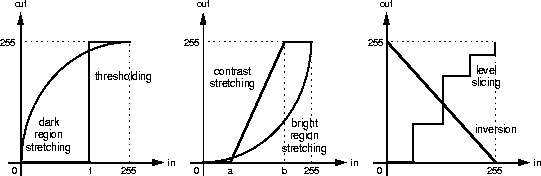
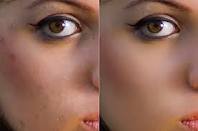
Physiological experiments have shown that very small changes in luminance are recognized by the human visual system in regions of continuous grey value, and not at all seen in regions of some discontinuities. A second design goal, therefore, is image sharpening. All these operations need neighbourhood processing, viz. the output pixel is a function of some neighbourhood of the input pixels:
Here is a trick that can speed up operations substantially, and serves as an example for both point and neighbourhood processing in a binary image: we number the pixels in a 3x3 neighbourhood like:
Compressing an image is significantly different than compressing raw binary data. Of course, general purpose compression programs can be used to compress images, but the result is less than optimal. This is because images have certain statistical properties which can be exploited by encoders specifically designed for them. Also, some of the finer details in the image can be sacrificed for the sake of saving a little more bandwidth or storage space. The objective of image compression is to reduce irrelevance and redundancy of the image data in order to be able to store or transmit data in an efficient form.
lossy and lossless compression
Image compression may be lossy or lossless. Lossless compression involves with compressing data which decompressed, will be an exact replica of the original data. This is the case when binary data such as executables, documents etc. are compressed. They need to be exactly reproduced when decompressed. On the other hand, images and music too need not be reproduced exactly. An approximation of the original image is enough for most purposes, as long as the error between the original and the compressed image is tolerable.
In a (8-bit) greyscale image each picture element has an assigned intensity that ranges from 0 to 255.
4.2 Methods for lossy compression
Reducing the color space to the most common colors in the image. The selected colors are specified in the color palette in the header of the compressed image. Each pixel just references the index of a color in the color palette. This method can be combined with dithering to avoid posterization. Transform coding. This is the most commonly used method. A Fourier-related transform such as DCT or the wavelet transform are applied, followed by quantization and entropy coding.
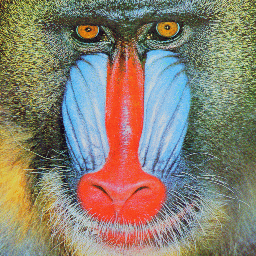
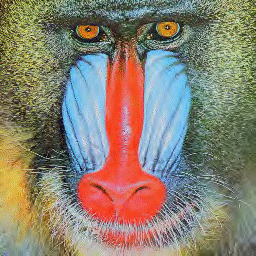
A grey scale image is what people normally call a black and white image, but the name emphasizes that such an image will also include many shades of grey. The best image quality at a given bit-rate is the main goal of image compression, however, there are other important properties of image compression schemes:
4.3 Scalability
Scalability generally refers to a quality reduction achieved by manipulation of the bit stream or file without decompression and re-compression. Other names for scalability are progressive coding or embedded bit streams. Despite its contrary nature, scalability also may be found in lossless codes, usually in form of coarse-to-fine pixel scans. Scalability is especially useful for previewing images while downloading them (e.g., in a web browser) or for providing variable quality access to e.g., databases.
4.4 There areseveral types of scalability:
Quality progressive or layer progressive: The bit stream successively refines the reconstructed image.
Resolution progressive: First encode a lower image resolution; then encode the difference to higher resolutions
Component progressive: First encode grey; then color.
4.5 Region of interest coding. Certain parts of the image are encoded with higher quality than others. This may be combined with scalability encode these parts first, others later.
4.7 Meta information. Compressed data may contain information about the image which may be used to categorize, search, or browse images. Such information may include colour and texture statistics, small preview images, and author or copyright information.
4.8 Processing power. Compression algorithms require different amounts of processing power to encode and decode. Some high compression algorithms require high processing power.
The quality of a compression method often is measured by the Peak signal-to-noise ratio. It measures the amount of noise introduced through a lossy compression of the image, however, the subjective judgment of the viewer also is regarded as an important measure, perhaps, being the most important measure.
4.9 Error Metrics
Two of the error metrics used to compare the various image compression techniques are the Mean Square Error (MSE) and the Peak Signal to Noise Ratio (PSNR). The MSE is the cumulative squared error between the compressed and the original image, whereas PSNR is a measure of the peak error. The mathematical formulae for the two are
MSE = $\text{MSE} = \frac{1}{MN} \sum_{y=1}^{M} \sum_{x=1}^{N} [I(x,y) - I'(x,y)]^2$
PSNR = 20 * log10 (255 / sqrt(MSE))
where I(x,y) is the original image, I'(x,y) is the approximated version (which is actually the decompressed image) and M,N are the dimensions of the images.
A lower value for MSE means lesser error, and as seen from the inverse relation between the MSE and PSNR, this translates to a high value of PSNR. Logically, a higher value of PSNR is good because it means that the ratio of Signal to Noise is higher. Here, the 'signal' is the original image, and the 'noise' is the error in reconstruction. So, if you find a compression scheme having a lower MSE (and a high PSNR), you can recognise that it is a better one.
5. Image Restoration
The purpose of image restoration is to "compensate for" or "undo" defects which degrade an image. Degradation comes in many forms such as motion blur, noise, and camera misfocus. In cases like motion blur, it is possible to come up with an very good estimate of the actual blurring function and "undo" the blur to restore the original image.
In cases where the image is corrupted by noise, the best we may hope to do is to compensate for the degradation it caused. In this project, we will introduce and implement several of the methods used in the image processing world to restore images.
6.Image Measurement Extraction
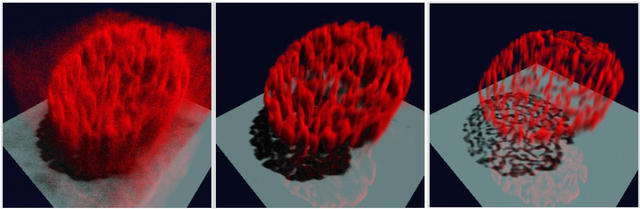
The example below demonstrates how one could go about extracting measurements from an image. The image at the top left of shows some objects. The aim is to extract information about the distribution of the sizes (visible areas) of the objects. The first step involves segmenting the image to separate the objects of interest from the background. This usually involves thresholding the image, which is done by setting the values of pixels above a certain threshold value to white, and all the others to black. Because the objects touch, thresholding at a level which includes the full surface of all the objects does not show separate objects.
A “true colour” image has 24 bit colour depth = 8 x 8 x 8 bits = 256 x 256 x 256 colours = ~16 million colours.
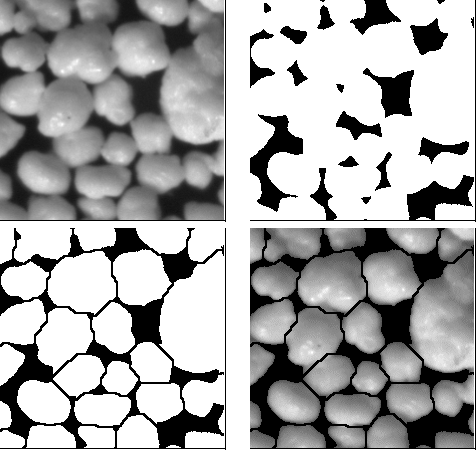
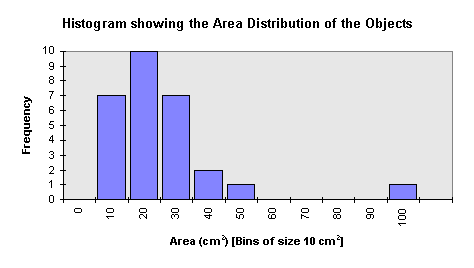
This problem is solved by performing a watershed separation on the image. A normal greyscale image has 8 bit colour depth = 256 greyscales The image at the lower right of figure 10 shows the result of performing a logical AND of the two images at the left of Figure. This shows the effect that the watershed separation has on touching objects in the original image.
Working Principles
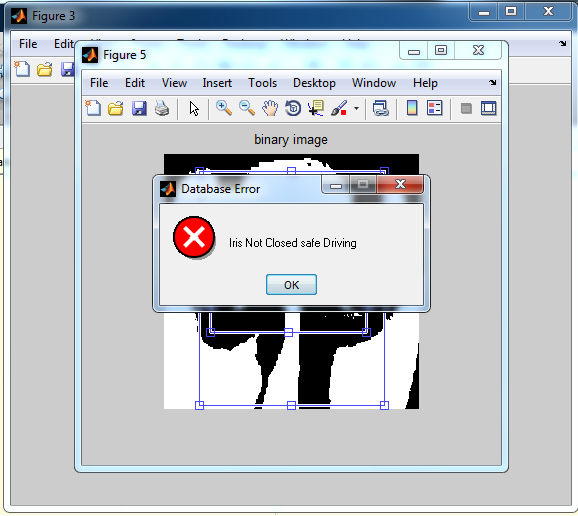
In this project, driver’s eye drowsiness is detected and alert the driver, also stop the vehicle automatically if the driver does not give response to the alert. For this, the camera is fixed on the vehicle that focuses straight towards the face of driver and checks the driver eyes with a specific end goal to recognize drowsiness using Matlab. A buzzer is issued to caution the driver, in such situation when drowsiness is recognized. If a driver does not give response to the buzzer means then the controller will stop the vehicle. For this pic microcontroller is used.
Simulation Output
Conclusion
Eye Drowsiness Detection was built to help a driver stay awake while driving in order to reduce car accidents caused by drowsiness. During the experiment the system has the capacity to choose whether the driver's eyes are opened or closed. At the point when the eyes are close for a really long time, warnings sign i.e. buzzer is issued to driver and also stop the vehicle if the driver does not response the buzzer. Also, throughout observation, the framework has the capacity suddenly identify any eye confining error that may have happened. If there should arise an occurrence of this kind of error, the system has the capacity to recover and accurately localize the person eyes. Image processing accomplishes greatly precise and trustworthy finding of sleepiness, a drowsiness detection system which judges the alertness level of driver on the basis of nonstop eye closures. The proposed system can be used for driver’s safety and its consequences.
References
- Rechtschaffen, “Current perspectives on the function of sleep,” Perspectives in Biology and Medicine, vol. 41, no. 3, pp.359–390, 1998 DOI: 10.1353/pbm.1998.0051
- Lin, L. Ko, I. Chung et al., “Adaptive EEG-based alertness estimation system by using ICA-based fuzzy neural networks,” IEEE Transactions on Circuits and Systems, vol. 53, no. 11, pp. 2469–2476, 2006. DOI: 10.1109/tcsi.2006.884408
- E. Rogado, J. Garcia, R. Barea, L. Bergasa and E. Lopez,“Driver Fatigue Detection System,” Proc. IEEE Int.Conf. Robotics and Biomimetics, 2009. DOI: 10.1109/robio.2009.4913155
- F. Nasoz, O. Ozyer, C. Lisetti, and N. Finkelstein, “Multimodal affective driver interfaces for future cars,” in Proc. ACM Int. Multimedia Conf. Exhibition, pp. 319–322, 2002. DOI: 10.1145/641007.641074
- M. Bayly, B. Fildes, M. Regan, and K. Young, “Review of crash effectiveness of intelligent transport system,”traffic Accident Causation in Europe (TRACE), 2007.U.S. Dept. Of Transportation, “Traffic Safety Facts 2006: S. B. Klein and B. M. ThorneBiological Psychology, Worth Pub, 2007 DOI: 10.1108/9780080555874-017
- S. Abtahi, “Driver Drowsiness Monitoring based on Yawning Detection,” MS thesis, University of Ottawa, 2012. DOI: 10.1109/imtc.2011.5944101
- T. Nakagawa, T. Kawachi, S. Arimitsu, M. Kanno, K.Sasaki, and H. Hosaka, “Drowsiness detection using spectrum analysis of eye movement and effective stimuli to keep driver awake,” DENSO Technical Review, vol.12, pp. 113–118, 2006. DOI: 10.1109/access.2024.3424654
- U. Nasoz, O. Ozyer, C. Lisetti, and N. Finkelstein,“Multimodal affective driver interfaces for future cars,” in Proc. ACM Int. Multimedia Conf. Exhibition, pp. 319–322, 2002. DOI: 10.1145/641007.641074
- Y. Lin, H. Leng, G. Yang, H. Cai, “An Intelligent Noninvasive Sensor for Driver Pulse Wave Measurement. Sensors Journal,” IEEE, 2007. DOI: 10.1109/jsen.2007.894923
- M. Singh, G. Kaur, ”Drowsiness detection on eye blink Duration using algorithm”, International Journal of Emerging Technology and Advanced Engineering , Volume 2, Issue 4, April 2012. DOI: 10.35940/ijitee.b1054.1292s319
- S. Vitabile, A. D. Paola and F. Sorbello, “A real-time nonintrusive FPGA-based drowsiness detection system”, Journal of Ambient Intelligence and Humanized Computing, Volume 2, Issue 4, pp 251-262, December 2011. DOI: 10.1007/s12652-011-0049-z
- Road safety information, rospa, “driver fatigue and road accidents” ,www.rospa.com, 2011 DOI: 10.1201/9780203756140-11
- Arun Sahayadhas,Kenneth Sundaraj,”Detecting Driver Drowsiness Based on Sensors A Review”,pp.16937-16953, ISSN 1424-8220, Malaysia 2012 DOI: 10.3390/s121216937
- Drowsy Driving, Facts and Stats: Drowsy Driving – Stay Alert, Arrive Alive. http: / / drowsydriving.org/about/ facts- and- stats/ , 2016. DOI: 10.1037/e416942008-002
- J. Qiang and X. Yang, “Real-time eye, gaze, and face pose tracking for monitoring driver vigilance,” International Journal of Real-Time Imaging, vol. 8, 2002, pp. 357–377, doi:. DOI: 10.1006/rtim.2002.0279
- P. Viola and M. Jones, “Robust real-time face detection,” International Journal of Computer Vision (IJCV), vol. 57, 2004, pp. 137-154. DOI: 10.1023/b:visi.0000013087.49260.fb
- S. Hu and G. Zheng, “Driver drowsiness detection with eyelid related parameters by Support Vector Machine,” International Journal of Expert Systems with Applications, vol. 36, 2009, pp. 7651–7658, doi: http://dx. DOI: 10.1016/j.eswa.2008.09.030
- Warning Message via Display Monitor in VW’s Car, VW Golf Turan some improvement. Driver fatigue detection system as standard | Responsejp (Automobile new model ls 2016. DOI: 10.1021/acsnano.1c00536.s004
- U. Svensson, “Blink behaviour based drowsiness detection”,Linkoping University, Swedish National Road and Transport Research Institute, 2004. DOI: 10.1016/s0386-1112(14)60150-3
- M.ValanRajkumar, P.S.Manoharan, Modeling and Simulation of Three-phase DCMLI using SVPWM for Photovoltaic System, Springer Lecture Notes in Electrical Engineering, under the volume titled “Power Electronics & Renewable Energy Systems", Volume 326, Chapter No 5, January 2015, Pages 39-45. DOI: 10.1007/978-81-322-2119-7_5
- M.ValanRajkumar, P.S.Manoharan, Harmonic Reduction of Fuzzy PI Controller based Three-Phase Seven-level DCMLI with SVPWM for Grid Connected Photovoltaic System, Journal International Review on Modeling and Simulations, Volume 6, No 3, June 2013, Pages 684-692. DOI: 10.20508/ijrer.v10i4.11289.g8052
- A.Ravi, P.S.Manoharan, M.ValanRajkumar, “Harmonic Reduction of Three-Phase Multilevel Inverter for Grid connected Photovoltaic System using Closed Loop Switching Control”, Journal-IREMOS, Volume 5, No 5, October 2012, Pages 1934-1942. ISSN: 1974-9821 (Print), 1974-982X (Online) DOI: 10.15866/iremos.v10i4.11688
- P.Thirumurugan, P.S.Manoharan, M.ValanRajkumar, “VLSI Based Inverter Switching Control” in the proceedings of International Conference on Mathematical Modeling and Applied Soft Computing MMASC’12 – Coimbatore Institute of Technology on July 2012, Vol-2 (Page):965-973. DOI: 10.1109/icaccct.2012.6320798
- C.Hemalatha, M.Valan Rajkumar, G.Vidhya Krishnan, “Simulation and Analysis for MPPT Control with Modified firefly algorithm for photovoltaic system”, International Journal of Innovative Studies in Sciences and Engineering Technology, Volume 2, No 11, Nov.2016, Pages 48-52. DOI: 10.1109/iccisc52257.2021.9484882
- G.Vidhya Krishnan, M.Valan Rajkumar, C.Hemalatha, “Modeling and Simulation of 13-level Cascaded Hybrid Multilevel Inverter with less number of Switches”, International Journal of Innovative Studies in Sciences and Engineering Technology, Volume 2, No 11, Nov.2016, Pages 43-47. DOI: 10.21275/v5i3.nov162392
- M.ValanRajkumar, P.S.Manoharan, FPGA Based Multilevel Cascaded Inverters with SVPWM Algorithm for Photovoltaic system, Elsevier Journal Solar Energy, Volume 87, Issue 1, January 2013, Pages 229-245. DOI: 10.1016/j.solener.2012.11.003
- M.ValanRajkumar, P.S.Manoharan, Space Vector Pulse Width Modulation of Three-Phase DCMLI with Neuro-Fuzzy MPPT for Photovoltaic System, World Journal of Modelling and Simulation, Volume 10, No 3, August 2014, Pages 193-205. DOI: 10.1109/icaccct.2012.6320798
- M.Valan Rajkumar, Prakasam, P. and Manoharan, P.S. (2016) Investigational Validation of PV Based DCDMLI Using Simplified SVM Algorithm Utilizing FPGA Tied with Independent Sources. Circuits and Systems, Volume 7, No 11, 3831-3848. http://dx. DOI: 10.4236/cs.2016.711320
- P.Thirumurugan, P.S.Manoharan, M.ValanRajkumar, VLSI Based Space Vector Pulse Width Modulation Switching Control in the proceedings of IEEE International Conference on Advanced Communication Control and Computing Technologies ICACCCT 2012 on August 2012, ISBN No. 978-1-4673-2045-0 (Print) (Page):366-370. DOI: 10.1109/icaccct.2012.6320798
- M.ValanRajkumar, P.S.Manoharan, “Modeling, Simulation and Harmonic Reduction of Three-Phase Multilevel Cascaded Inverters with SVPWM for Photovoltaic System”, Journal International Review on Modeling and Simulations, Volume 6, No. 2, April 2013, Pages 342-350. ISSN: 1974-9821 (Print), 1974-982X (Online) DOI: 10.1016/j.solener.2012.11.003
- M.Valan Rajkumar, G.Ranjhitha, M.Pradeep, Mohammad Fasil PK, R.Sathishkumar, “Fuzzy based Speed Control of Brushless DC Motor fed Electric Vehicle”, International Journal of Innovative Studies in Sciences and Engineering Technology (IJISSET), Volume: 3, Issue: 3, March 2017, Pages 12-17. ISSN: 2455-4863 (Online). DOI: 10.1109/elecsym.2017.8240399
- M.Valan Rajkumar, J.Chandramohan, D.Aravind, M.Basker, “Performances Analysis of Power Factor Correction for PWM Control based Bridgeless Cuk Rectifier with Positive Output Voltage”, International Journal of Emerging Technologies in Engineering Research (IJETER), Volume: 5, Issue: 4, April 2017, Pages 116-121. ISSN: 2454-6410 (Online). DOI: 10.1109/ic-etite47903.2020.amolkhot70
- K.Aswini, K.Nandhini, SR.Nandhini, G.Akalya, B.Rajeshkumar, M.Valan Rajkumar, “Simulation and Analysis of ASCAD Multilevel Inverter with SPWM for Photovoltaic System”, International Journal of Innovative Studies in Sciences and Engineering Technology (IJISSET), Volume: 3, Issue: 4, April 2017, Pages 1-9. ISSN: 2455-4863 (Online). DOI: 10.5829/idosi.ije.2013.26.11b.13
- M.Valan Rajkumar, M.Mahakumar, M.Manojkumar, M.Hemaraj, E.Kumaravel, “Modelling and Analysis of DC-DC Converter with Various MPPT Algorithms for PV System”, International Journal of Innovative Studies in Sciences and Engineering Technology (IJISSET), Volume: 3, Issue: 4, April 2017, Pages 17-22. ISSN: 2455-4863 (Online). DOI: 10.17148/ijireeice/ncaee.2017.21
- M.Valan Rajkumar, T.Indumathi, “Analysis of Low Power Multi-core Embedded Management for Energy Harvesting”, IOSR-Journal of Electrical and Electronics Engineering, Volume 12, Issue 2, Ver. II, March-April 2017, Pages 25-33. ISSN: 2320-3331 (Print) 2278-1676 (Online). DOI: 10.9790/1676-1202022533
- A.Ravi, M.Valan Rajkumar, P.S.Manoharan, “Harmonic Reduction of Three-Phase Eleven-level DCMLI with Fuzzy MPPT for Grid Connected Photovoltaic System”, International Journal of Applied Engineering Research (IJAER), Volume 10, No 2, 2015, Pages 3251-3268. ISSN: 0973-4562 (Print). DOI: 10.1007/978-81-322-2119-7_5
- M.Valan Rajkumar, J.Karthikeyan, P.S.Manoharan, “Modeling and Simulation of Multiphase DCMLI with SVPWM for Photovoltaic System”, International Journal of Applied Engineering Research (IJAER), Special Issue: Volume 9, No 24, 2014, Pages 8477-8483. ISSN: 0973-4562 (Print). DOI: 10.1007/978-81-322-2119-7_5
- M.ValanRajkumar, P.S.Manoharan, “Modeling and Simulation of Five-level Five-phase Voltage Source Inverter for Photovoltaic Systems”, Journal PrzegladElektrotechniczny, Volume 10, No. 10, October 2013, Pages 237-241. ISSN: 0033-2097 (Print) DOI: 10.1109/icpces.2010.5698659
- M.Valan Rajkumar, P.S.Manoharan, A.Ravi, “Simulation and an Experimental Investigation of SVPWM Technique on a Multilevel Voltage Source Inverter for Photovoltaic Systems”, Elsevier International Journal of Electrical Power and Energy Systems, Volume 52, Issue 9, November 2013, Pages 116-131. ISSN: 0142-0615 (Print), 1879-3517 (Online) DOI: 10.1016/j.ijepes.2013.03.022
- SR.Nandhini, G.Akalya, K.Aswini, K.Nandhini, M.Valan Rajkumar, B.Rajeshkumar, “A New Topology of H-bridge based Multilevel Inverter for PV System with Reduced Switches”, International Journal of Emerging Technologies in Engineering Research (IJETER), Volume: 5, Issue: 4, April 2017, Pages 60-68. ISSN: 2454-6410 (Online). DOI: 10.5829/idosi.ije.2013.26.11b.13
- M.Valan Rajkumar, M.Mahakumar, M.Manojkumar, M.Hemaraj, E.Kumaravel, “A New DC-DC Converter Topology with Grey Wolf MPPT Algorithm for Photovoltaic System”, International Journal of Emerging Technologies in Engineering Research (IJETER), Volume: 5, Issue: 4, April 2017, Pages 54-59. ISSN: 2454-6410 (Online). DOI: 10.5373/jardcs/v11sp12/20193248
- L.Malliga, K.Bommannaraja, M.Valan Rajkumar, “Investigation of FCM based Image Retrievel-Segmentation on Human Computational Intelligent Systems”, International Journal of Applied Engineering Research (IJAER), Special Issue: Volume 10, No 12, 2015, Pages 10769-10774. ISSN: 0973-4562 (Print). DOI: 10.37622/ijaer
- U.Suresh Kumar, P.S.Manoharan, M.Valan Rajkumar, “Feasibility Sensitivity Analysis in Potential Area for Standalone Hybrid Renewable Energy in Tamil Nadu, India”, Applied Mechanics and Materials Journal, under the volume titled “Advancements in Automation and Control Technologies", Volume 573, June 2014, Pages 757-766. ISSN: 1660-9336 (Print), ISBN-13: 978-3-03835-124-5 (Online). DOI: 10.4028/www.scientific.net/amm.573.757
- C.Hemalatha, M.Valan Rajkumar, M.Gayathri, “IOT Based Building Monitoring System Using GSM Technique”, IOSR-Journal of Electronics and Communication Engineering (IOSR-JECE), Volume 12, Issue 2, Ver. III, March-April 2017, Pages 68-75. ISSN: 2278-8735 (Print) 2278-2834 (Online). DOI: 10.9790/2834-1202036875
- S.Rashini, P.S.Manoharan, M.Valan Rajkumar, “Interfacing PV system to the Utility Grid using a Voltage Source Inverter”, Journal of Emerging Technologies Electrical Engineering, Special Issue- ICBDM 2013, Volume 1, No 1, March 2013, Pages 124-129. ISSN: 0973-2993 (Print) DOI: 10.1016/j.ijepes.2013.03.022
- S.Sathyaraj, M.Valan Rajkumar, J.Chandramohan, “Modeling and Simulation of Asymmetric Cascaded Multilevel Inverter with Reduced Switches using Multicarrier PWM Control”, International Journal of Advanced Research in Electrical, Electronics and Instrumentation Engineering (IJAREEIE), Volume 5, Issue 10, October 2016, Pages 8064-8071. ISSN: 2320-3765 (Print), 2278-8875 (Online) DOI: 10.15662/ijareeie.2014.0312049
- G.Ranjhitha, M.Valan Rajkumar, “Implementation of Genetic Algorithm based Maximum Power Point Tracking for Photovoltaic System”, International Journal of Innovative Research in Science, Engineering and Technology (IJIRSET), Volume 5, Issue 11, November 2016, Pages 18860-18868. ISSN: 2347-6710 (Print), 2319-8753 (Online) DOI: 10.15680/ijirset.2015.0412007
- S.Sathishkumar, M.Valan Rajkumar, R.Yuvaraj, “Modeling and Analysis of Soft-Switched Interleaved Boost Converter for Photovoltaic System”, International Journal for Science and Advance Research in Technology (IJSART), Volume 2, Issue 11, November 2016, Pages 43-48. ISSN: 2395-1052 (Online) DOI: 10.5829/idosi.ije.2015.28.10a.10
- M.Sundaraperumal, M.Valan Rajkumar, A.Venkatesh, “Modeling and Analysis of Current Source Multilevel Inverter using PI Controllers with Multicarrier PWM Technique”, International Journal for Science and Advance Research in Technology (IJSART), Volume 2, Issue 11, November 2016, Pages 275-280. ISSN: 2395-1052 (Online) DOI: 10.1109/icimia.2017.7975521
- R.Yuvaraj, S.Sathishkumar, M.Valan Rajkumar, “Analysis of PV based Soft Switching Boost DC-DC Converter with Zero Current Switching Technique”, International Journal of Advanced Research in Management, Architecture, Technology and Engineering (IJARMATE), Volume 2, Issue 12, December 2016 Pages 1-5. ISSN: 2454-9762 (Print) 2454-9762 (Online) DOI: 10.35291/2454-9150.2020.0348
- M.Valan Rajkumar, M.Mahakumar, M.Manojkumar, M.Hemaraj, E.Kumaravel, “A New MPPT design using Grey Wolf Optimization Techniques with DC-DC Converter for PV System”, International Journal for Science and Advance Research in Technology (IJSART), Volume 3, Issue 3, March 2017, Pages 829-835. ISSN: 2395-1052 (Online) DOI: 10.21090/ijaerd.92867
- K.Nandhini, SR.Nandhini, G.Akalya, K.Aswini, M.Valan Rajkumar, B.Rajeshkumar, “Implementation of 21-level Asymmetrical Cascaded Multilevel Inverter with Reducing Number of Switches”, International Journal for Science and Advance Research in Technology (IJSART), Volume 3, Issue 3, March 2017, Pages 809-818. ISSN: 2395-1052 (Online) DOI: 10.21090/ijaerd.030558
- S.Sathishkumar, M.Valan Rajkumar, S.Vinothkumar, M.Maruthamuthu, A.Sounder, A.Kumaresan, “A New Design for DC-DC Converter Topology with MISO for Renewable Energy Resources”, International Journal of Emerging Technologies in Engineering Research (IJETER), Volume: 5, Issue: 4, April 2017, Pages 143-149. ISSN: 2454-6410 (Online) DOI: 10.30534/ijeter/2022/091062022
- M.Valan Rajkumar, M.Mahakumar, M.Manojkumar, M.Hemaraj, E.Kumaravel, “Implementation of Various MPPT Algorithms with SEPIC Converter for PV System”, International Journal of Engineering Research & Technology-Special Issue 2017, Volume 5, Issue 13, 2017, Pages 589-593. ISSN: 2278-0181 (Print) DOI: 10.35940/ijitee.b1198.1292s419
- G.Akalya, K.Aswini, K.Nandhini, SR.Nandhini, M.Valan Rajkumar, B.Rajeshkumar, “Modelling and Analysis of Multilevel Inverter for Photovoltaic System”, International Journal of Advanced Research Methodology in Engineering & Technology (IJARMET), Volume 1, Issue 3, May 2017, Pages 36-43. ISSN: 2456-6446 (Online) DOI: 10.5829/idosi.ije.2013.26.11b.13
- Mohammad Fasail PK, M.Pradeep, R.Sathishkumar, G.Ranjhitha, M.Valan Rajkumar, “Speed Control BLDC Motor using Fuzzy Logic and PID Controller fed Electric Vehicle”, South Asian Journal of Engineering and Technology, Volume 3, Issue 3, March 2017, Pages 118-131. ISSN: 2454-9614 (Print) DOI: 10.4273/ijvss.17.5.17
- G.Vidhya Krishnan, M.Valan Rajkumar, D.Umakirthika, “Role of Internet of Things in Smart Passenger Cars”, International Journal of Engineering And Computer Science (IJECS), Volume: 6, Issue: 5, May 2017, Pages 21410-21417. ISSN: 2319-7242 (Online). DOI: 10.18535/ijecs/v6i5.37
- M.Valan Rajkumar, T.Indumathi, “Performance Analysis of PV based Low Power Multi-Core Embedded Management using Wireless Communication System”, International Journal of Emerging Technologies in Engineering Research (IJETER), Volume: 5, Issue: 5, May 2017, Pages 129-136. ISSN: 2454-6410 (Online). DOI: 10.9790/1676-1202022533
- C.Hemalatha, M.Valan Rajkumar, M.Gayathri, “Performance Analysis of IoT based Secured Smart Building Monitoring System Interface using GSM Technique”, International Journal of Emerging Technologies in Engineering Research (IJETER), Volume: 5, Issue: 5, May 2017, Pages 141-147. ISSN: 2454-6410 (Online). DOI: 10.9790/2834-1202036875
- P.Pushparani, M.Valan Rajkumar, R.Suganya, “Simulation and Analysis of SVHM Technique for DCMLI under Transient Conditions with Non-Linear Loads”, International Journal of Emerging Technologies in Engineering Research (IJETER), Volume: 5, Issue: 11, November 2017, Pages 90-96. ISSN: 2454-6410 (Online). DOI: 10.30534/ijeter/2021/15972021
- R.Suganya, M.Valan Rajkumar, P.Pushparani, “Simulation and Analysis of Boost Converter with MPPT for PV System using Chaos PSO Algorithm”, International Journal of Emerging Technologies in Engineering Research (IJETER), Volume: 5, Issue: 11, November 2017, Pages 97-105. ISSN: 2454-6410 (Online). DOI: 10.47607/ijresm.2020.384
- P.Pushparani, M.Valan Rajkumar, R.Suganya, “Modeling and Analysis of Maximum Power Point Tracking for Photovoltaic System using Fuzzy Logic Controller”, International Journal for Science and Advance Research in Technology (IJSART), Volume 3, Issue 11, November 2017, Pages 298-306. ISSN: 2395-1052 (Online) DOI: 10.21275/art20164351
- R.Suganya, M.Valan Rajkumar, P.Pushparani, “Modeling and Analysis of Sinusoidal PWM Technique for CHB Multilevel Inverter for Photovoltaic System”, International Journal for Science and Advance Research in Technology (IJSART), Volume 3, Issue 11, November 2017, Pages 307-315. ISSN: 2395-1052 (Online) DOI: 10.21090/ijaerd.02075
- M.Sundaraperumal, M.Valan Rajkumar, D.Aravind, “Simulation and Analysis of APOD Pulse Width Modulation Technique for Z-Source Cascaded Multilevel Inverter for Photovoltaic System”, International Journal for Science and Advance Research in Technology (IJSART), Volume 3, Issue 11, November 2017, Pages 816-824. ISSN: 2395-1052 (Online) DOI: 10.1063/1.5058754
- V.Mahesh, M.Valan Rajkumar, D.Aravind, “Improving Energy Efficiency based Aware Link Adaptation for Multiple-Input Multiple-Output OFDM Wireless Networks”, International Journal of Recent Advancement in Engineering & Research (IJRAER), Volume 3, Issue 11, November 2017, Pages 18-27. ISSN: 2456-401X (Online) DOI: 10.24128/ijraer.2017.ef56uv
- S.Sathyaraj, D.Aravind, M.Valan Rajkumar, “Detection of Ventricular Fibrillation and Ventricular Tachycardia for Shockable Cardiac Arrhythmias using Slope Analysis Method”, International Journal of Recent Advancement in Engineering & Research (IJRAER), Volume 3, Issue 11, November 2017, Pages 28-36. ISSN: 2456-401X (Online) DOI: 10.24128/ijraer.2017.tu45mn